The folded cube resting in an open palm: a black block the size of a walnut, its top a sunburst of ivory rays split across four tiles

Art Deco Infinity Cube

Eight black cubes on one ring of links. Fold it one way and a sunburst comes together on top; fold it on and there is always another move.

Eight cubes, one ring.

8 cubes joined end to end by 8 links into a loop with no first link and no last. Your fingers do the pushing; the links, lit here, are the whole mechanism.
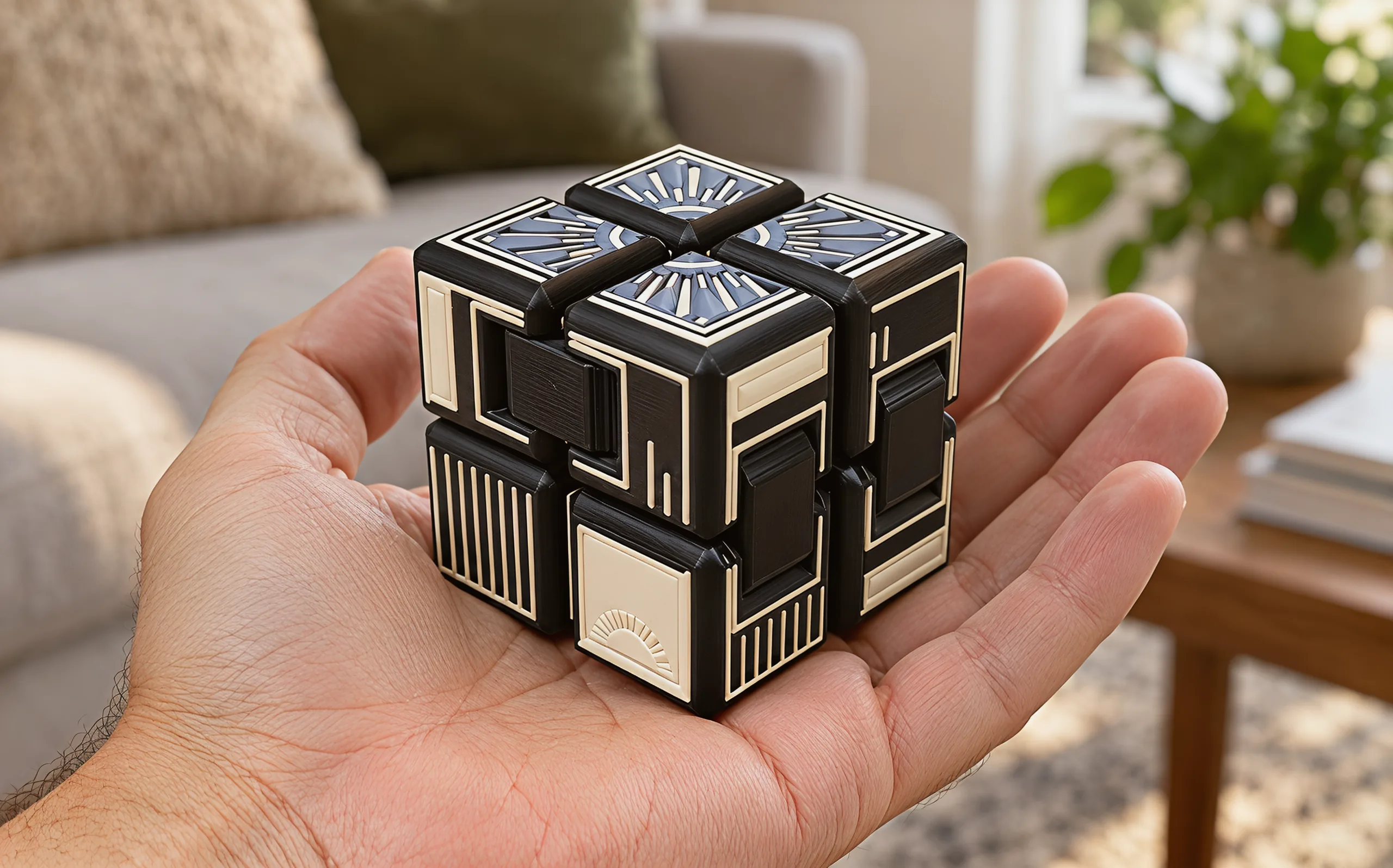
Push the ends under.

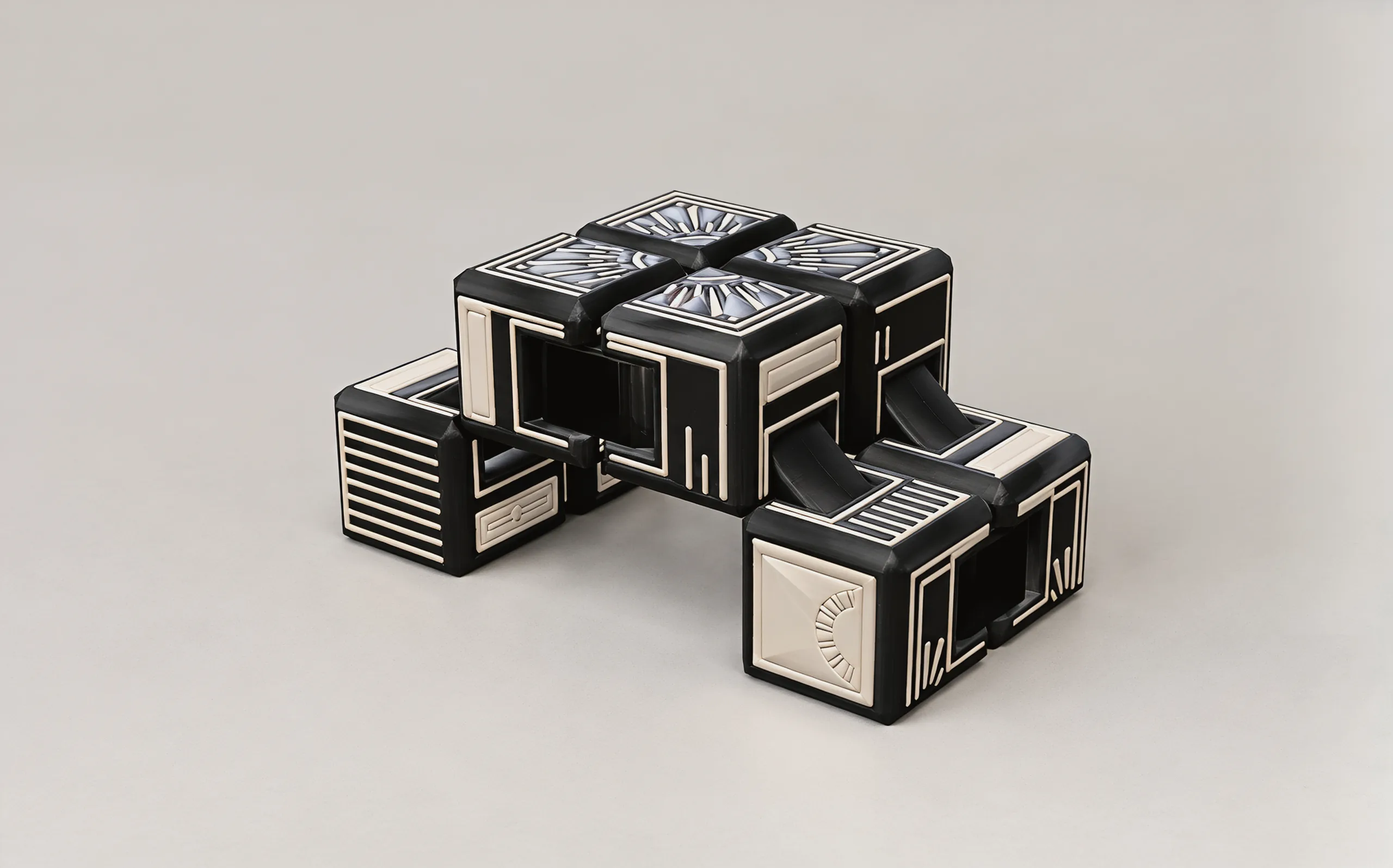
Both end pairs swing down beneath the middle four. Four links turn, a quarter turn on each side of their seam, and the faces close flush.

The sunburst meets.

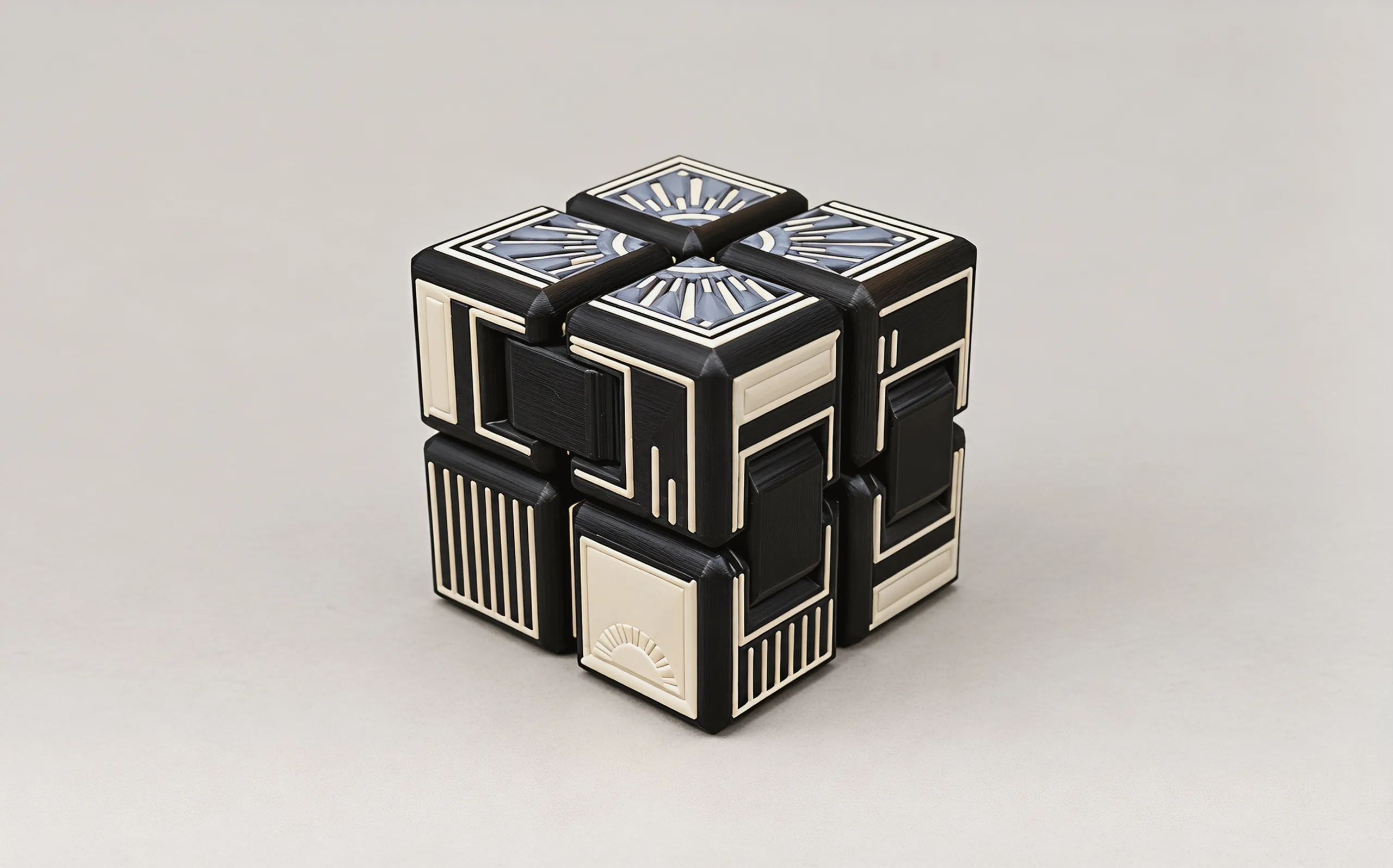
The 4 middle tiles carry no link, so nothing breaks the rays. Folded this way they come together on top as one sunburst.

Open it, flip it.

Unfold the ends, then turn the back row over onto the front. Now the other four links are working.

A second cube.

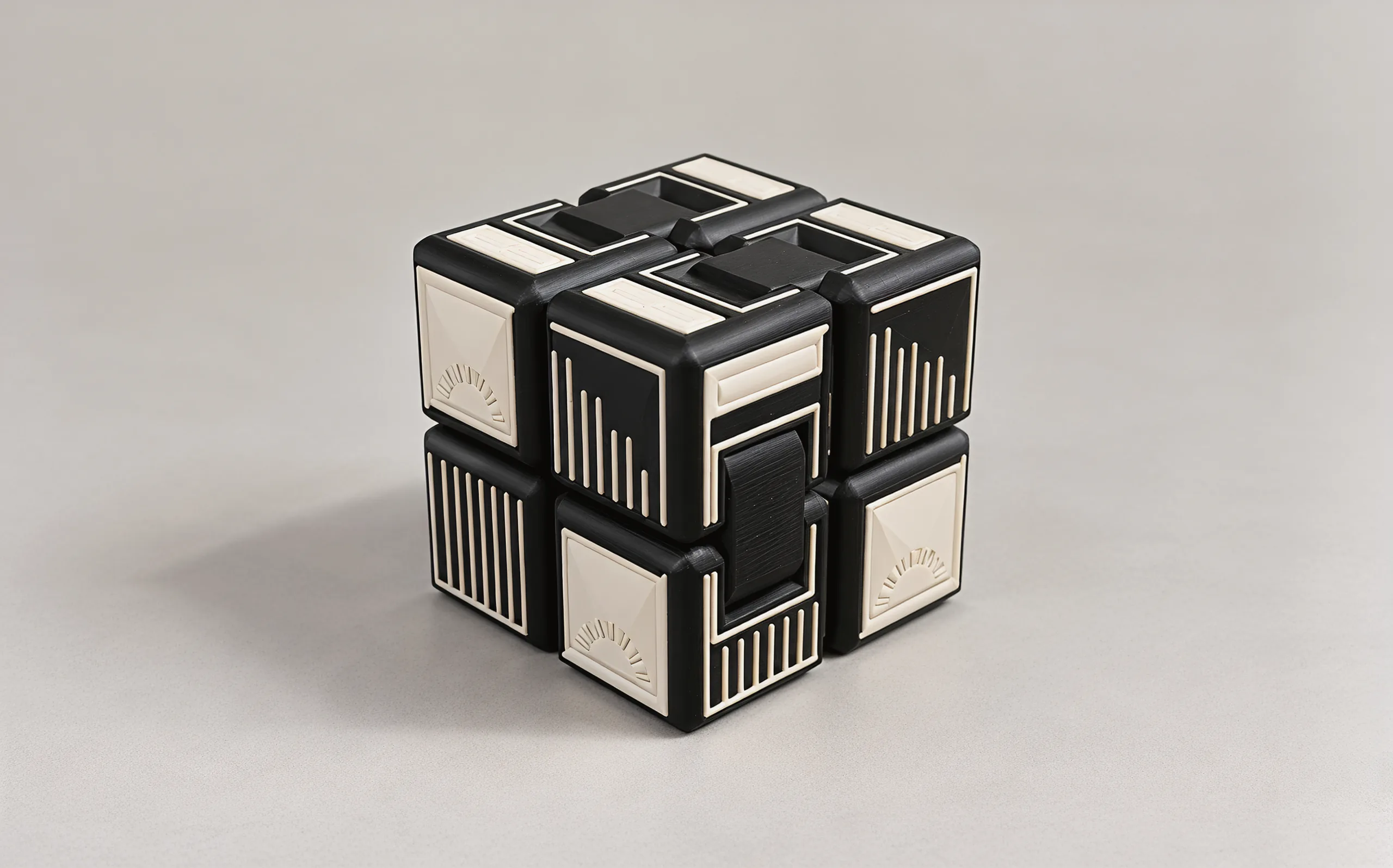
Fold the bar in half and it closes into a different cube, ivory panels and small fans facing out.

There is no last fold.

Open it out and the ring is back where it started, ready to make the sunburst again. The loop never runs out of moves.

Up close

Folded, it is 1.6 in on each side and weighs 1.3 oz: small enough to close a hand around. Opened flat it lies 3.3 × 1.6 × 0.8 in.
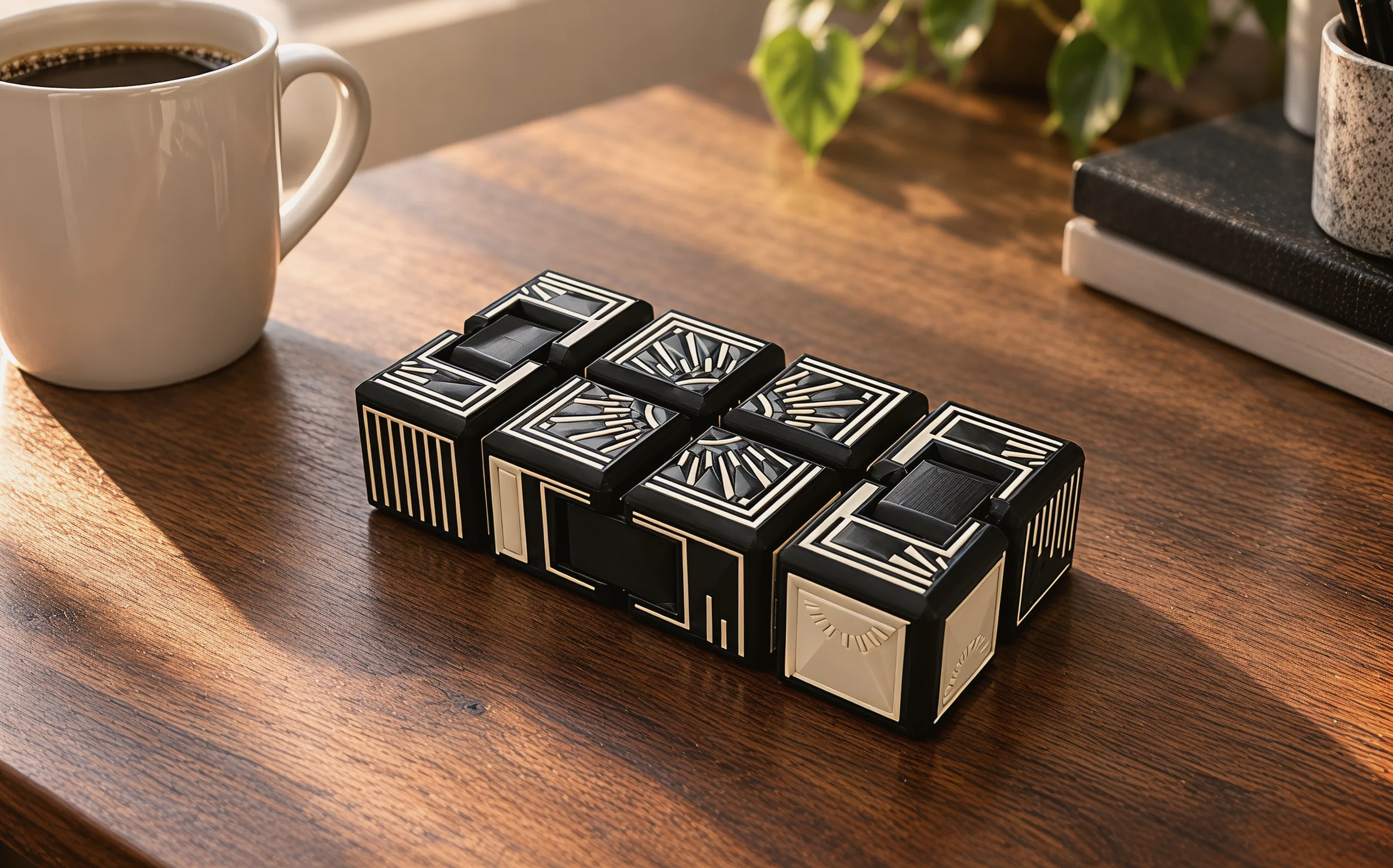
The cube lying open on a walnut desk next to a white mug, eight black cubes in two rows of four
Opened out on the desk, it is a flat bar of eight tiles. The sunburst already shows across the middle four.
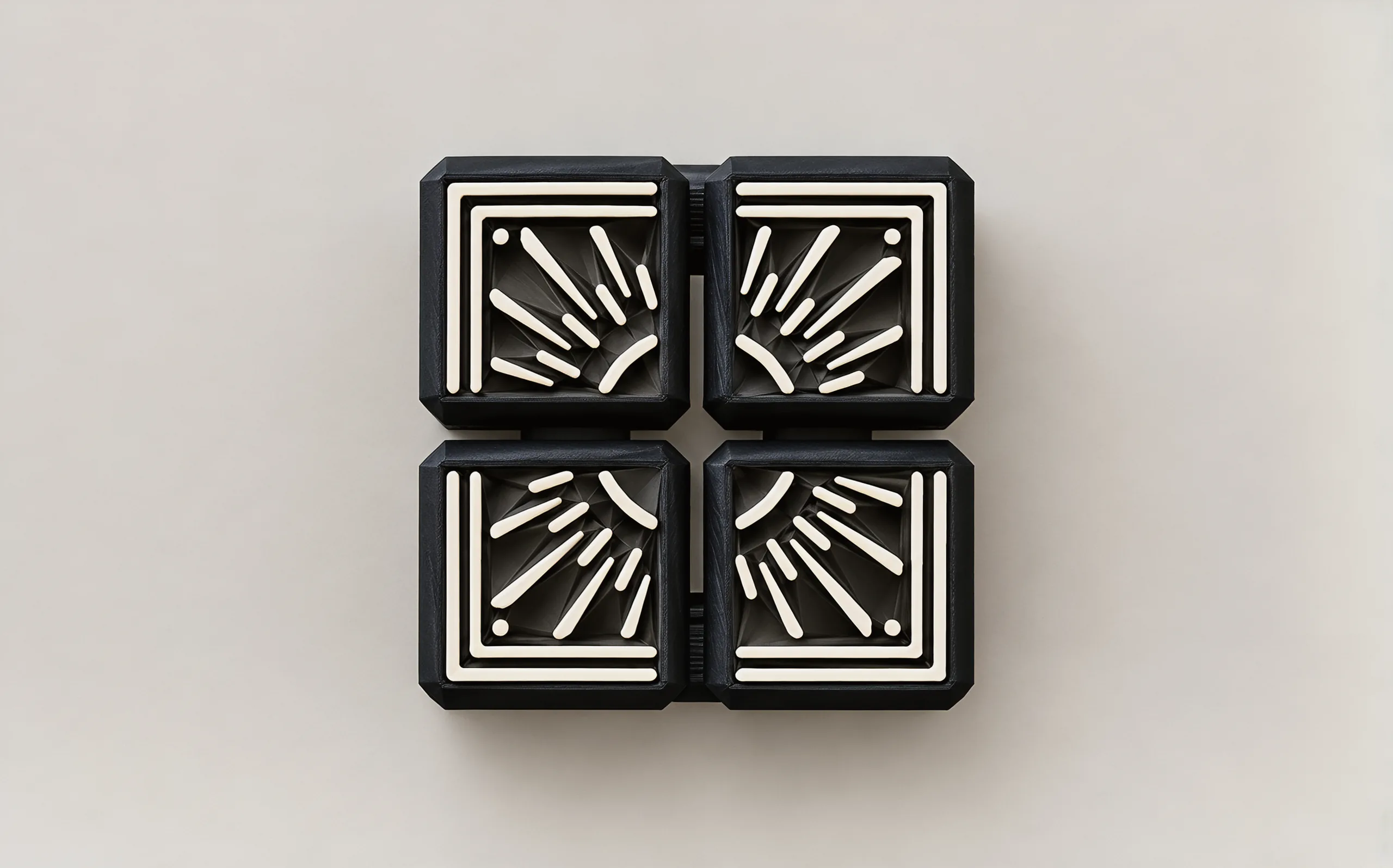
Looking straight down on the sunburst face: four black tiles, each with ivory rays fanning from the centre and a stepped frame
The sunburst from above. Each tile holds a quarter of it, so it only reads whole when the cube is folded right.
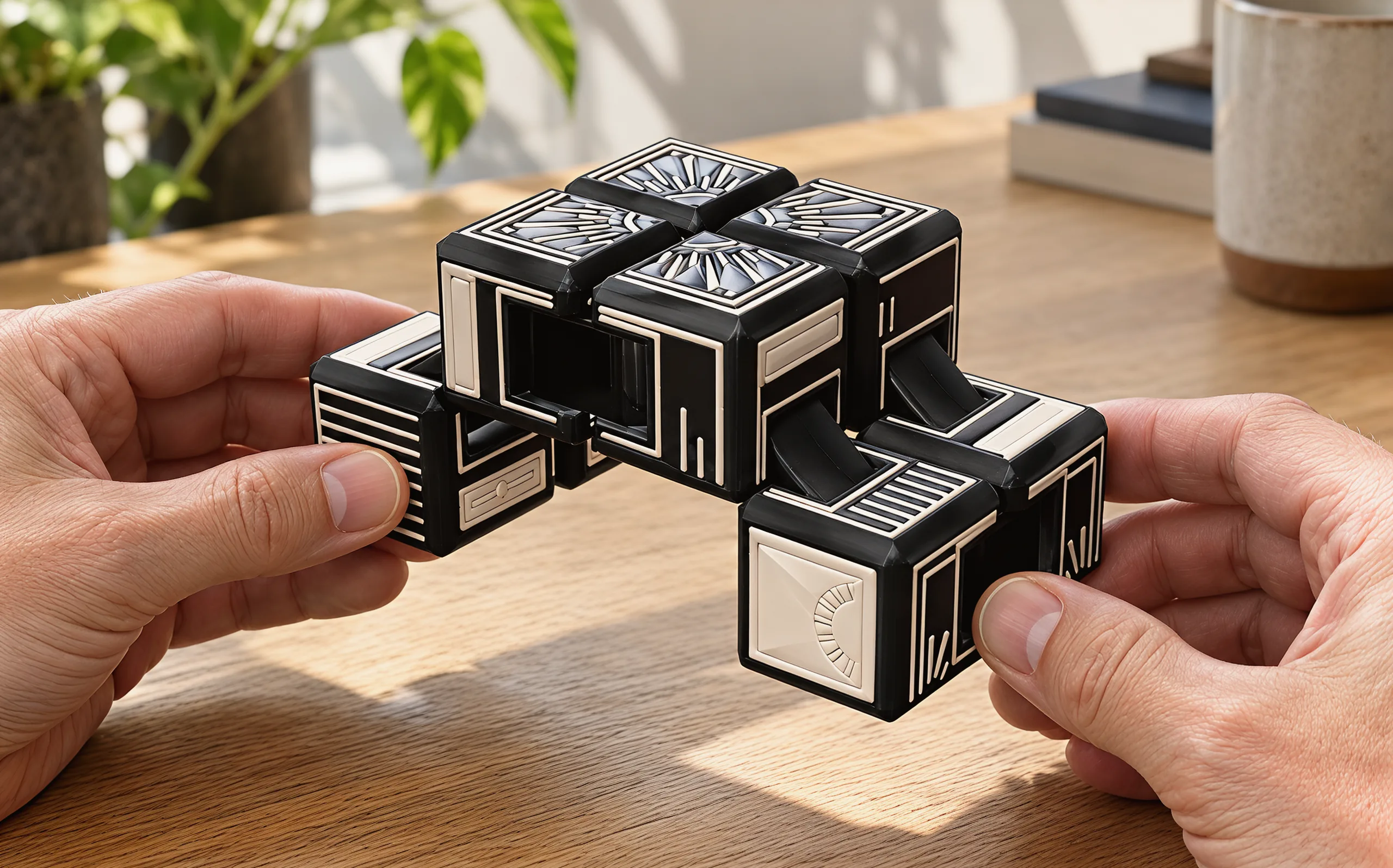
Two hands holding the cube halfway through a fold, thumbs on the outer cubes
Mid-fold, thumbs on the outer cubes. The links keep every cube attached, so nothing drops while you play.
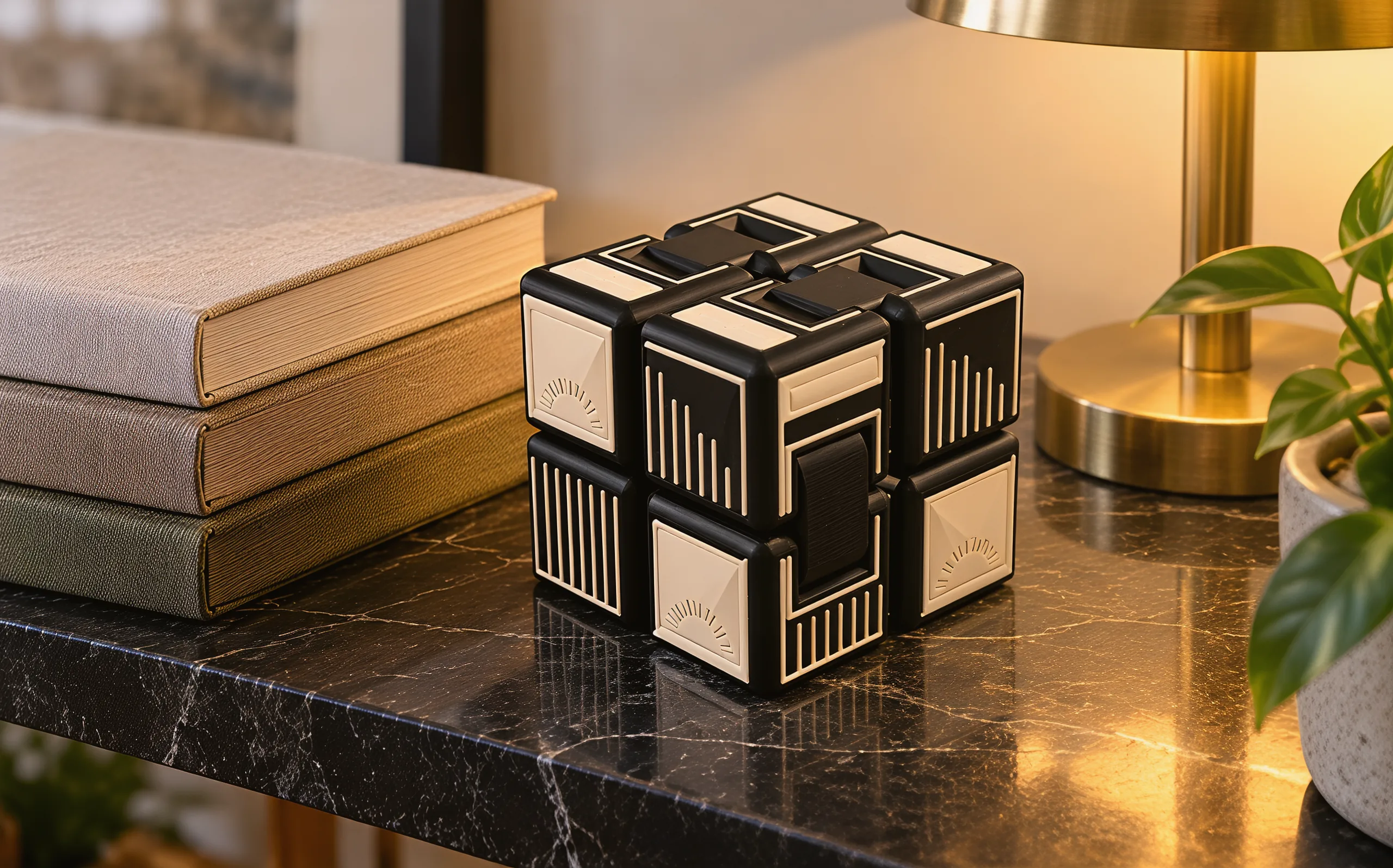
The cube folded with its ivory panels out, standing on a black marble shelf by a stack of cloth-bound books
Left folded on a shelf, it looks like a small Deco ornament, not a toy.
The cube lying flat on a pale ground, seen from a low angle: striped ends, framed tiles and the links set into the seams
The links sit in pockets cut into the cubes, across the seams, so nothing hangs off the outside.

One ring, two cubes.

Seen from above, the 8 cubes lie in two rows of four, and the 8 links run around them in a single loop. Each cube shape uses four of those links; the other four rest until you fold the other way.

Fold both ends under: the four links on the underside turn, and the four middle tiles, the only ones with no link on top, meet as the sunburst.

Top view of the flat ring: eight cubes in two rows of four, a sunburst across the middle four, and the eight links in one loop
The sunburst cube: four rayed tiles meeting on top

Eight cubes in one ring.

Art Deco Infinity Cube: black cubes, ivory Art Deco inlays, and a fold that never runs out.

8
cubes, each 0.8 in on a side, every face dressed in rays, fans, frames or stripes
8
links set into the seams, each turning on a pin in either cube
1
sunburst, made by 4 tiles when you fold it that way
Folded
1.6 × 1.6 × 1.6 in
Opened flat
3.3 × 1.6 × 0.8 in
Weight
1.3 oz
Finish
Black with ivory-white inlays set flush, so nothing stands proud where faces meet
Motion
Folds by hand, over and over, with no end stop
Power
None: no batteries, no springs
Design
Based on Sturdy Infinity Cube by Jan Pieper, MIT licence
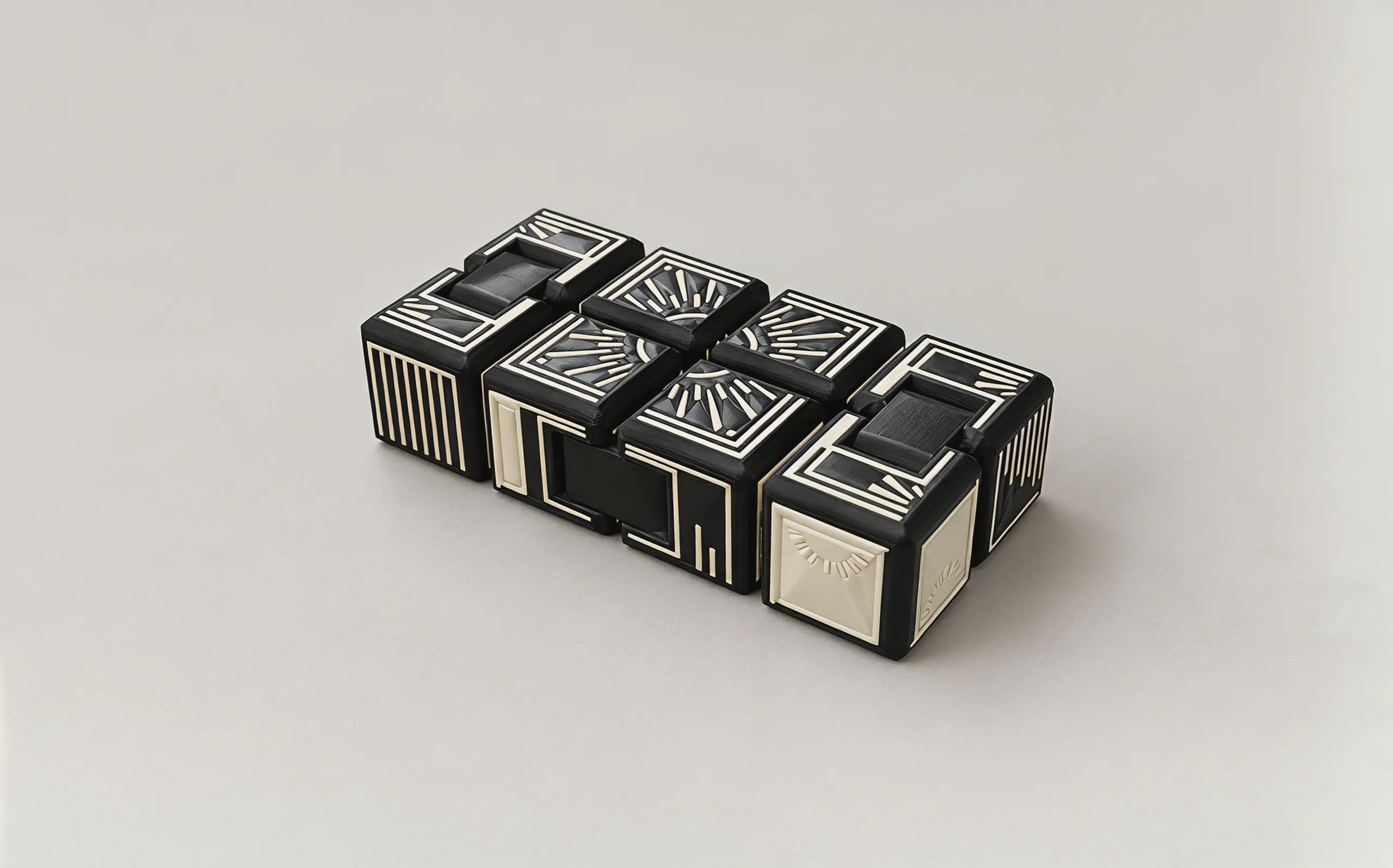
The folded cube in an open palm, sunburst face up

Good to know

Does it need batteries?
No. Nothing in it is powered and there is no spring. Your fingers fold it and the links carry each cube round.
How big is it in the hand?
Folded, 1.6 in on each side and 1.3 oz. Opened flat it is 3.3 × 1.6 × 0.8 in.
Why does it never stop folding?
The 8 cubes are joined into one closed ring by 8 links. Wherever two links line up along one edge, that pair can open, and each fold leaves another pair lined up for the next.
Do the patterns stick out?
No. Every ivory line is an inlay set flush with the black, so faces close against each other without catching.
Where does the design come from?
It is based on Jan Pieper's Sturdy Infinity Cube, shared under the MIT licence, redrawn with Art Deco faces.