Bull Bear Seesaw
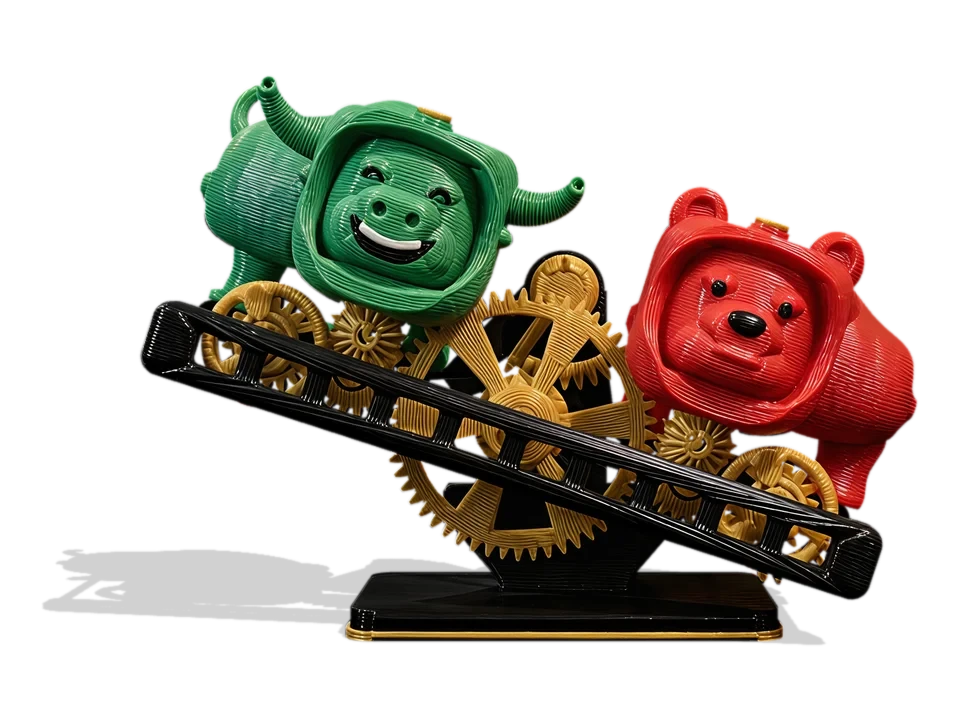
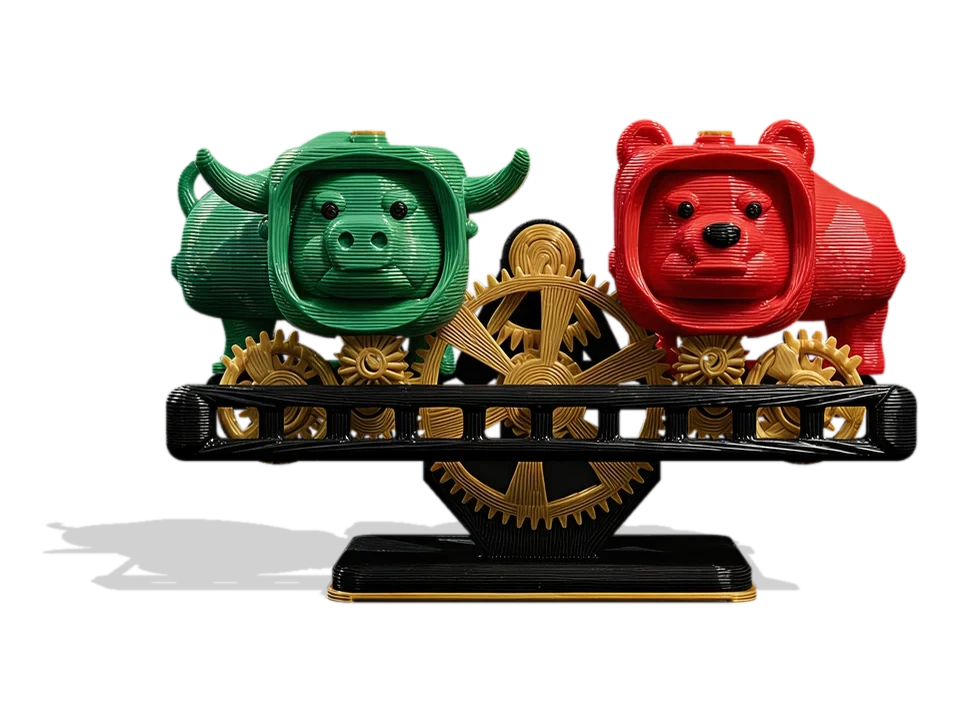
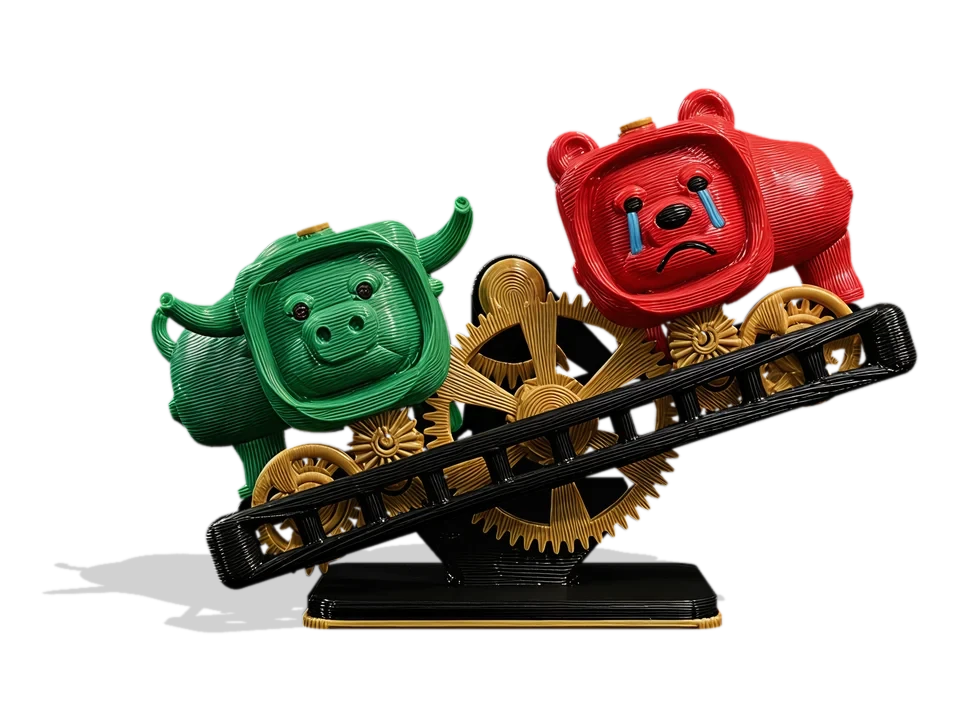
A desk seesaw with a brass-coloured gear train on show. Tip it, and whichever animal rises turns its face: the bull breaks into a grin, the bear bursts into tears. Bring it back to level and both go back to a straight face.
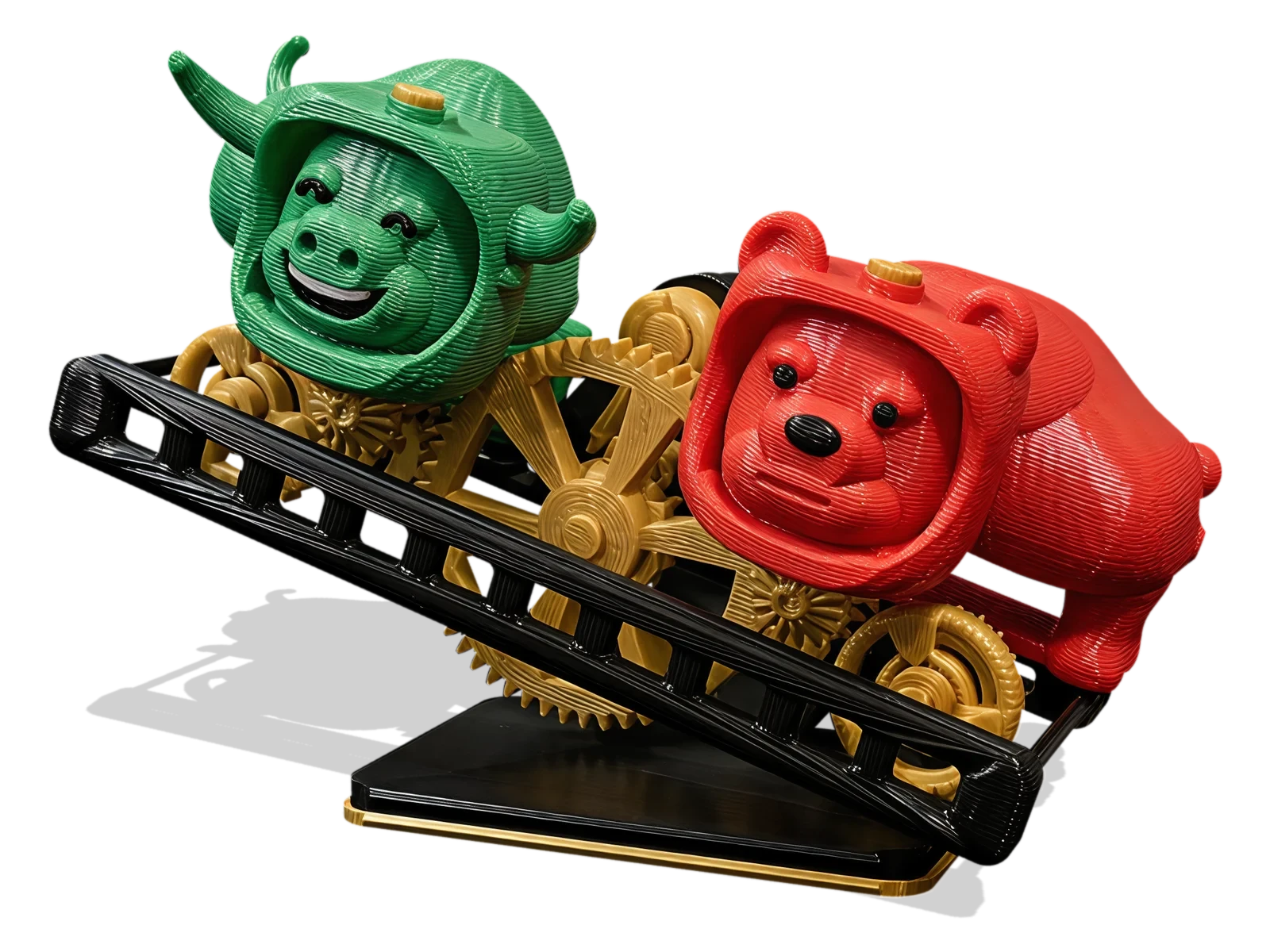
One session on the desk
Open
Beam level, both faces neutral. Nobody is up, nobody is down.
Rally
Press the bear end down. Once the bull has risen 4.5°, its face starts to turn, and by the 18° stop it has come round a full 180° to a grin.
Under the hood
With the front rail faded out: a pinion rolls around a fixed sector as the beam tips, and every degree of tilt becomes 6⅔° at the gears under each animal.
Pullback
Back to level, and the same gear teeth turn the grin back to neutral. It's driven all the way back, not left to drop back on its own.
Sell-off
Tip it the other way and the bear rises. Its face turns 180° to the crying side: a frown and two blue tears. The bull, now low, keeps a straight face.
Close
Level again, both neutral. Only the animal on the way up ever changes face.
From a tilt to a turned face
There's no motor and no spring. Your hand tips the beam, and six stages of gearing turn that tilt into a half-turn of the face on the rising end.
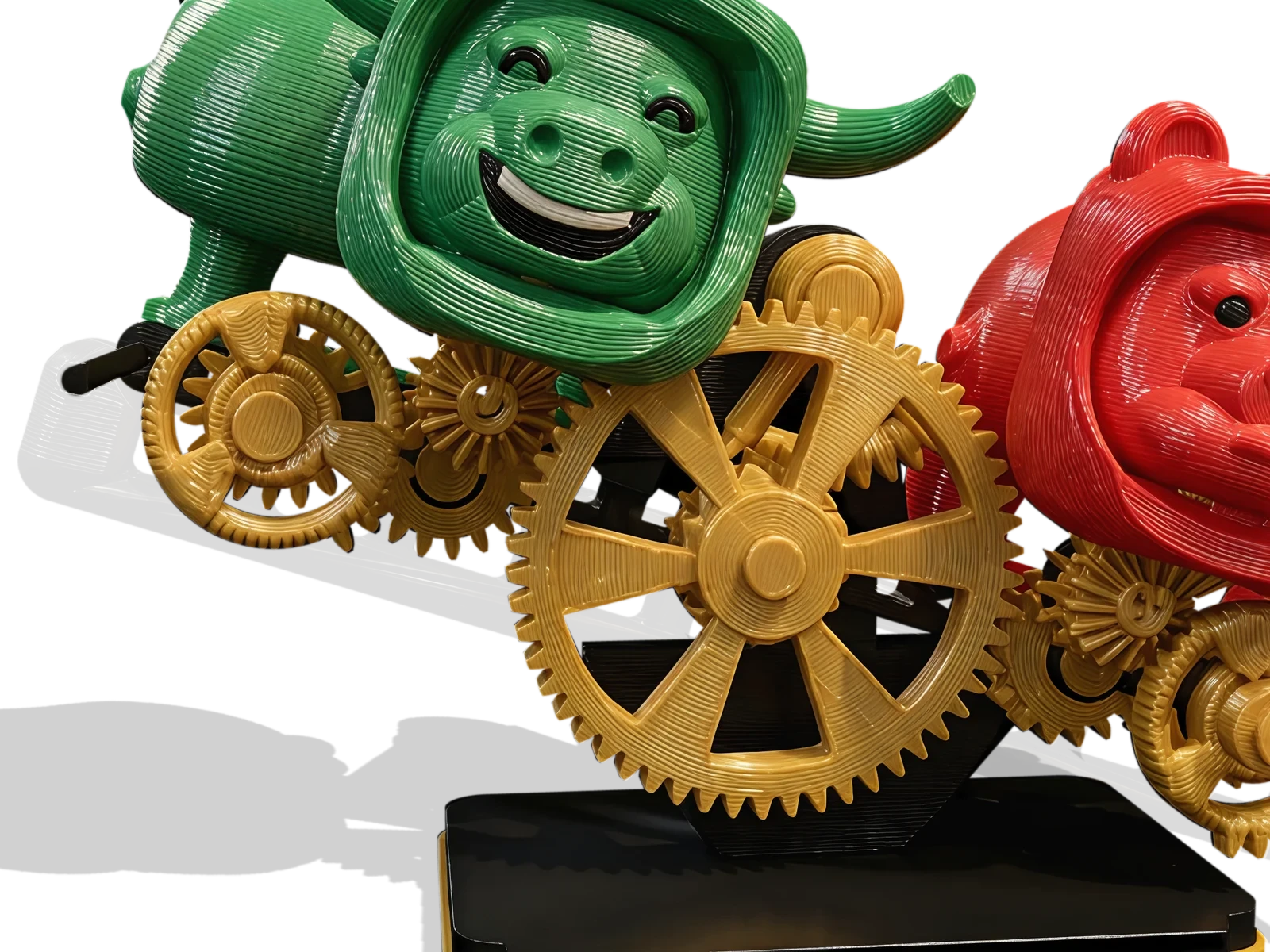
Fixed sector
A 40-tooth sector is keyed to the stand and never moves.
Rolling pinion
An 18-tooth pinion on the beam rolls round the sector as you tip it, and spins the 54-tooth compound gear it is fixed to.
Idlers and outputs
18-tooth idlers carry the turn out to each end. By the output gears, one degree of tilt has become 6⅔°.
One-way coupling
A 28-tooth coupling with most of its teeth left off. For the first 4.5° it slides past; then only the rising side's teeth catch its 14-tooth flip gear. The low side stays locked.
Miter pair
Two 16-tooth miter gears turn the motion through 90° onto an upright shaft inside the head.
Two-sided face
The shaft turns the face block 180°, finishing on the grin or the tears as the beam reaches its 18° stop.
Three positions, three faces
Put one on your desk
- Size
- 9.3 × 4.5 × 6.7 in
- Beam
- 8.7 in, tips ±18°
- Printed parts
- 45
- Weight
- 14.9 oz
- Material
- PETG
- Print time
- 39.3 hours
The motion on this page is computed from the CAD model's own gear train.