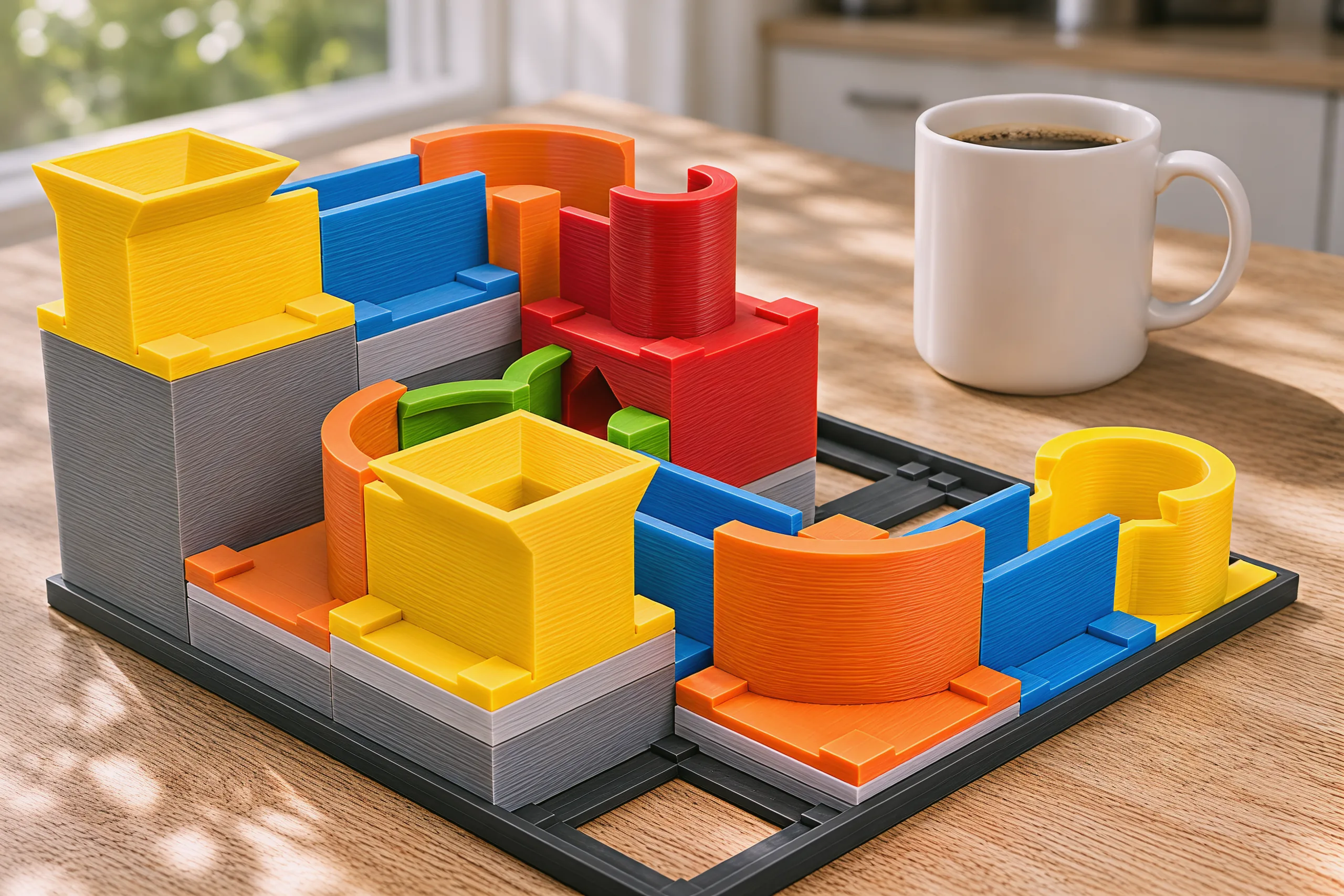
Marble Run Module
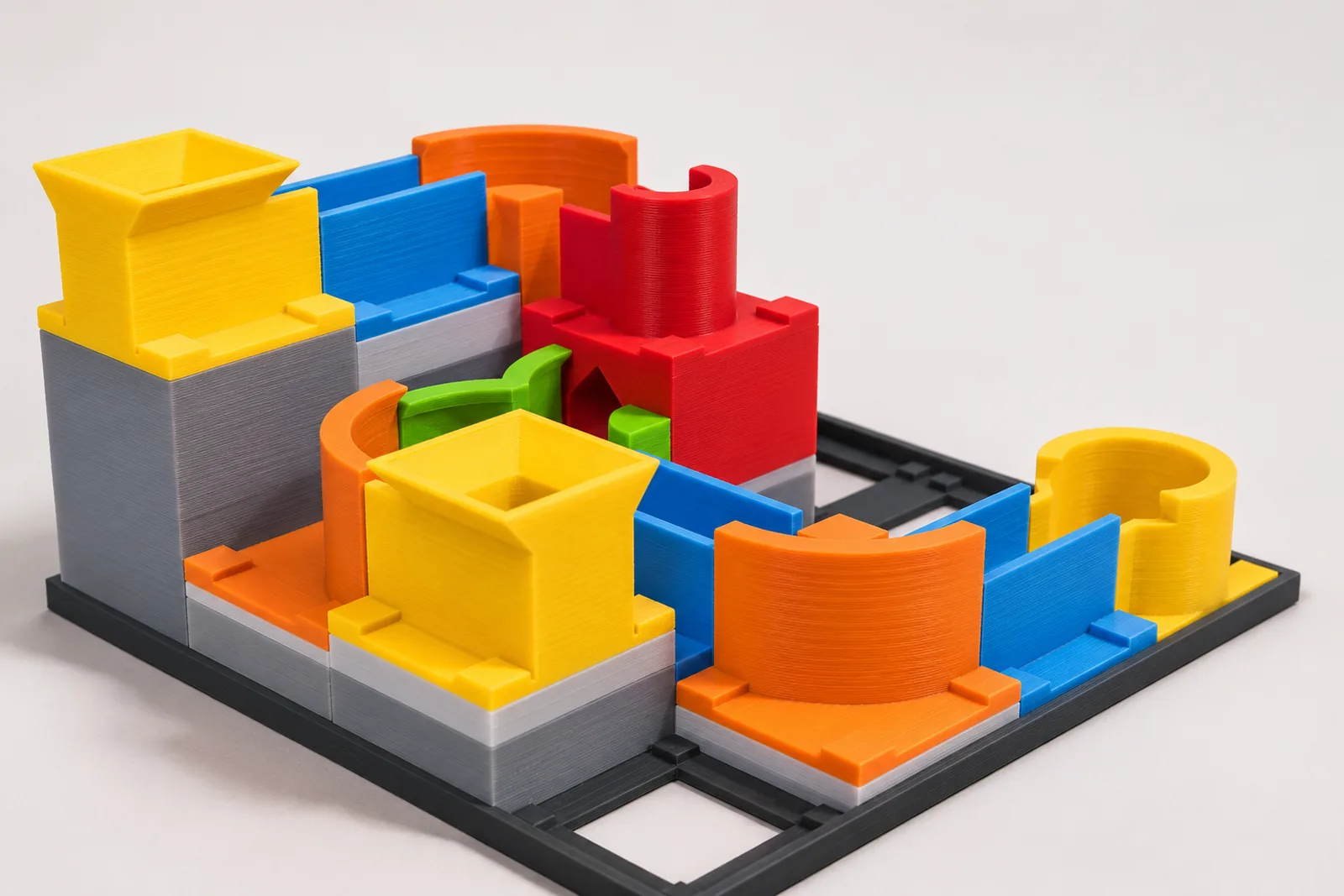
Twelve track tiles on stacking risers, one tray, and a route that only ever goes downhill.
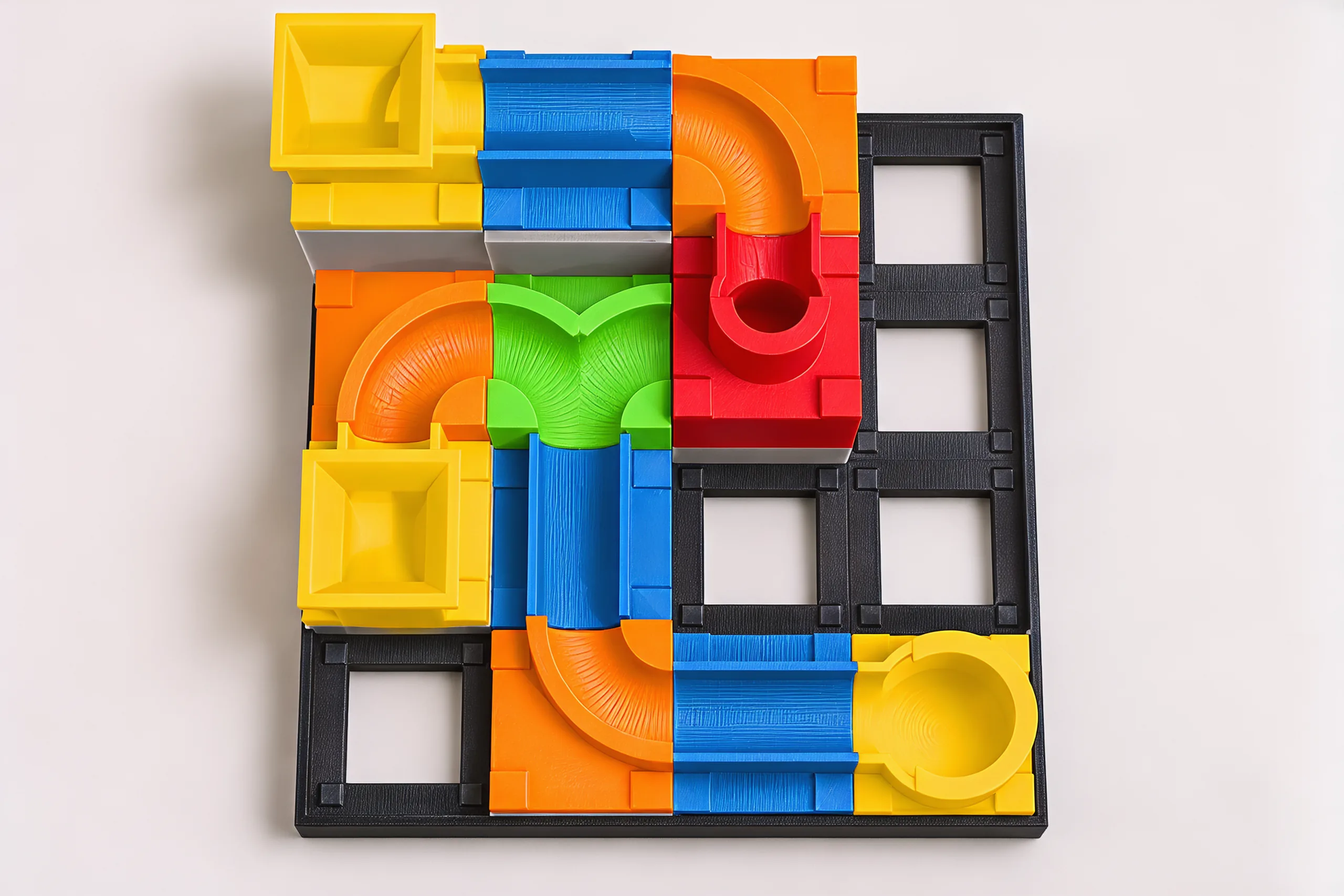
A board of sixteen cells.
The tray is a 4 × 4 grid of 2.4 in cells. Grey risers stack inside each cell to lift it in 5 mm steps, up to 16 steps at the back corner.
Twelve tiles drop in.
Each tile sits on its own stack. The colour tells you its job: yellow to start and finish, blue straight, orange curve, red to drop, green to merge.
Drop a marble in the top funnel.
Use a 24 mm glass marble. Every tile hands it to the next about 1.7 mm lower, so it rolls on without ever having to climb.
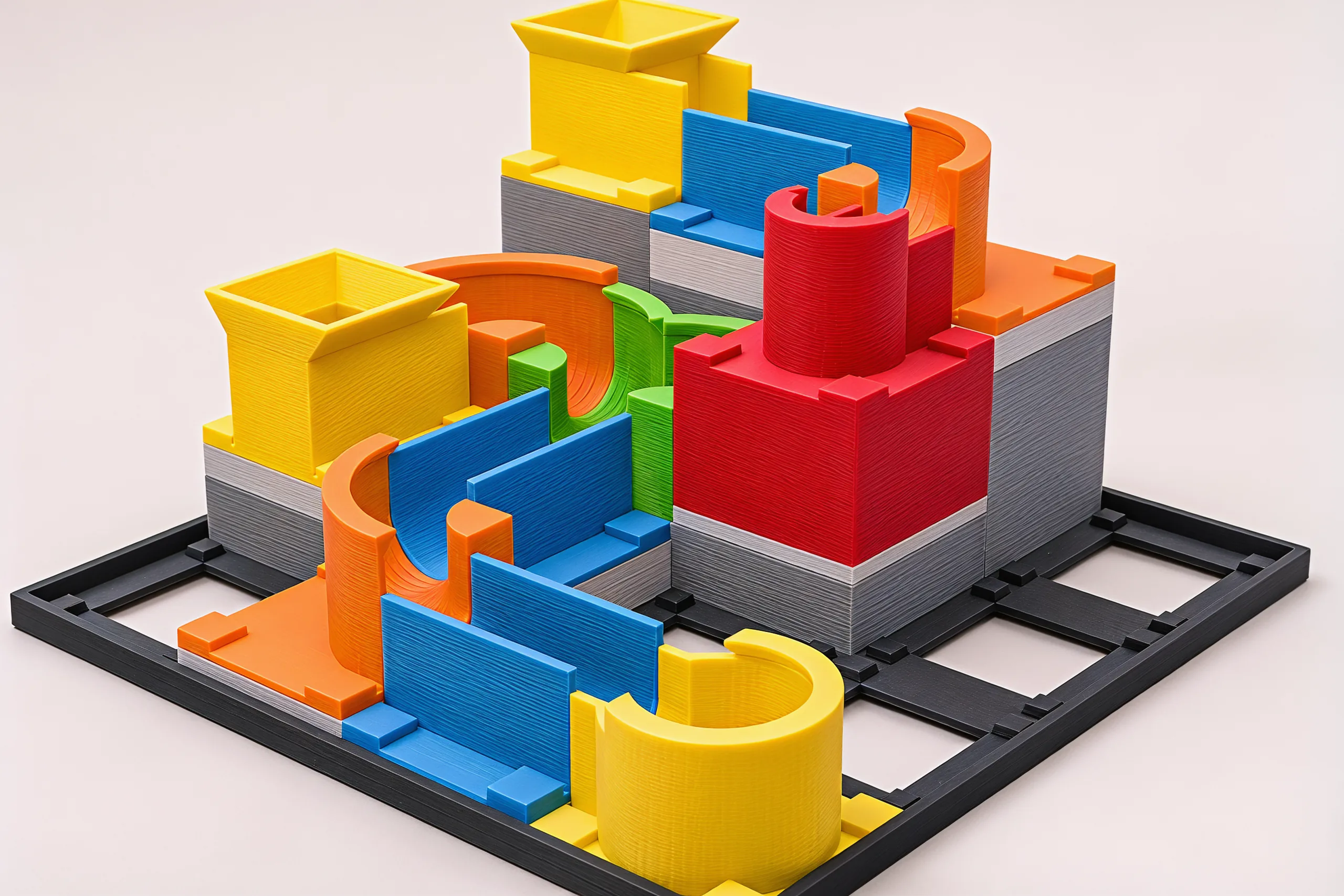
Down the chimney.
The red tile has a hole in its floor. The marble falls about 1.5 in inside the hollow column under it, out of sight, and rolls out of a window at the foot.
A second start joins in.
The low funnel on the left starts a shorter route. It curves round and meets the first one at the green merge tile, so two marbles can race to the same finish.
Into the cup.
Four more tiles, each a step lower, bring it to the yellow cup on the tray: 3.3 in below where it started.
Seven kinds of tile, four heights of riser.
Drawn at the same scale, so you can see how they compare. Pick one to read what it does.
Where a marble goes in: a square hopper that funnels it onto the track. There are two, so the board has two routes.
A straight run across one cell, with a wall on each side.
Turns the route a quarter turn inside one cell. Curves come in left and right hands.
A short track that ends in a hole in its floor. It sits on top of the chimney column and drops the marble into it.
A hollow tower that stands in for a riser stack. The marble falls down inside it and leaves through a window at the bottom.
Two ways in, one way out: the tile where the second route joins the first.
A round cup at tray level, the end of the line for both routes.
Hollow blocks that stack under a tile, one 5 mm step for every unit of height. They come 5 one-step, 5 two-step, 6 four-step and 4 eight-step.
Up close
Sized for a tabletop.
The whole run takes up 9.8 × 9.8 × 5.0 in, about a dinner plate's footprint. Each cell is 2.4 in across, room for one 24 mm glass marble to roll through a channel with walls on both sides.
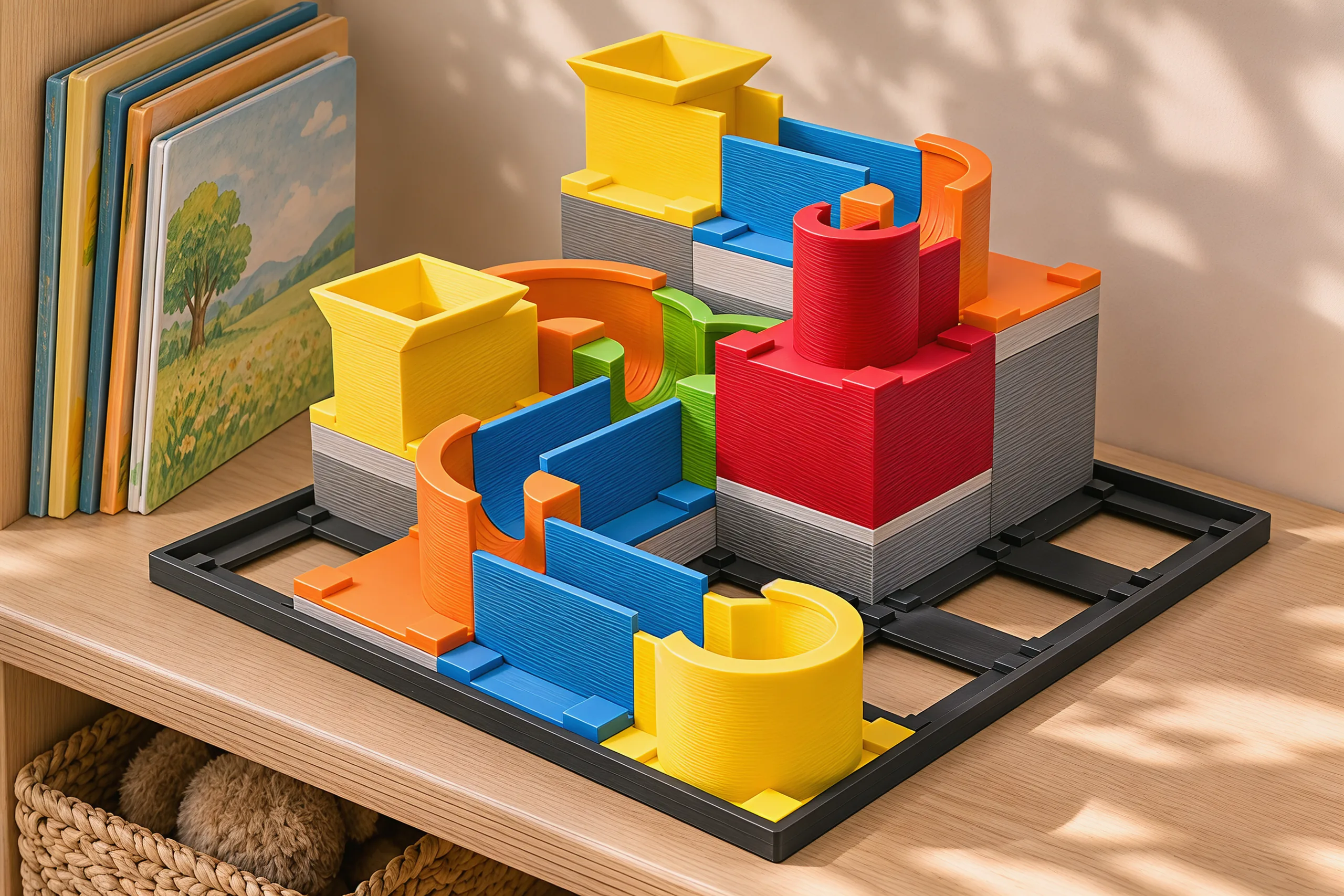
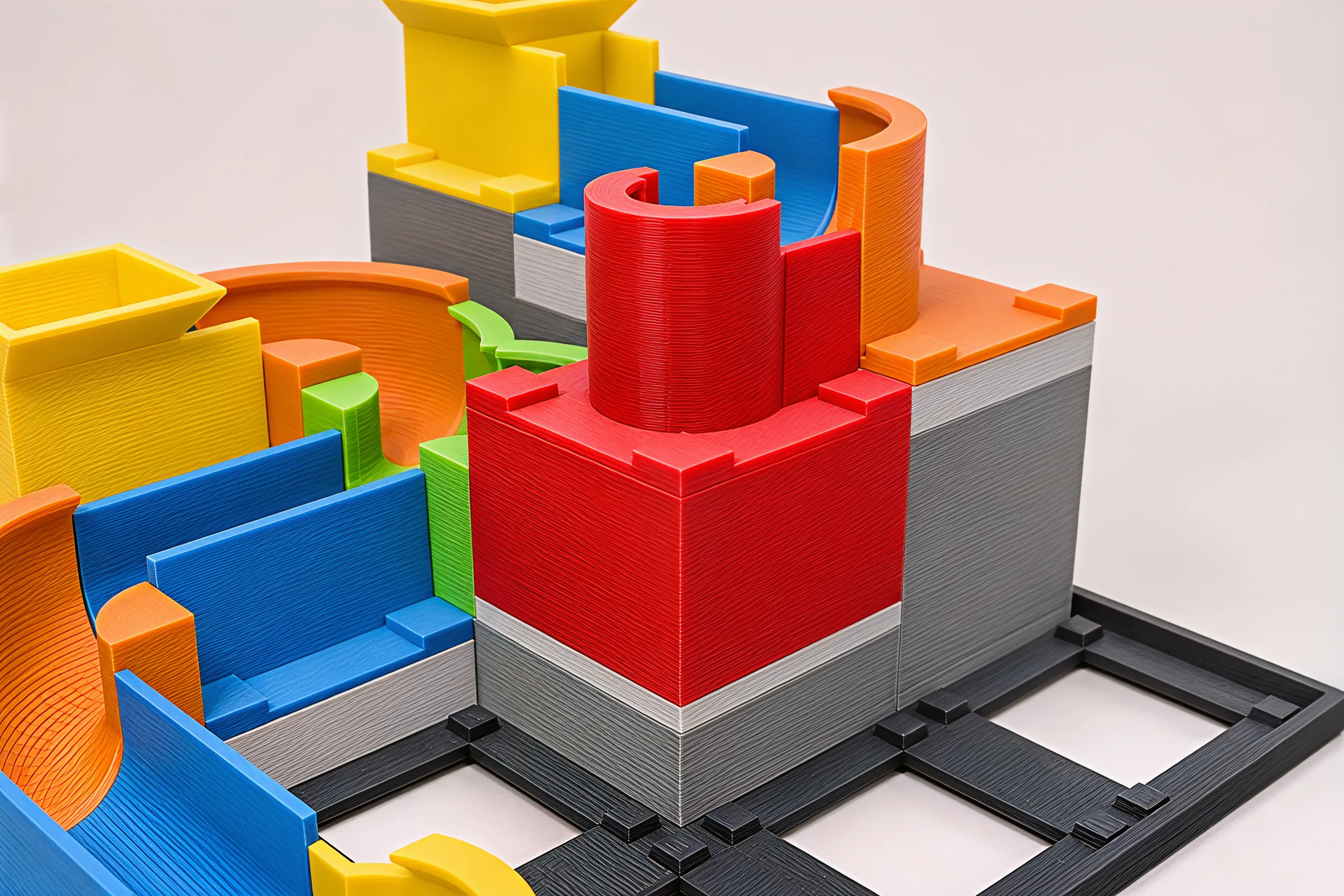
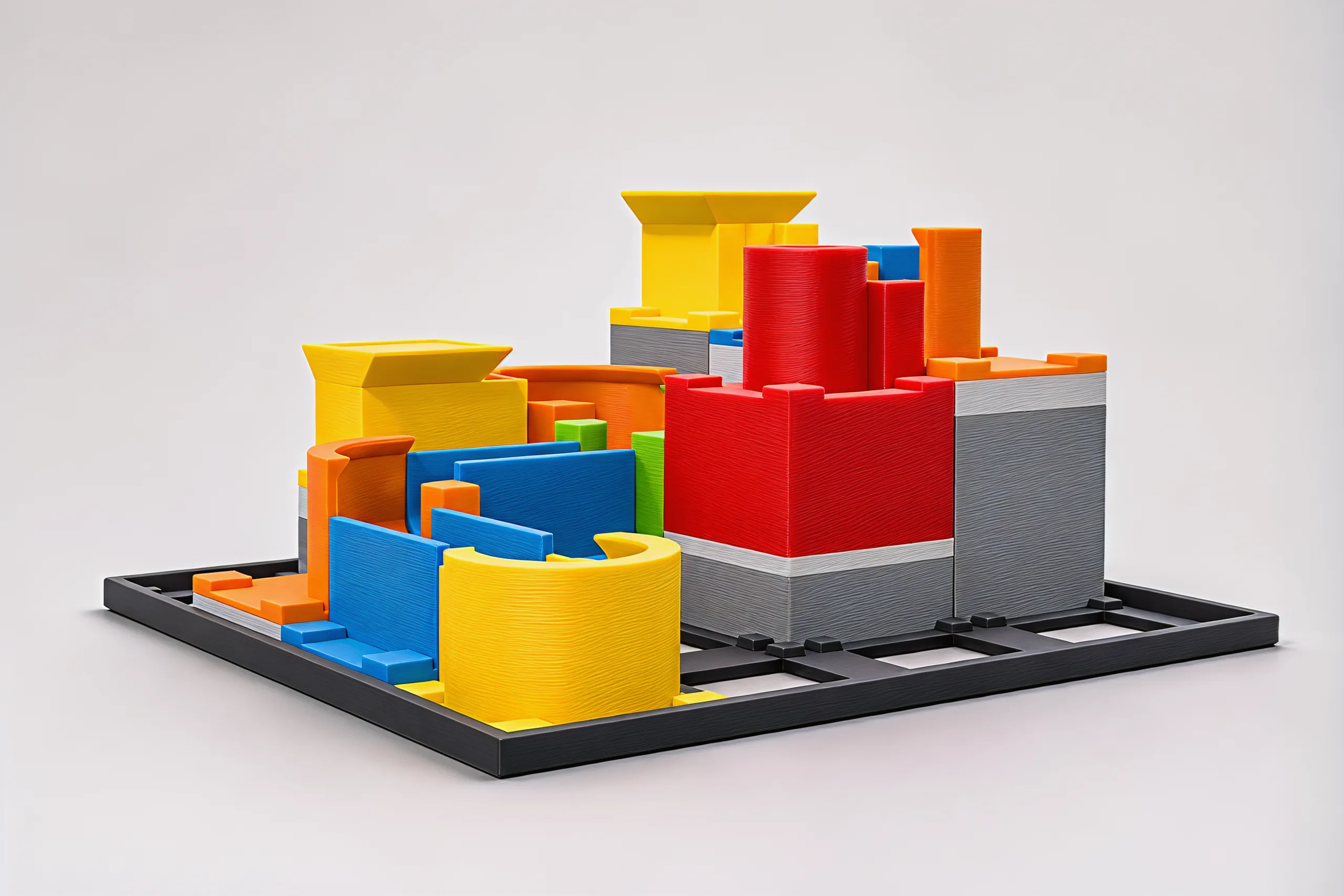
Every cell has a height. The route only goes down.
Heights are counted in steps of 5 mm. The top funnel stands on 16 steps, the cup sits on the tray, and every tile in between is lower than the one before. Rebuild it your own way, or play it as a puzzle: set a few tiles, then finish the route so it still runs downhill.
Tap a cell to see what it stands on.
Twelve tiles, twenty risers, one tray.
Marble Run Module, a gravity marble run you can build two routes on and rebuild as many ways as the heights allow.
- 12
- track tiles in seven kinds, colour-coded by job
- 20
- stacking risers, one to eight steps tall
- 1
- tray, a 4 × 4 grid of 2.4 in cells
- Size
- 9.8 × 9.8 × 5.0 in
- Weight
- 24.1 oz
- Grid
- 4 × 4 cells, 2.4 in (60 mm) each
- Heights
- 5 mm steps, 16 steps at the top funnel
- Routes
- Two start funnels, joined at one merge
- Total fall
- 3.3 in, top funnel to cup
- Marbles
- 24 mm glass, sold separately
- Age
- Not for children under 3: small parts
Good to know
Does it come with marbles?
No. It is made for 24 mm glass marbles, which are sold separately. Any glass marble of that size rolls the whole route; the smaller everyday marbles are too small for it.
What makes the marble move?
Gravity, nothing else. Each tile hands the marble on about 1.7 mm lower than it received it, so from the top funnel to the cup it only goes downhill. No batteries, no motor, no switch.
Can I build a different route?
Yes. Tiles and risers come apart and stack again in any of the 16 cells. Build freely, or set a few tiles as a puzzle and finish the route around them. The one rule is the one the board shows: each tile a step or more below the one before.
Is it safe for young children?
Not for children under 3. Marbles and the smaller pieces are a choking hazard.
How much room does it take?
9.8 × 9.8 × 5.0 in, and it weighs 24.1 oz. That is about the footprint of a dinner plate.