


Explore Qwen Model | China’s Biggest AI Model

The Qwen model, developed by Alibaba Group's Qwen Team, represents a monumental leap in artificial intelligence (AI), offering powerful capabilities in natural language understanding, text generation, and multimodal data processing. As China's biggest AI model, it challenges global dominance in the AI landscape. In this blog, we’ll explore the Qwen series, its technical advancements, applications, and potential impact on the AI ecosystem.
What is the Qwen Model?
The Qwen model is a series of large language models (LLMs) and multimodal models developed by the Qwen Team at Alibaba Group. Designed for diverse scenarios, Qwen integrates advanced AI capabilities, such as natural language understanding, text and vision processing, programming assistance, and dialogue simulation. It stands out as a transformative force in AI research and applications.
Core capabilities of the Qwen LLM model are:
- Text Creation and Processing: Qwen excels in generating high-quality text for emails, stories, scripts, and professional documents while offering summarization and text-polishing services.
- Multilingual Translation: With support for over 29 languages, including Chinese, English, French, Spanish, and Japanese, Qwen delivers efficient translation across diverse linguistic contexts.
- Programming Assistance: Qwen functions as a coding assistant, capable of writing, debugging, and optimizing code for various programming languages.
- Dialogue Simulation and Role Play: With robust dialogue simulation, Qwen facilitates interactive communication, making it ideal for chatbots and virtual assistants.
- Data Visualization: It can generate charts, structured outputs, and JSON formats for effective data presentation.
Causal Language Models
At its core, the Qwen model utilizes causal language models (CLMs), which predict the next token in a sequence based on prior context. This autoregressive mechanism ensures coherent and contextually relevant text generation.
The term “causal” highlights the model’s reliance on past tokens without considering future tokens during text generation. This attribute enables Qwen to excel in tasks like:
- Text completion
- Content generation
- Conversational AI applications
CLMs are pivotal in applications requiring a sequential understanding of language, making them the backbone of Qwen’s LLMs.
Pre-Training & Base Models
The base models in the Qwen series are pre-trained on massive multilingual and multimodal datasets. These foundational models aim to capture the statistical structure of language, enabling versatile use across numerous applications. Characteristics of Qwen base models:
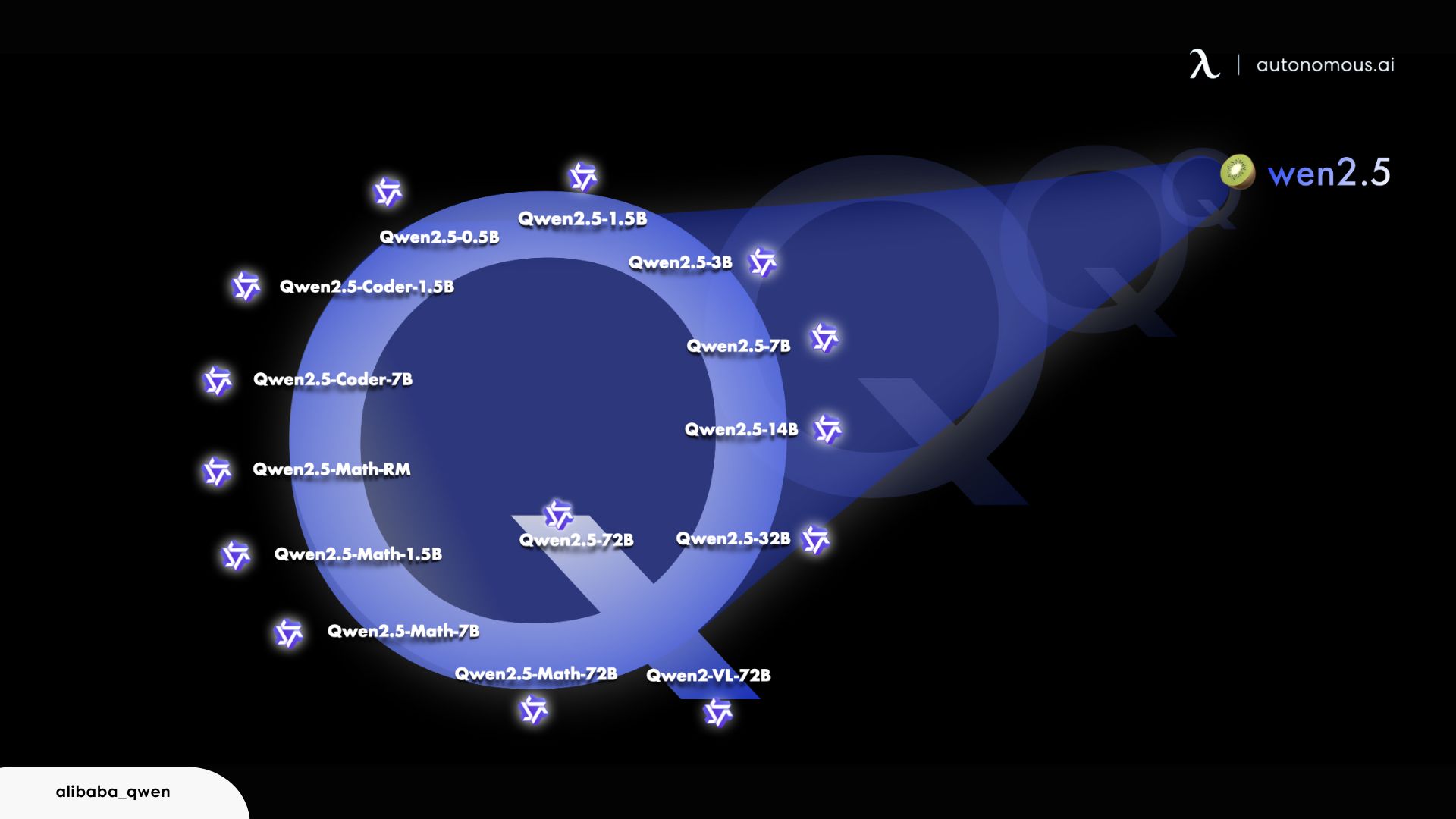
- Examples include Qwen2.5-7B and Qwen2.5-72B.
- Base models generate fluent text but may require fine-tuning for instruction-following tasks.
- These models established the groundwork for Qwen’s advanced functionalities.
Post-Training & Instruction-Tuned Models
Instruction-tuned models in the Qwen series are fine-tuned for executing specific instructions. This post-training phase ensures improved task-specific performance in conversational and contextual settings.
Instruction-tuned models, like Qwen2.5-7B-Instruct, demonstrate enhanced accuracy in:
- Summarization
- Translation
- Role-based interactions
Training includes multi-turn datasets, enabling better conversational flows. These models prioritize user-centric functionality, making them indispensable for enterprise applications and AI-driven automation.
Length Limits and Long-Context Support
Qwen models, particularly the latest Qwen2.5, are engineered for long-context tasks. With a packed sequence length of 32,768 tokens, these models are suited for:
- Extensive document processing
- Multi-turn dialogues
- Generating outputs up to 8,000 tokens
Such capabilities make Qwen ideal for complex applications like research document analysis and detailed report generation.
Qwen2.5-0.5B: The Latest Advancement
The Qwen2.5-0.5B model is a testament to Alibaba's continuous innovation. Despite its smaller size within the Qwen2.5 series, it boasts impressive technical specifications:
- Parameters: 0.49 billion
- Architecture: Advanced transformers with RoPE and SwiGLU
- Context Length: Full 32,768 tokens
Key Improvements
- Enhanced Knowledge: Specialized expert models improve coding, mathematical reasoning, and multilingual understanding.
- Instruction Following: The model excels in adhering to diverse prompts and generating structured outputs like JSON.
- Multilingual Proficiency: Support for over 29 languages solidifies its global applicability.
Running Qwen Behind an Always-on Agent
Qwen ships open-weight, so you can serve it yourself and point an agent at it instead of a closed API. As of June 2026, the Autonomous Intern does this: it takes any OpenAI-compatible endpoint, so a Qwen2.5-Instruct model you host or rent becomes the brain for inbox triage, repo watching, and scheduled jobs that run while your laptop is off.
One honest limit. The Intern is a 4.7-inch box with 4GB of memory - it runs the agent loop, not the model. A 72B Qwen checkpoint still needs a real GPU somewhere; the Intern calls that endpoint rather than hosting it. If you want local inference on consumer hardware, you need a separate rig. If you want a cheap, quiet computer keeping a Qwen-backed agent reachable over Telegram or Slack, that is the fit.

FAQs
Can you run the Qwen model on a small home device?
Small Qwen checkpoints run on capable consumer hardware; larger ones need a GPU. A low-power box like the Autonomous Intern runs the agent layer and calls a Qwen endpoint over an OpenAI-compatible API rather than hosting the model itself.
Is Qwen good for an always-on AI assistant?
Yes, because Qwen is open-weight and OpenAI-compatible, an agent can call it on your terms. Pairing a self-hosted Qwen2.5-Instruct model with an always-on device keeps an assistant reachable without routing through a closed provider.
Conclusion
By challenging American dominance in AI, Qwen positions itself as a revolutionary force in global AI innovation. Its wide-ranging applications highlight its versatility and transformative potential. With robust multilingual support, long-context processing, and multimodal expertise, Qwen not only advances the AI landscape but also underscores China’s growing influence in shaping the future of technology.