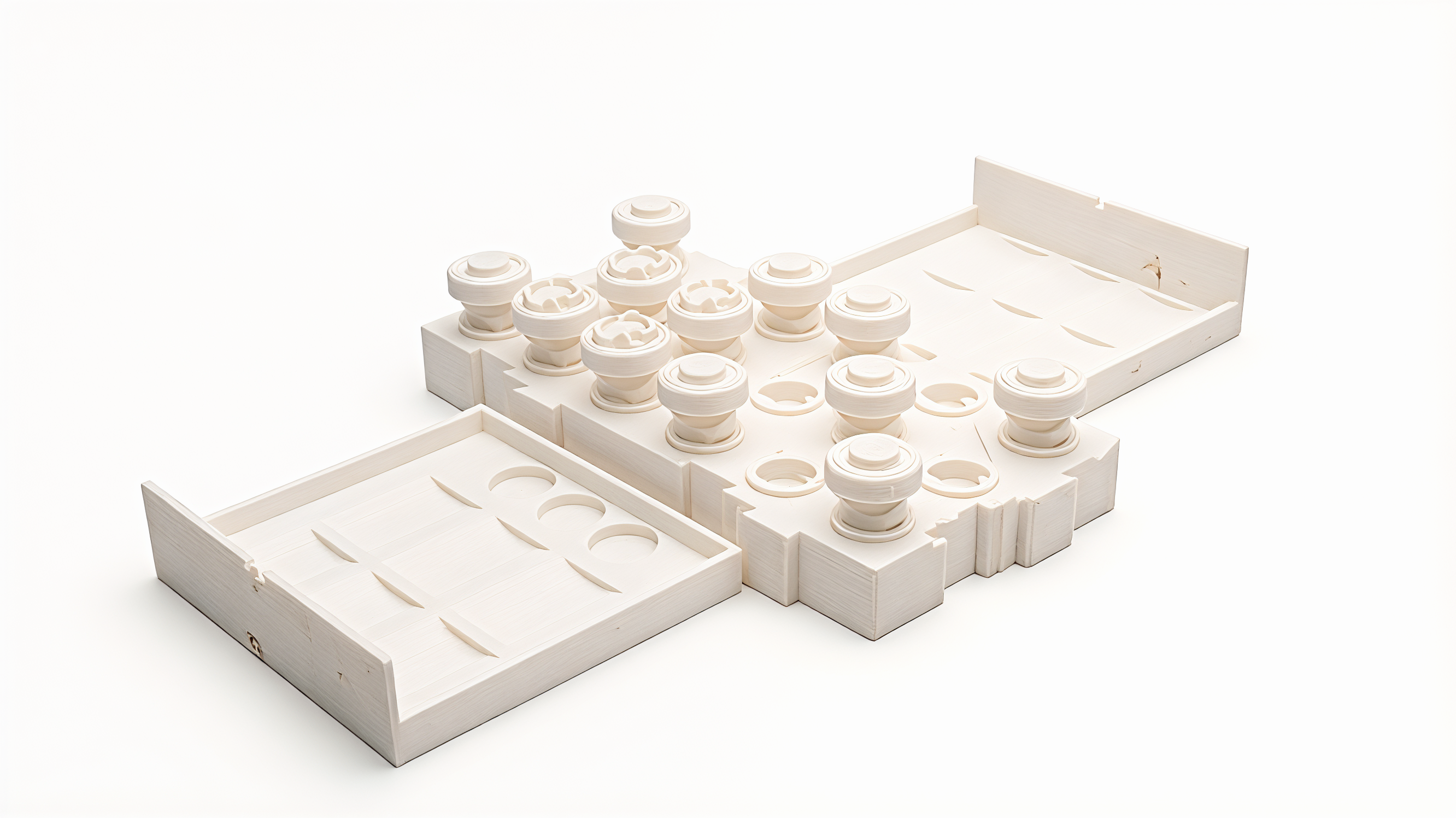
Two players, one hidden field Blindcap: Duel is designed for exactly two people and a 25-minute table. Each player plants six mushrooms whose species is hidden in the buried shank, spends three probes to read the rival field, and commits three crowns before harvest. It is deduction resolved by the printed objects, with no cards, dice, app, or moderator.
:quality(75)/https://cdn.autonomous.ai/panda-social/6a8a071857e4d5db73f54a5b/6a8a071957e4d5db73f54a5c/product-media/use-case-16x9.png)
Plant, read, commit Both players seed the center at once, then play five rounds. On each turn, plant one mushroom and either probe or crown a rival mushroom; passing is not allowed. Your five main actions are exactly three probes and two crowns, in any order. The round starter alternates. After round five, each player places the reserved third crown, then harvest begins.
:quality(75)/https://cdn.autonomous.ai/panda-social/6a8a071857e4d5db73f54a5b/6a8a071957e4d5db73f54a5c/product-media/play-loop-16x9.png)
The pin is the reader Every socket has one-dot and two-dot channels. A buried tunnel admits the probe and leaves it low; solid shank stops it high. Leave the pin where it rests until harvest, so its height and owner mark become public board state. One result narrows four species to two. Results from both channels identify the mushroom without an app or a ruling from either player.
:quality(75)/https://cdn.autonomous.ai/panda-social/6a8a071857e4d5db73f54a5b/6a8a071957e4d5db73f54a5c/product-media/reader-high-low-16x9.png)
Four species, one cap All four species share the same cap silhouette above the loam. Beneath them, deadhead reads high/high, bracket low/high, inkcap high/low, and hollow low/low across the one-dot and two-dot channels. You know the six mushrooms you planted. Your rival knows only what the public pins expose, while visible cap marks keep ownership separate from species.
:quality(75)/https://cdn.autonomous.ai/panda-social/6a8a071857e4d5db73f54a5b/6a8a071957e4d5db73f54a5c/product-media/species-code-16x9.png)
Crowns score groves At harvest, each maximal orthogonally connected group of one species is a grove; a lone mushroom counts, diagonals do not, and an uncrowned grove scores zero. A grove crowned by one player scores size squared. If both players have a crown there, each scores its size. Inkcap and hollow groves score double. Extra same-owner crowns add nothing.
:quality(75)/https://cdn.autonomous.ai/panda-social/6a8a071857e4d5db73f54a5b/6a8a071957e4d5db73f54a5c/product-media/harvest-scoring-16x9.png)
The field settles ties Highest total wins. Before removing pins, both players record four public counts: rival mushrooms tested in both channels, distinct rivals probed, probes beneath their crowns, and probes resting low. Then fully withdraw every pin before lifting and inverting the mushrooms. Ties compare the largest uncontested grove, then those four rows in order.
What the model checked The final 400-game executable-model run ended every game in 24 moves, with zero deadlocks, forced turns, undefined branches, or information leaks. Competent-policy win credit was 50.75%/49.25%: a 0.75-point edge over fair share, below the 10-point seat-effect kill line. Shared wins fell from 42% to 8.5% after the earned tiebreaks. This is routing evidence, not a human playtest.
Print the coupon first The digital fit matrix admits every intended route and blocks every absent route, but no physical fit has been verified. Before printing the set, print the socket, four mushroom, probe, and tile-joint coupons. Low and high must be obvious without seeing the shank, channels must not cross-talk, and keyed parts must work across print variation. Keep this draft private until that test passes.
:quality(75)/https://cdn.autonomous.ai/panda-social/6a8a071857e4d5db73f54a5b/6a8a071957e4d5db73f54a5c/product-media/coupon-layout-cad-16x9.png)


:quality(75)/https://cdn.autonomous.ai/panda-social/6a8aba7a57e4d5db73f56e54/6a8aba7b57e4d5db73f56e56/media/thumbnail-3js1-7d6ea66f94b1547f.jpg)

:quality(75)/https://cdn.autonomous.ai/panda-social/6a6b49d2f795702d2a99366a/6a6c083dac50948e9ab7f85c/media/thumbnail-3js1-cadab14b5eec79f4.jpg)

:quality(75)/https://cdn.autonomous.ai/panda-social/uploads/admin/1786021451166427793.jpg)
:quality(75)/https://cdn.autonomous.ai/panda-social/6a87c380b0fc13db78252e87/6a88182607f1df86b26518e7/media/thumbnail-3js1-319f61e71186d53a.jpg)

:quality(75)/https://cdn.autonomous.ai/panda-social/6a8a6b4cbc76c29387f00c21/6a8a6b4ebc76c29387f00c22/media/thumbnail-3js1-160bb52a2a03a50c.jpg)
:quality(75)/https://cdn.autonomous.ai/panda-social/uploads/admin/1786020827641957324.jpg)

:quality(75)/https://cdn.autonomous.ai/panda-social/6a6993a3130c7b87872b0597/6a69aa09ac50948e9a709acf/media/thumbnail-3js1-e43ce5d2ecc81d61.jpg)
:quality(75)/https://cdn.autonomous.ai/panda-social/uploads/admin/1786022033060821878.jpg)

:quality(75)/https://cdn.autonomous.ai/panda-social/6a8a6b7457e4d5db73f55e7c/6a8a6b7457e4d5db73f55e7d/media/thumbnail-3js1-200136117affde40.jpg)
:quality(75)/https://cdn.autonomous.ai/panda-social/uploads/admin/1786021557787413570.jpg)

:quality(75)/https://cdn.autonomous.ai/panda-social/uploads/admin/1786021379723593025.jpg)
:quality(75)/https://cdn.autonomous.ai/panda-social/uploads/admin/1786014154462965936.jpg)
Comments