Qwen3-VL Explained Models Variants and Local Setup

Qwen3-VL is Alibaba's open-weight vision-language model, the current generation in the Qwen-VL line, built to understand images, video, and documents and act on what it sees. It reads text in images across many languages, follows video over long durations, and can drive agentic tasks like operating a UI from a screenshot. This guide covers what Qwen3-VL does, its model sizes, how it compares to earlier Qwen-VL versions, and how to run it on your own hardware.
What Qwen3-VL can do
Qwen3-VL is a vision-language model that takes images or video alongside text and returns grounded, structured answers. It builds on the Qwen-VL architecture, using a dynamic-resolution vision encoder so it handles images at their native size and ratio rather than forcing a fixed resolution. Its main capabilities are:
- Image understanding, including charts, diagrams, and complex layouts
- Document parsing and OCR across roughly 29 languages, useful for forms and scans
- Video understanding over long durations, with question answering and summaries
- Visual grounding, locating and pointing to specific elements in an image
- Agentic use, operating interfaces or devices from what it sees on screen
These are the features that make a vision-language model useful for real products rather than demos. The document OCR and video understanding in particular are why it shows up in data-extraction and media pipelines.
Qwen3-VL model variants
Qwen3-VL comes in several sizes, so the right one depends on your hardware and how much accuracy the task needs. The table sums up the main variants.
Variant | Size | Best for |
|---|---|---|
Qwen3-VL 8B | 8B | Higher-accuracy vision and document work |
Qwen3-VL 4B | 4B | Balanced quality on a single GPU |
Qwen3-VL 2B | 2B | Lightweight and edge deployments |
Instruct variants | Varies | Following prompts and structured output |
Thinking variants | Varies | Step-by-step visual reasoning |
The Instruct variants are tuned to follow instructions and return structured output, while the Thinking variants add explicit reasoning steps for harder visual problems. There are also larger models in the line for maximum accuracy, so you can scale up when a task needs it.
Qwen3-VL versus earlier Qwen-VL models
Qwen3-VL is the current version and the best starting point, while Qwen2-VL and Qwen2.5-VL are its predecessors. Each generation improved resolution handling, video understanding, and agentic grounding, so newer is generally better unless you have an existing system tied to an older version. The table sums up the lineage.
Qwen2-VL | Qwen2.5-VL | Qwen3-VL | |
|---|---|---|---|
Generation | First widely used | Interim update | Current |
Focus | Dynamic resolution, video | Refined perception | Stronger reasoning and grounding |
Best for | Legacy systems | Legacy systems | New projects |
If you are starting today, use Qwen3-VL. Existing pipelines on Qwen2-VL or Qwen2.5-VL do not need to move immediately, and all three sit within the wider Qwen model family, with similar interfaces across generations.
How to run Qwen3-VL locally
Qwen3-VL is open-weight, so you can run it yourself instead of calling a closed vision API, which keeps images and documents on your own machine. The common runtimes are Ollama for a simple local setup and vLLM for higher-throughput serving, usually with 4-bit or 8-bit quantization to control memory.
Hardware is the deciding factor. The 2B and 4B variants run on a single consumer GPU, so a modern card handles everyday image and document tasks, while the 8B and larger models need more VRAM for smooth serving.
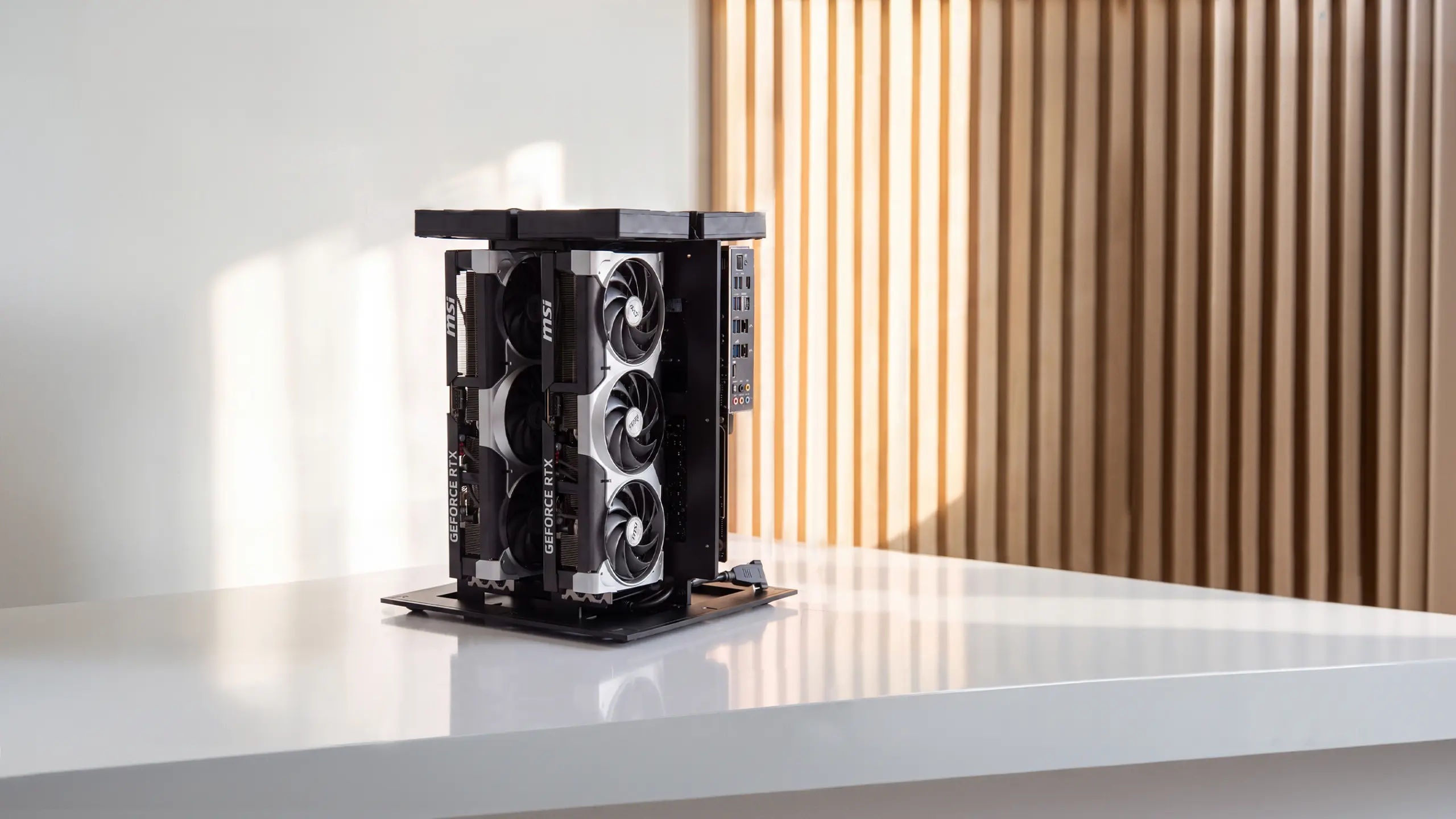
For running the larger Qwen3-VL models continuously, or serving a team, a machine built to run open models locally, such as the Autonomous Computer, pairs dual RTX 5090 GPUs with a vLLM serving stack to keep images and documents on your own hardware with no per-call cost. For light use, a single consumer GPU is enough to start.
What developers use Qwen3-VL for
Qwen3-VL fits anywhere vision and structured output meet. The most common uses are:
- Document AI, extracting fields from forms, invoices, and scans as structured data
- Video understanding, summarizing or answering questions about long footage
- UI and screen agents, reading an interface and deciding the next action
- Accessibility and OCR, reading text in images across many languages
- Visual search and tagging, describing and locating elements in large image sets
Because it is open-weight and runs on your own hardware, it also suits use cases where images cannot leave your environment, like medical, legal, or internal document processing.
Frequently asked questions
What is Qwen3-VL?
Qwen3-VL is Alibaba's open-weight vision-language model, the current generation in the Qwen-VL line. It understands images, video, and documents alongside text, handling OCR, video question answering, visual grounding, and agentic tasks like operating a UI from a screenshot. It comes in several sizes, so you can match it to your hardware.
What sizes does Qwen3-VL come in?
Qwen3-VL is released in several sizes, commonly 2B, 4B, and 8B, plus larger models for maximum accuracy, each in Instruct and Thinking variants. Smaller sizes like 2B and 4B run on a single consumer GPU, while larger ones need more VRAM. Pick the size that fits your hardware and accuracy needs.
Can I run Qwen3-VL with Ollama?
Yes. Qwen3-VL is open-weight, so you can run it locally with Ollama for a simple setup or vLLM for higher-throughput serving. The 2B and 4B variants run on a single consumer GPU, while larger models need more VRAM. Quantization helps fit bigger variants into limited memory.
How is Qwen3-VL different from Qwen2.5-VL?
Qwen3-VL is the newer generation, with stronger visual reasoning, grounding, and agentic capabilities than Qwen2.5-VL, which itself improved on Qwen2-VL. For new projects, Qwen3-VL is the better starting point. Existing systems built on Qwen2.5-VL still work and do not need to migrate immediately unless you need the newer features.
Is Qwen3-VL open source?
Most Qwen3-VL models are open-weight, so you can download and run them yourself under permissive licensing, though specific variants may have different terms. This openness is the main practical difference from closed vision models, since it lets you keep images and documents on your own hardware rather than sending them to an external API.
Where is the Qwen3-VL technical report?
Qwen publishes technical details for its vision-language models through its official blog and arXiv papers, which cover the architecture, training, and benchmark results. Check the Qwen team's GitHub and Hugging Face pages for the current Qwen3-VL model cards and the linked report, since these are updated as new variants release.
Conclusion
Qwen3-VL is the current generation of Alibaba's open vision-language models, built to read images, video, and documents and act on them, with sizes that scale from 2B edge models to larger flagships. It is the better starting point than Qwen2-VL or Qwen2.5-VL for new projects, and because it is open-weight, you can run it on your own hardware to keep visual data private. Match the variant to your GPU, start with a smaller size, and scale up as the task demands.