


Home Office Desk Size and How to Fit Your Room


A home office desk size question is really a room question. The standard width, depth, and height matter, but in a home office the harder problem is fitting a desk into a room that also has a bed, a door, a window, or a second person. This guide sizes a desk to your space: how much floor area you need, how to measure the room, where to place the desk, and what fits a small or shared home office. For the raw measurements by desk type, see the standard desk dimensions guide; here the focus is the room.
How much space does a home office desk need?
A single home office workstation needs about 30 sq ft (2.8 sq m) for the desk and chair together, and 50-100 sq ft (4.6-9.3 sq m) for a comfortable full office with storage and walking room.
That number splits into two parts. The desk footprint is the surface itself - a 48 in × 24 in desk covers about 8 sq ft. The clearance is everything around it: the chair when pushed back, room to stand, and a path to walk in. Clearance usually takes more floor than the desk. Plan both, not just the desktop.
How to measure your room before buying a home office desk
Measure the room before you measure the desk. A desk that technically fits can still make a room feel cramped if you skip the clearance.
Map the wall. Measure the length of the wall or corner where the desk will sit. This sets the maximum desk width.
Mark the footprint. Use painter's tape to outline the desk on the floor, then walk around it. You feel a tight fit before you buy it.
Add chair clearance. Leave 24-36 in (61-91 cm) behind the desk for the chair and standing room.
Check the openings. Note where the door swings, where windows sit, and where the nearest outlet is. A desk should not block a door or a radiator.
Check the doorway. Pre-assembled desks have to fit through the door to reach the room. Most interior doors are 28-32 in (71-81 cm) wide. Flat-packed desks assemble in the room, so this matters less for them.

What desk size fits your room?
Match the desk width to your available wall space, then pick a shape that uses the room efficiently. The table below maps common room situations to a home office desk size and layout.
Available wall or space | Suggested desk width | Layout that works |
Under 6 ft (alcove, bedroom corner) | 36-48 in compact, or an L-shape in the corner | Against the wall, or tucked into the corner |
6-8 ft (spare room) | 48-60 in | Against the wall with chair clearance behind |
8 ft or more (dedicated room) | 60-72 in, or an L-shape | Against a wall, facing a window, or floating |
Shared by two people | Two 48-55 in zones, or one 70 in top | Side by side, or back to back |
If your only free space is a corner, an L-shape often fits more surface into less of the room than a straight desk, because it uses the dead corner instead of a full wall. The L-shaped desk dimensions guide covers those sizes. For very tight rooms, a small desk under 48 in keeps the floor open.
How to fit a desk in a small or awkward home office
In a small room, work with the room's shape instead of forcing a full-size desk into it. Three tactics recover the most space.
Use the corner. A corner or L-shape desk fills space that a straight desk leaves empty, so you get more surface without giving up a whole wall.
Go shallow. A 18-24 in deep writing or compact desk frees up walking room in a narrow space. It suits a laptop, though it is tight for a large monitor.
Use vertical space. Wall shelves or a desk with a hutch move storage up and off the floor, so the desk footprint stays small.
A desk that adjusts in height also helps in a shared small room, because one surface can serve two people instead of fitting two separate desks into the space.
Setting up a two-person or shared home office
A shared home office needs either two work zones or one wide desk split between users. Plan for two chairs, two sets of clearance, and a desk height that suits both people.
Side by side, give each person 48-55 in of width so chairs and elbows don't collide. Back to back, two desks against each other suit a floating layout in a larger room. The harder constraint in a shared setup is height: a fixed desk that fits one person forces the other to compromise.
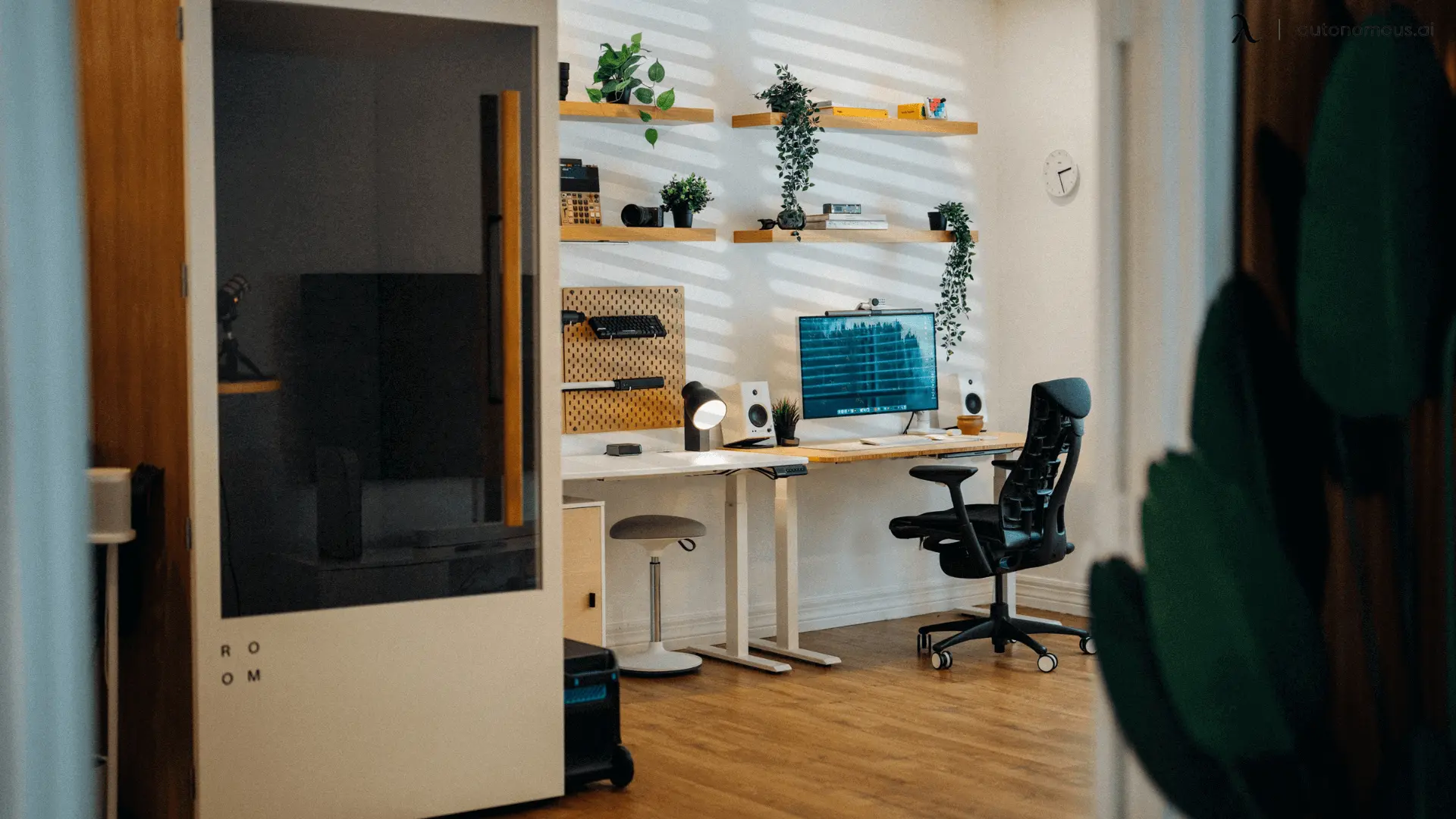
One desk that adapts to a tight or shared room
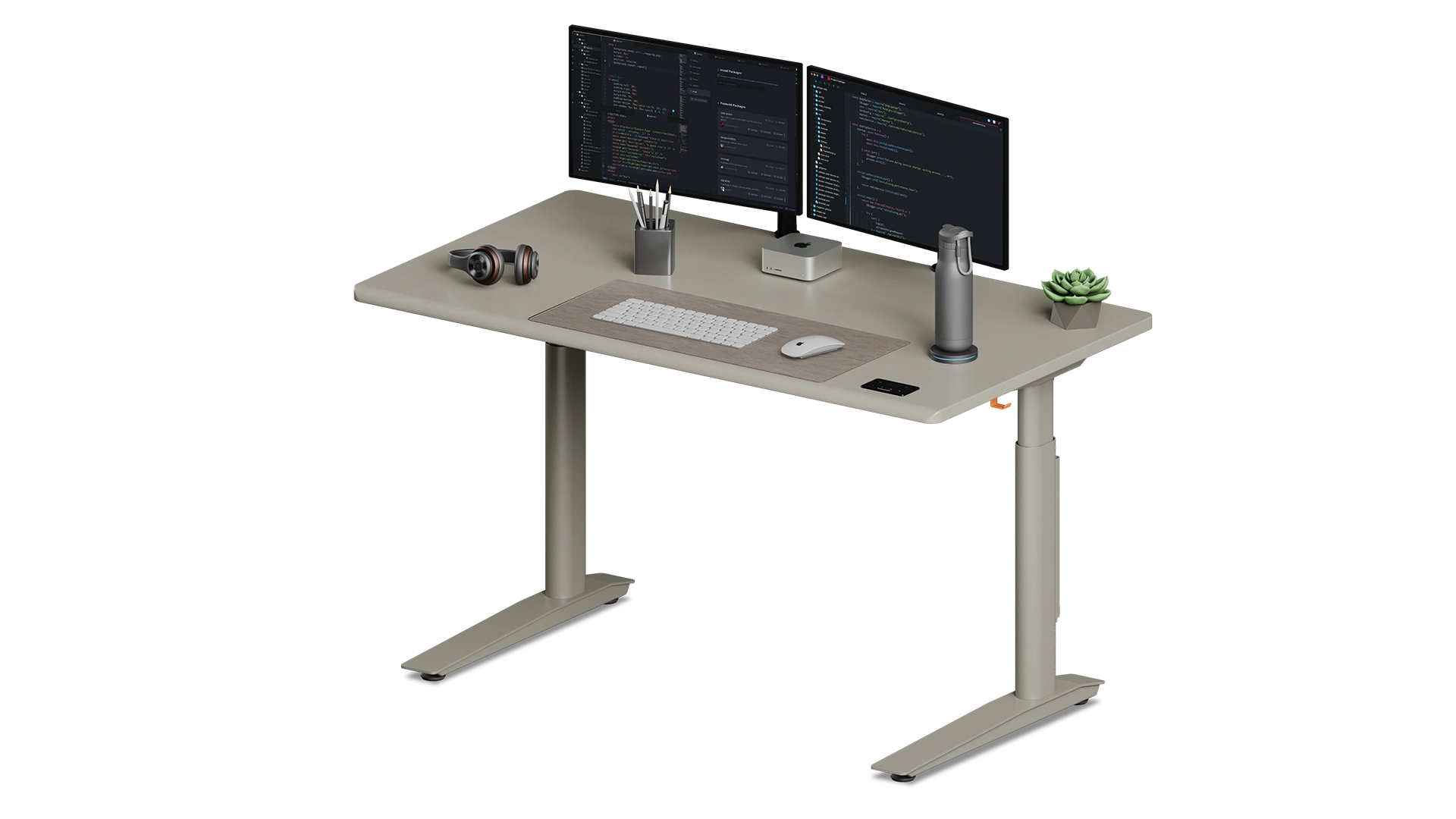
A height-adjustable standing desk solves the two problems a home office creates: a single height has to serve more than one body, and the room is often too small for a bulky frame. An adjustable surface moves to each user, and a clean frame leaves more usable floor.
The Autonomous Desk Pro adjustable standing desk fits this. The top comes in 53 in × 29 in or a 70.5 in Expanse, and the frame footprint runs 40.4-70.9 in long by 26.4 in wide, so you can size it to a small room or a shared wall. Its C-shaped frame removes the front crossbar that sits under most desks, which clears knee space in a tight setup. The height adjusts from 29.5 in to 48.5 in, so two people can share one desk across sitting and standing. The dual-motor frame lifts 330 lb, runs under 30 dB, and carries a lifetime frame warranty. It ships from $499. Desk Pro is the desk we ship to ourselves, so the stability and load numbers come from a frame in daily use rather than a spec sheet alone.
FAQs
How much space do you need for a home office desk?
A home office desk needs about 30 sq ft (2.8 sq m) for the desk and chair together, and 50-100 sq ft (4.6-9.3 sq m) for a full office with storage and walking room. The clearance around the desk usually takes more floor than the desktop itself.
What is the ideal desk size for a home office?
The ideal home office desk size matches your wall space: 36-48 in wide for a corner or small room, 48-60 in for a spare room, and 60-72 in for a dedicated office. Pick the width your room allows, then leave 24-36 in of clearance behind the chair.
What size desk fits a 10x10 room?
A 10 by 10 ft room (100 sq ft) comfortably fits a 48-60 in desk with room for a chair, clearance, and some storage. You can go up to 72 in or an L-shape if the desk is the room's main furniture and you don't need a bed or seating in the same space.
Is a 60-inch desk too big for a home office?
A 60 in desk is not too big for most home offices and suits dual monitors or spread-out work. Confirm you have at least 8 ft of wall for it and 24-36 in of clearance behind the chair. In a small bedroom corner, a 60 in desk can crowd the room.
What is the smallest desk that works in a home office?
The smallest practical home office desk is about 36 in wide and 18-24 in deep, enough for a laptop, a notebook, and a small monitor. Below 36 in, surface space gets tight once you add a screen. A corner desk can add room without a wider footprint.
How do I measure my room for a desk?
Measure the wall or corner where the desk will sit to set the maximum width, then mark the desk footprint on the floor with painter's tape. Add 24-36 in behind the chair for clearance, and note where the door, window, and nearest outlet are.
How much clearance do I need behind a desk chair?
Leave 24-36 in (61-91 cm) behind a desk chair so you can push back and stand without hitting a wall or furniture. In a shared office, give each chair its own clearance so two people can move at the same time.
Can a desk go in front of a window?
A desk can go in front of a window, and the daylight reduces eye strain and lifts focus. Watch for glare on your screen during bright hours. Angling the desk side-on to the window, rather than facing it directly, usually controls glare better.
Will a desk fit through my door?
A pre-assembled desk has to clear your doorway, which is usually 28-32 in (71-81 cm) wide on interior doors. Measure the desk's shortest dimension against the door before buying. Flat-packed desks assemble in the room, so the doorway is rarely a problem for them.
What desk shape is best for a small home office?
An L-shaped or corner desk is usually best for a small home office, because it uses the dead corner instead of a full wall and adds surface without widening the footprint. A shallow 18-24 in writing desk is the next best option for a narrow room.
What desk works for a two-person home office?
A two-person home office works with either two 48-55 in desks side by side or one 70 in top split between users. Give each person their own chair clearance, and choose a height-adjustable desk so a single surface suits both people's heights.
Conclusion
Home office desk size comes down to the room as much as the desk. Start with the floor: about 30 sq ft for the desk and chair, more for a full office. Measure the wall, mark the footprint, and leave 24-36 in of clearance before you commit to a width. Then place the desk for daylight and focus, and use a corner or an adjustable surface when the room is small or shared. Size the room first, and the desk follows.