Autonomous Desk Pro
Why Desk Pro's top uses Interpon 700 powder coating on HDF
We tested UV-cured paint on MDF and melamine on HDF before settling on Interpon 700 epoxy-polyester powder on HDF. Here's the data and the tradeoffs.
What we picked, and what we rejected
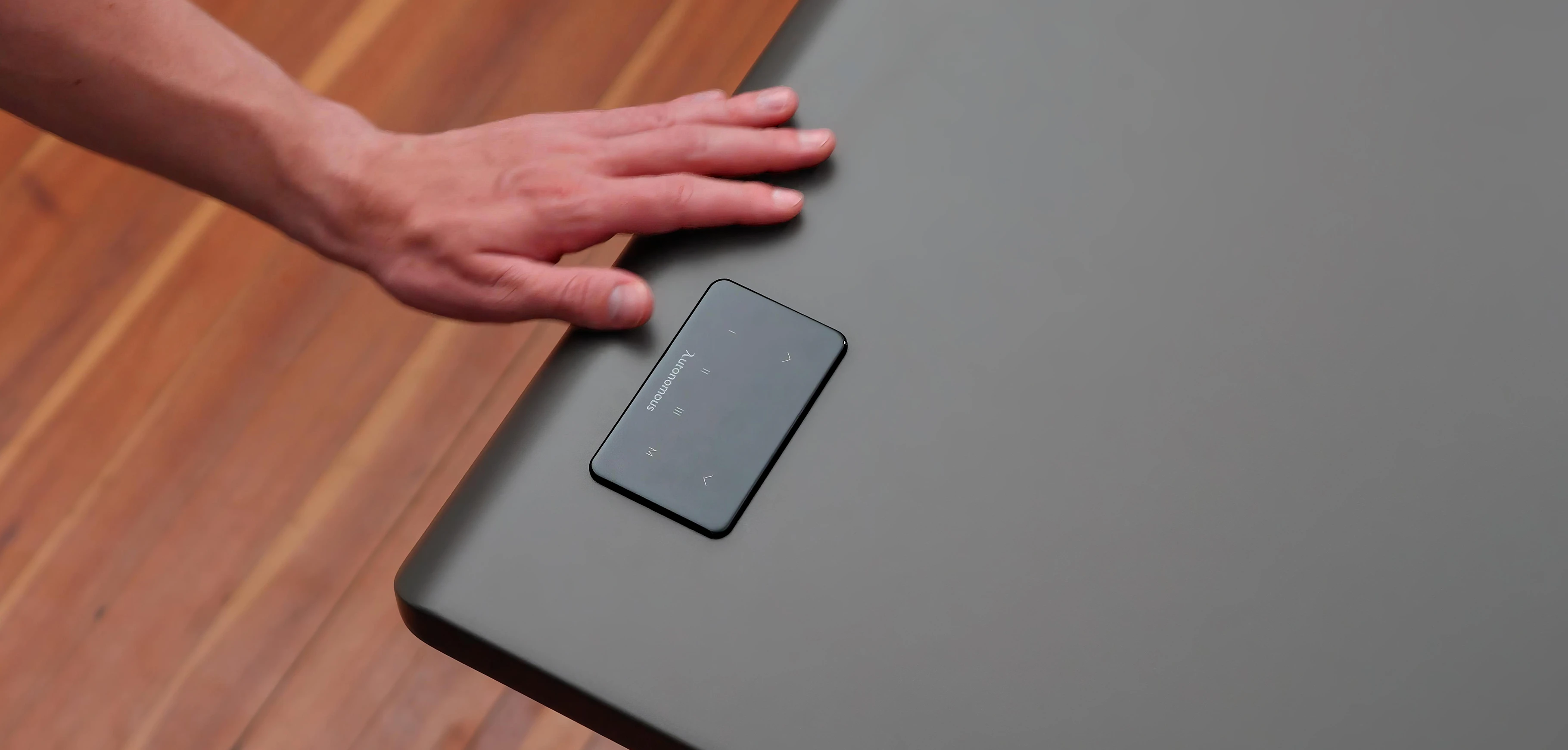
Desk Pro's top is high-density fiberboard (HDF) coated with Interpon 700 epoxy-polyester powder. We picked this combo after rejecting two alternatives: UV-cured paint on MDF (peeled), and melamine on HDF (chipped at edges).
The top is the first thing you touch when you unbox a desk, and the surface you'll work on for thousands of hours. A weak coating scratches, absorbs moisture, releases VOCs, and chips at the edges where your arms rest. We wanted a finish that held up to 12-hour sessions, not a showroom photo.
This post covers the three coatings we tested, the test data behind the choice, and the tradeoffs still open at scale.
What is Interpon 700 epoxy-polyester powder coating
Powder coating starts as a dry powder, sprayed onto the surface with an electrostatic gun. The panel then goes into a 180°C oven for 15-20 minutes. The powder melts, fuses, and cures into a hard layer bonded to the substrate. No solvents. Near-zero VOC emissions.
Interpon 700 is an epoxy-polyester powder from AkzoNobel. We use it on HDF instead of melamine laminate or polyurethane matte sealer because it bonds better with the prepared HDF surface and holds up under everyday abuse — coffee spills, hot laptops, mouse friction, arms leaning on the edge.
Three tests, one winner
We tested three combinations before settling on the current one.
Test 1: UV-cured paint on medium-density fiberboard (MDF). The paint cured fast under UV light. But MDF is soft and porous, so the paint soaked in unevenly. Adhesion dropped. The finish peeled within weeks of normal handling. Rejected.
Test 2: Melamine laminate on HDF. Looked smooth and glossy on day one. Chipped at the edges as soon as the desk got bumped during shipping or moves. Melamine is brittle at thin profiles — fine on a flat untouched surface, not fine on a desk that gets handled. Rejected.
Test 3: Interpon 700 epoxy-polyester powder on HDF. HDF's denser, more uniform substrate took the powder evenly. The fused coating bonded across the whole surface, edges included. After adhesion, impact, and salt-spray testing, this combo held up where the others didn't. Shipped.
How we apply it on the line
HDF panels are cleaned and lightly sanded. Then sprayed with Interpon 700 via electrostatic gun. Then cured at 180°C for 15-20 minutes. The cured layer is bonded mechanically and chemically to the HDF, not sitting on top like a laminate.
Test data vs traditional liquid paint
We benchmarked Interpon 700 against an oil-based liquid paint — the default finish in this price bracket. Five metrics, same HDF substrate, same test conditions.
- Scratch resistance. Liquid paint shows damage at 10 N of scratch force. Interpon 700 holds to 12 N before showing damage. 20% more force before failure.
- Impact resistance. Liquid paint withstands 20 kg·cm of impact force. Interpon 700 withstands 30 kg·cm. In energy terms: 50% more impact energy absorbed.
- UV fade rate. Liquid paint degrades at roughly 0.1% per month under UV exposure — about 12% color fade over a year. Interpon 700 degrades at 0.02% per month — under 0.25% fade over the same year. 5× slower degradation.
- Corrosion resistance (salt spray). Liquid paint shows significant corrosion after 100 hours of salt-spray testing. Interpon 700 holds for 500 hours before significant corrosion. 5× longer to corrosion onset.
- Cure energy per panel. Liquid paint air-dries for about 3 hours at 1 kW = 3 kWh per panel. Interpon 700 cures in 0.33 hours at 2 kW = 0.66 kWh per panel. About 4.5× less energy per panel. Plus zero solvent emissions during cure.
- VOC emissions. Oil-based liquid paint releases volatile organic compounds throughout drying and into the room for weeks after. Interpon 700 is solvent-free — near-zero VOC during cure and after.
What you'll notice on the desk
Three concrete things on a Desk Pro top vs a typical liquid-painted one:
- Mouse glides without drag. The cured matte surface stays smooth — no sticky patches from solvent residue.
- Edges don't chip from arm contact. The bonded powder wraps and holds where a laminate would crack.
- Spills wipe clean. Coffee, water, hot mug rings — no absorption into the substrate, no rings left behind.
Tradeoffs we're still working on
Two open challenges we monitor on every batch.
Wood substrate behavior. Powder coating was designed for metal. HDF works because it's dense and uniform, but it's still wood — moisture content, surface density, and oven dwell time all affect bond strength. Any inconsistency in prep or cure shows up later as adhesion loss. We check moisture and density on every incoming HDF batch, and we monitor oven temperature continuously during cure.
Color variation at scale. Interpon 700 is repeatable within a batch, but reclaim powder — the overspray we recover and reuse — can produce subtle "marble effects" if not fluidized properly between runs. For furniture-grade finish, this matters. We control it with tight QC on fluidization pressure and curing temperature, and we don't ship panels that drift outside spec.
What we'd still like to test
Long-term abrasion under real desk use (not lab scratch tests). Edge impact recovery after years of bag knocks. UV behavior near windows in tropical climates vs temperate ones. If you've had a Desk Pro for over a year and want to share how the top has held up, ping us — we're collecting field data.