


The 9 Best Petite Office Chairs for Short People 2026

.webp)
I am 5'2", and I have spent years fighting office chairs. Here is the thing nobody selling them will tell you: most petite office chairs are not petite. They are standard chairs with the word petite added to the listing, so the seat still starts too high, the lumbar still lands between your shoulder blades, and the arms are still set for wider shoulders than yours.
So I stopped trusting the labels and read the numbers instead. Below are the nine petite office chairs I would actually put a short person in, what each one is like when you are short, and how to set any of them up so you stop hurting by mid-afternoon. If you have already bought a "petite" desk chair that let you down, none of this will surprise you.
Quick comparison
CabLady S2 | Sidiz T25 | Aeron Size A | Leap V2 | OM Paramount | Neutral Posture | Clatina | |||
Min seat height | 18.5" | 18" | 17.3" | ~15.7" | 14.75" | ~15.5" | 15.5" | ~15.75" | ~17.7" |
Seat depth adjusts | Yes | Yes | Yes | No | No | Yes | Yes | Yes | No |
Price | $499 | $449 | ~$410 | $355 | ~$1,835 | ~$650 | ~$571 | ~$1,342 | ~$199 |
.webp)
The chairs I would actually put a short person in
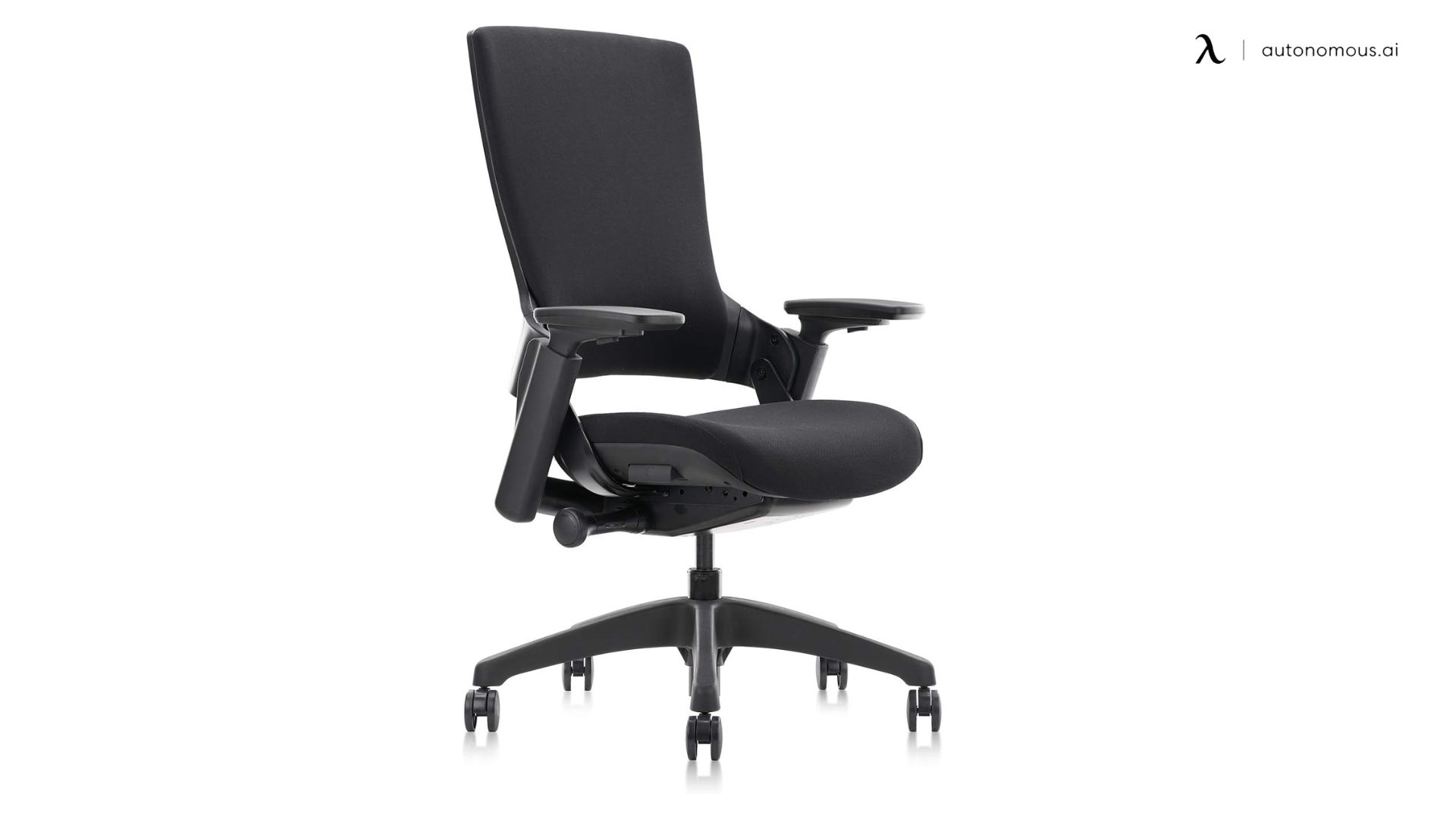
1. Autonomous ErgoChair Pro - Best for lower-back pain
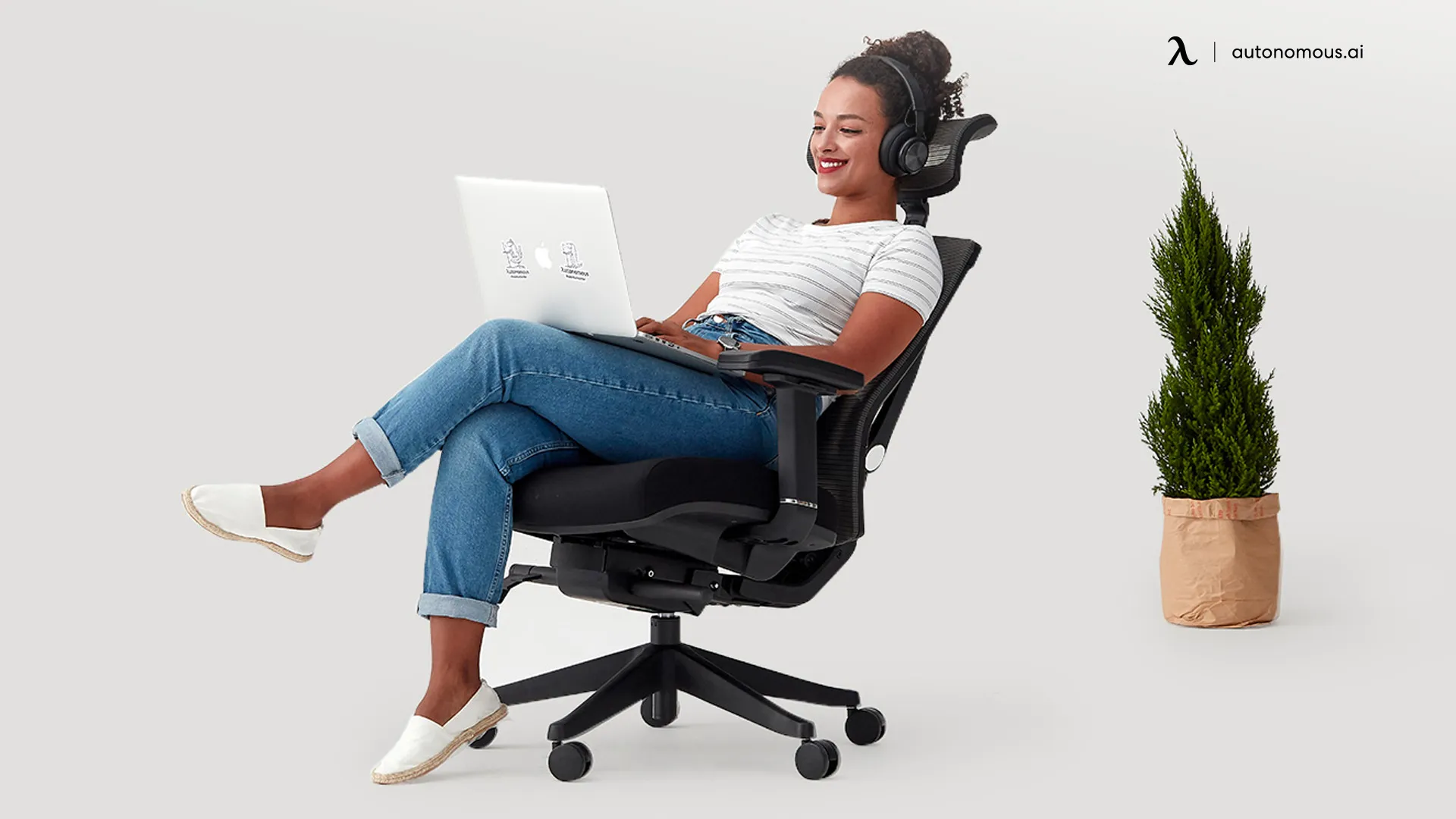
Specs:
- seat height 18.5-22"
- seat depth 19-21.5" (adjustable)
- 3D arms 11-14" (height, width, depth)
- sliding lumbar (6" range)
- 22 degree recline with 5 lock positions
- 9 adjustment points
- 300 lb
- lifetime warranty
At 5'2", the first thing I did was slide the lumbar all the way down, and that is where the ErgoChair Pro earns its spot as an ergonomic office chair for a short person with back pain. The pad finally sat on my lower back instead of my shoulder blades, which is the fix for the ache most short people wrongly blame on their posture. On a standard chair the lumbar curve is built for someone five or six inches taller, so it lands in your mid-back. The Pro's sliding lumbar support travels a full 6 inches, which is more room to place support on a short torso than almost any petite office chair in this price range.
Setup took about two minutes. I dropped the seat to its lowest at 18.5 inches, shortened the seat depth so the front edge cleared the backs of my knees, and locked the recline at one of the five positions on the synchro-tilt. The seat still starts higher than a truly petite chair, so my feet dangled until I slid a footrest underneath, and while the 3D arms pull in and out for narrow shoulders, they do not drop below 11 inches, so if you want them lower the Ultra 2's go down to 7.
What makes the Pro worth it despite running large is the support and the backing. The nine adjustment points and the Italian Donati mechanism, rated to 100,000 cycles, keep it from developing the slack cheaper chairs get after a year, and it is covered by a lifetime warranty rather than the three to twelve years most competitors here offer. If lower-back pain is the reason you are shopping for a petite office chair, this is the one I would start with.
Pros
- Sliding lumbar travels 6 inches, low enough for a short torso
- Seat depth and 3D arms adjust in to a smaller frame
- Lifetime frame warranty on a 100,000-cycle mechanism
Keep in mind
- The seat starts at 18.5 inches, so under about 5'3" a footrest is part of the setup
2. Autonomous ErgoChair Ultra 2 - Best overall for posture
.webp)
Specs:
- seat height 18-23"
- seat depth 18-20.5" (adjustable)
- 4D arms 7-11" (height, width, depth, angle)
- lumbarless flex-frame
- 320 lb
- lifetime warranty
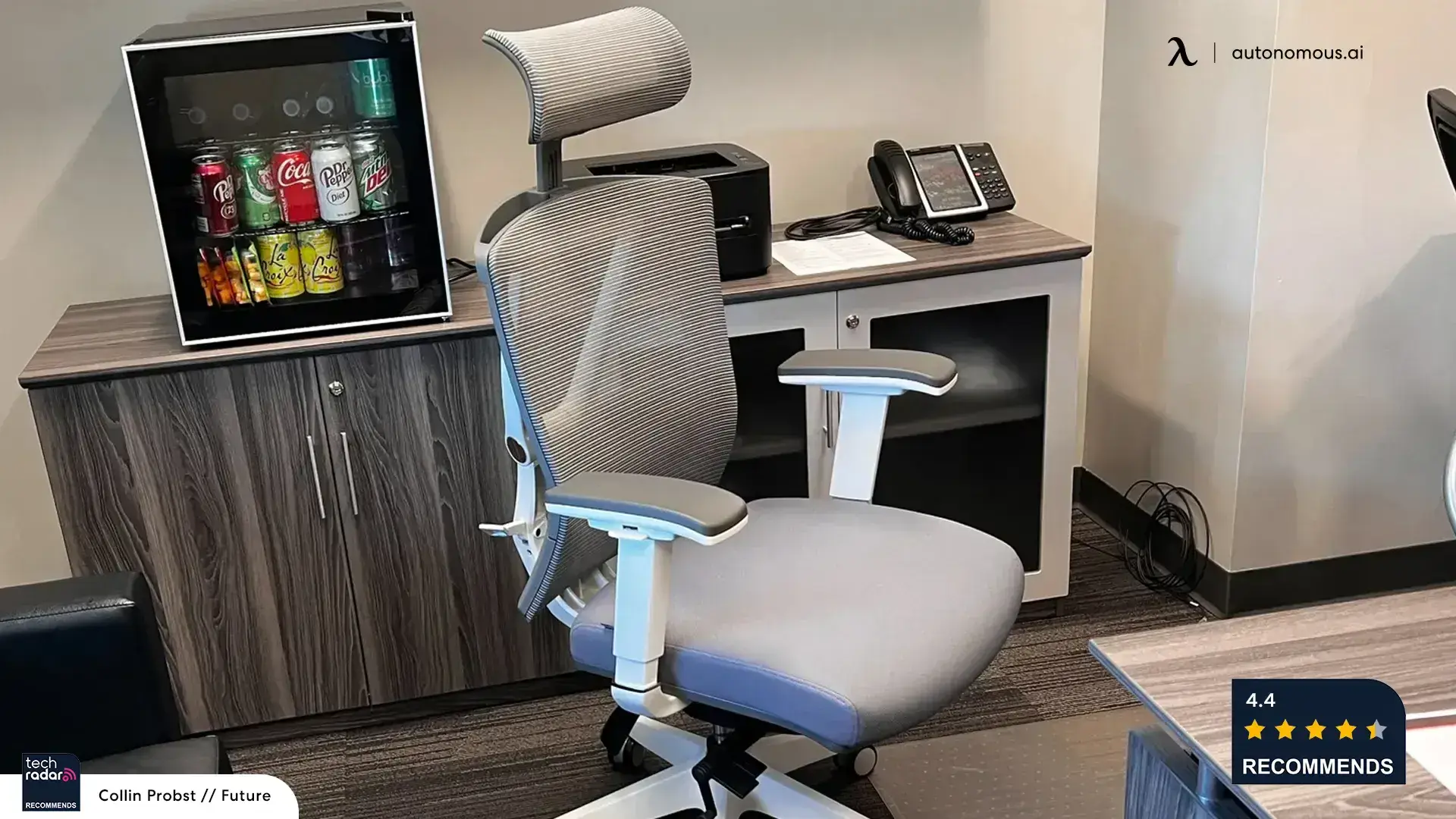
The Ultra 2 solves lumbar the opposite way, and for a short torso that is often the smarter fix. There is no pad to place at all: the whole back is a lumbarless flex-frame, two backrest layers over 62 pressure nodes that flex with you as you move, so there is no fixed bump waiting to land between your shoulder blades. That is why I rate it the best ergonomic chair for short people on posture. A standard lumbar is set for someone taller and presses into the wrong spot, while a flex-frame supports the whole spine wherever your back happens to be, which is what keeps you upright without a pressure point fighting you all day.
For me the standout was the arms. The 4D armrests drop to 7 inches above the seat, the lowest here, and pull inward, so my shoulders finally relaxed instead of hiking up to reach the pads, which is the detail that matters most if you have narrow shoulders. The seat starts at 18 inches, a hair lower than the Pro but still footrest territory under about 5'2", and the seat depth shortens to 18 inches so the front edge clears the backs of your knees. The four-layer seat, molded foam over TPE webbing and polymer coil springs, spreads your weight instead of pooling it at the hips, which I noticed most on long days.
Pros
- 4D arms drop to 7 inches and pull inward, the lowest here
- Lumbarless flex-frame, so no fixed pad lands wrong on a short back
- Four-layer seat spreads weight, with a lifetime frame warranty
Keep in mind
- The seat starts at 18 inches, so a footrest is still part of the setup under about 5'2"
So which of the two Autonomous chairs is for you?
If you want to position a lumbar pad to an exact spot, get the Pro; if narrow shoulders and a back that likes to shift and recline are your issue, the Ultra 2 is the pick. It reclines to 25 degrees on the same Italian Donati mechanism, holds up to 320 lb, and carries the same lifetime frame warranty. If you are a petite woman weighing this chair specifically, our engineer's Ultra 2 fit guide walks through the geometry for a smaller frame in detail.
3. CabLady S2 - Petite-built fit, but a short warranty
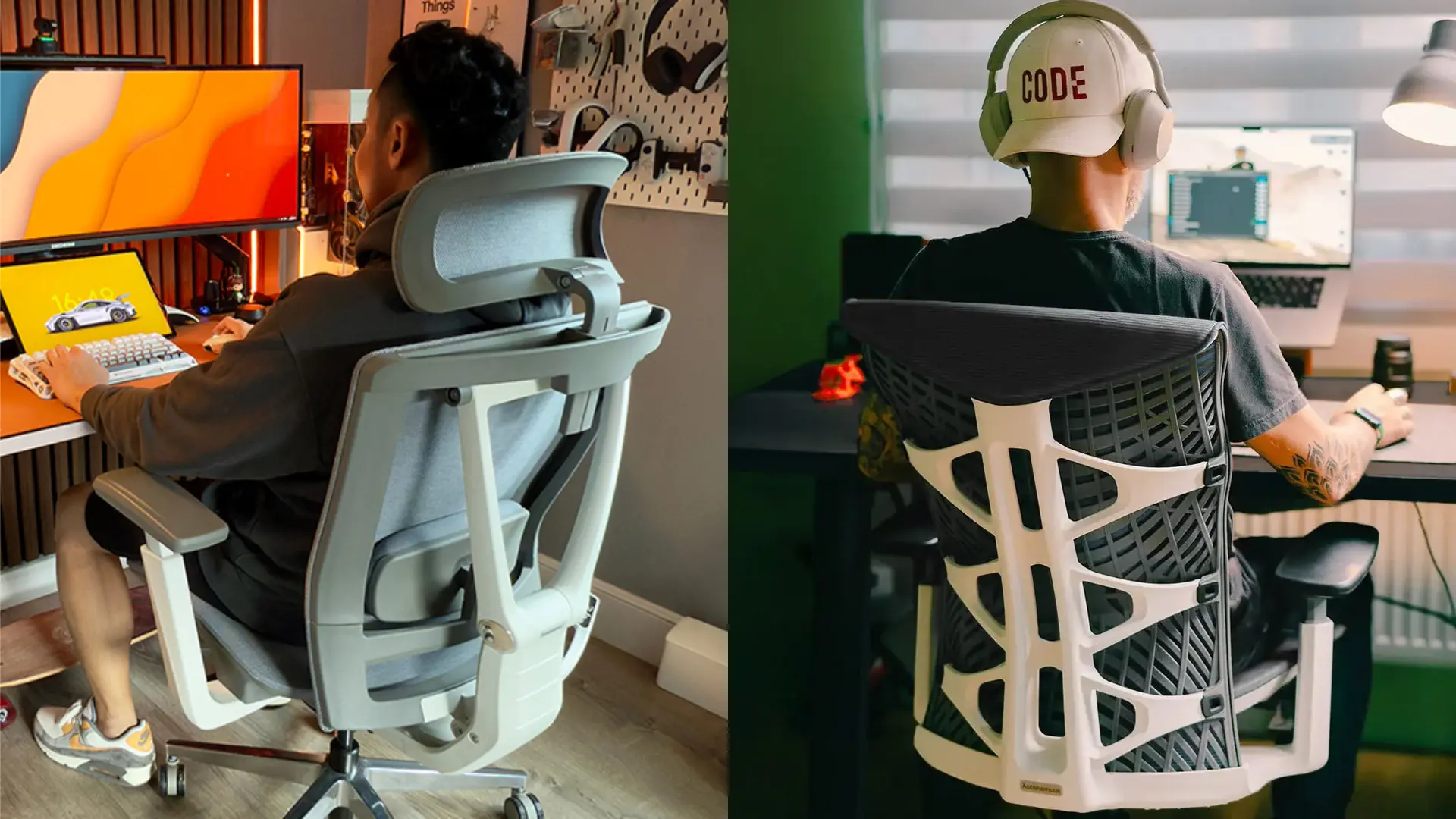
Specs:
- seat height 17.3-20.8"
- seat depth 15.7" (adjustable)
- 3D flip-up arms
- adjustable low lumbar
- 4D headrest
- built-in footrest
- reclines to 136 degrees
- 330 lb
- 3-year warranty
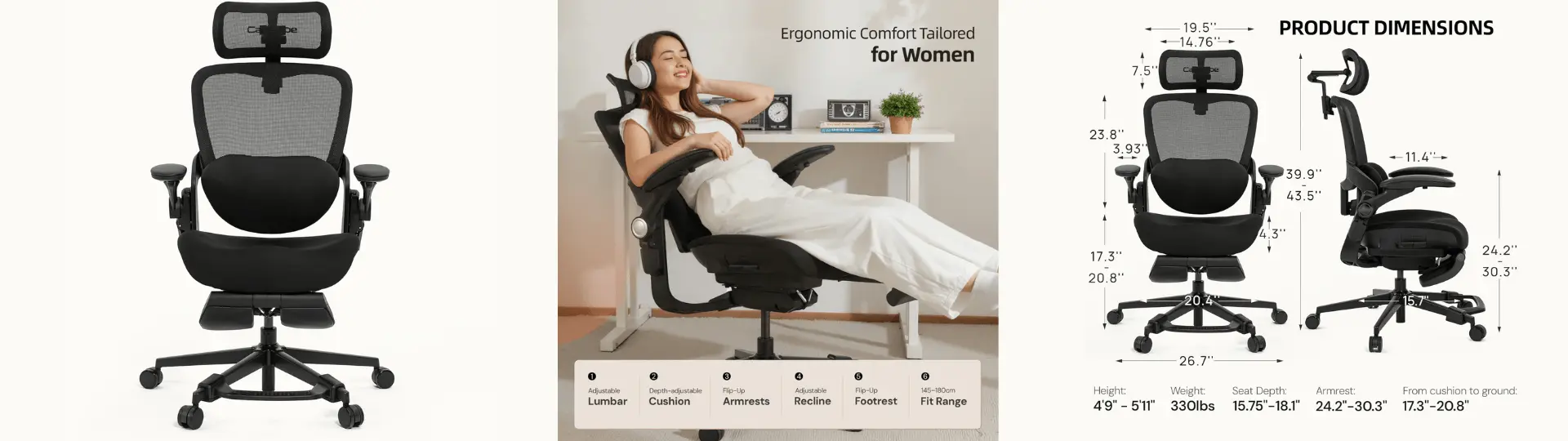
This is the most purpose-built-for-petite chair on the list, and you feel it right away. It is designed around a petite woman's frame, roughly 4'9" to 5'11", and it shows in the details. The lumbar sits low and adjusts to a short waist, so support lands on your lower back instead of your mid-back, and the seat depth shortens by more than two inches so the front edge clears your knees. Best of all, it has a footrest built into the chair, so you are not buying one separately or dragging one over, and it reclines to 136 degrees, far enough to actually lean back and rest, which most petite office chairs cannot do. The 4D headrest adjusts low enough for a shorter neck, and the cushioned seat is softer than the mesh chairs here.
The trade is real, though. The warranty is three years against the lifetime coverage on the Autonomous chairs, and it is a newer brand with a molded-plastic frame rather than a proven one. If out-of-the-box petite fit matters more than long-term durability, it is genuinely the closest fit here. If you want that fit to still be there in a decade, weigh the warranty.
Pros
- Built around a petite frame, 4'9" to 5'11"
- Low adjustable lumbar, plus seat depth that shortens over 2 inches
- Footrest built into the chair, and it reclines to 136 degrees
Cons
- 3-year warranty, the shortest coverage on this list
- Newer brand with a molded-plastic frame rather than a proven one
4. Sidiz T25 - Low seat, but nothing adjusts to your frame
Specs:
- seat height about 15.7-20.7"
- fixed seat depth
- fixed arms
- no lumbar support
- auto-fit tilt
- 275 lb
- up to 12-year warranty
The T25 is one of the few chairs here actually sized for a small body, built for people 4'9" and up, and it shows the moment you sit down. The seat goes low enough that my feet reached the floor without a footrest, and the weight-sensing auto-fit tilt sets its own recline tension, so there is no knob to hunt for. It is the simplest chair to just sit in, and at its price it is the most affordable office chair for a petite person on this list.
What you give up is adjustment. There is no lumbar to place, the arms do not move, and the seat depth is fixed, so if your back pain comes from lumbar position rather than seat height, this will not solve it. GREENGUARD certified and backed by up to a 12-year warranty, it is the pick when you want a genuinely small, simple, and affordable petite office chair, not something you fine-tune.
Pros
- Genuinely sized small, with the seat dropping to about 15.7 inches
- Weight-sensing auto-fit tilt, so there is no tension knob to set
- The most affordable pick here, backed by up to a 12-year warranty
Cons
- No lumbar support to position
- Fixed arms and a fixed seat depth, so very little adjusts to you
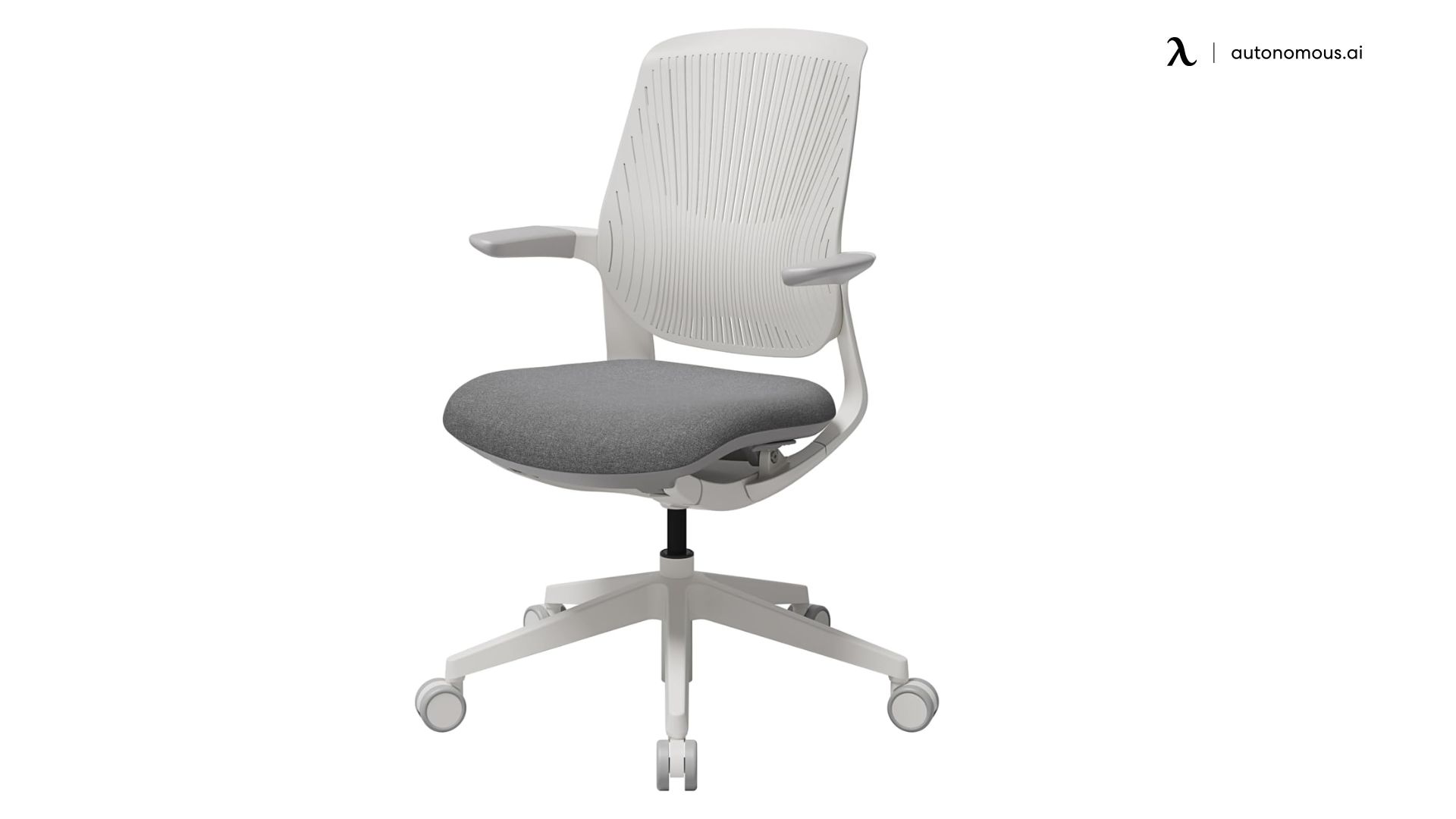
5. Herman Miller Aeron Size A - Lowest seat, but the fit doesn't adjust
Specs:
- seat height 14.75-19"
- fixed 16" seat depth
- arms 7-11.5"
- PostureFit SL lumbar
- 300 lb
- 12-year warranty
The Aeron Size A is the one chair here that genuinely goes low, 14.75 inches, so if you are a 5-foot person or close to it, it is the rare office chair you can sit in with feet flat and no footrest. The 8Z Pellicle mesh runs cool, the tilt is smooth, and the build is famously durable, backed by a 12-year warranty. But for a short frame it has two catches: the seat depth is fixed at 16 inches with no adjustment, so a shorter thigh cannot be dialed out of the backs of your knees, and it is by a wide margin the most expensive chair on this list. You are paying premium money for a low seat you can otherwise get from a footrest under a cheaper chair. It is worth it if the low seat and the strong resale value matter to you, and hard to justify if they do not.
Pros
- The lowest seat here at 14.75 inches, so feet reach the floor unaided
- 8Z Pellicle mesh runs cool, with a 12-year warranty
- Holds its resale value better than anything else on this list
Cons
- Seat depth is fixed at 16 inches with no adjustment
- By a wide margin the most expensive chair here
- No headrest offered at any price
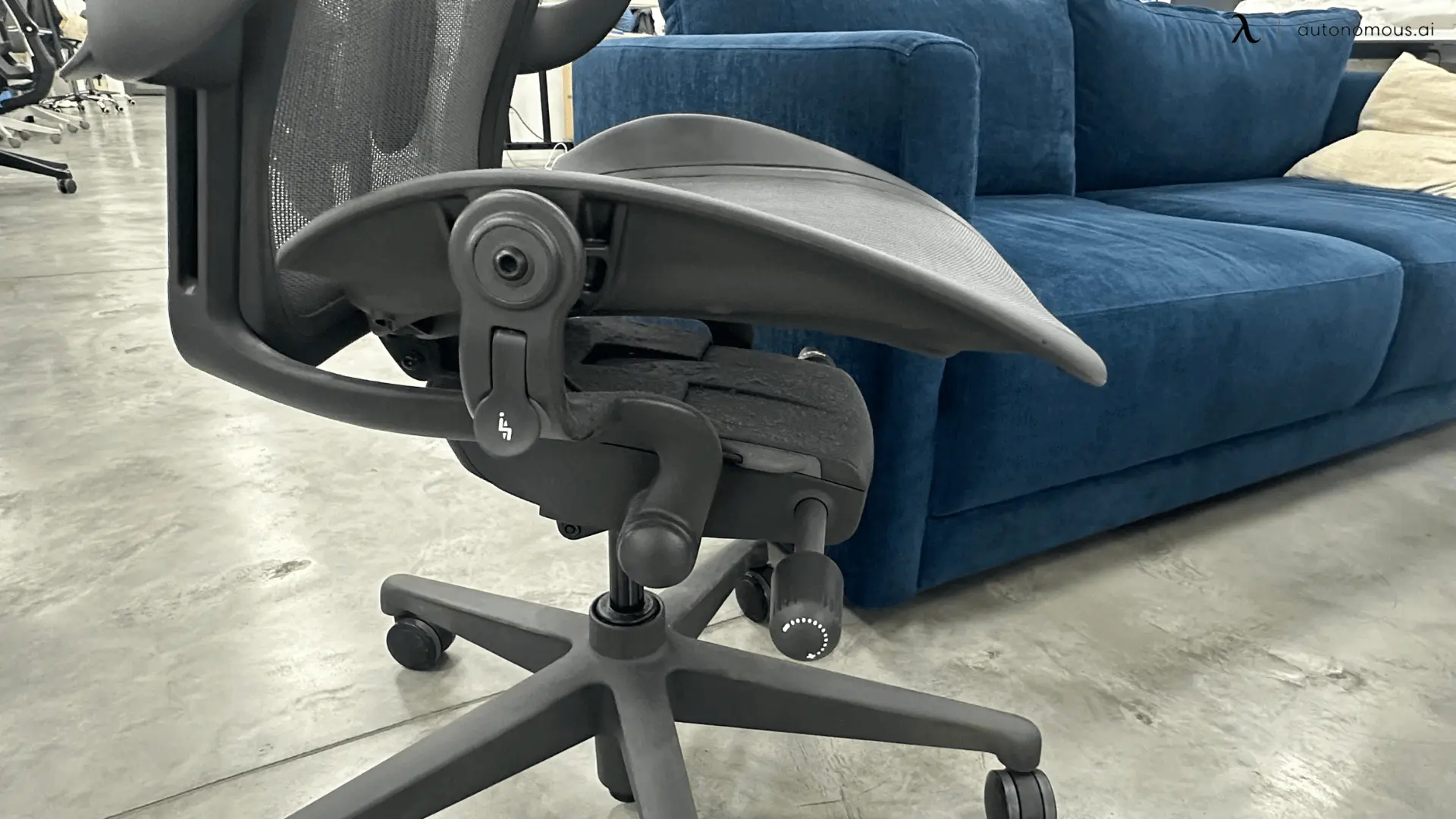
6. Steelcase Leap V2 - Adjustable, but restored, not new
Specs:
- seat height about 15.5-20.5"
- seat depth to ~15.7"
- arm width 12.75-20"
- adjustable lumbar
- 400 lb
- dealer warranty
A refurbished Steelcase Leap V2 is how you get serious adjustability without paying new-chair prices, which makes it one of the better-value ergonomic chairs for a short person here. Its lumbar support travels almost to the bottom of the backrest, which is exactly what a short torso needs to keep back pain from a mis-placed curve, and its arm-width range is among the widest made, so the arms pull in for narrow shoulders. It also adjusts seat depth and lumbar firmness, so you can size it to a small frame.
Refurbished units from reputable sellers run around $650, roughly half the price of new, with the same fit and a long dealer warranty. The catch is that it is restored rather than new, the four-way arms that matter most to short users are usually a paid upgrade, and you should confirm the exact minimum seat height with the seller, since some units sit closer to 16.75 inches than the 15.5 that gets quoted.
Pros
- Lumbar travels almost to the base of the backrest, ideal for a short torso
- Arm-width range among the widest made, so the pads pull in
- Roughly half the price of new, with the same fit
Cons
- Restored rather than new, so condition varies by seller
- The 4D arms short users need most are usually a paid upgrade
- Minimum seat height varies by unit, so confirm it before buying
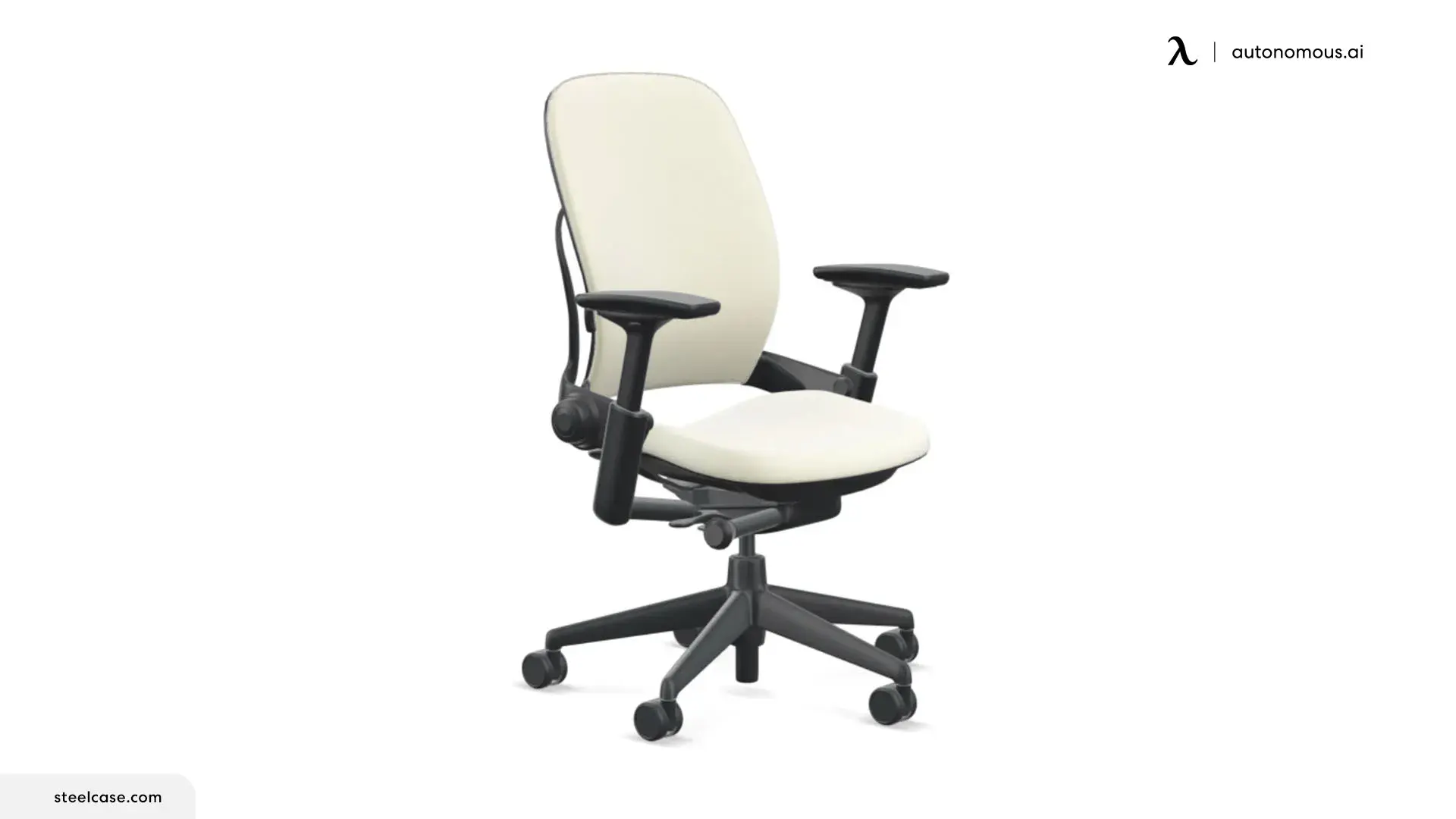
7. OM Paramount Petite - Narrow arms, but a basic build
Specs:
- seat height 15.5-20"
- seat depth to 16"
- arms from 13.25" wide
- basic lumbar
- 7-year warranty
If the thing that kills you is arms set too wide, the OM Paramount Petite is the chair. Its arms pull in to 13.25 inches, the narrowest here, and drop low, so a narrow-shouldered user can finally reach the pads without hiking up the shoulders. It is sized for a petite frame and adds seat-depth and forward-tilt adjustment, which makes it the most adjustable petite office chair under $600. For the money, little else here adjusts more.
The trade is that the build sits a notch below the premium chairs, the seat is firm, and the lumbar is basic rather than something you finely position on a short torso. It is the right call when narrow shoulders are your main problem and you want real adjustment without a premium price.
Pros
- Arms pull in to 13.25 inches and sit low, the narrowest here
- Adds seat-depth and forward-tilt adjustment
- The most adjustable petite chair under $600
Cons
- Build sits a notch below the premium chairs
- Firm seat, and a basic lumbar you cannot finely position

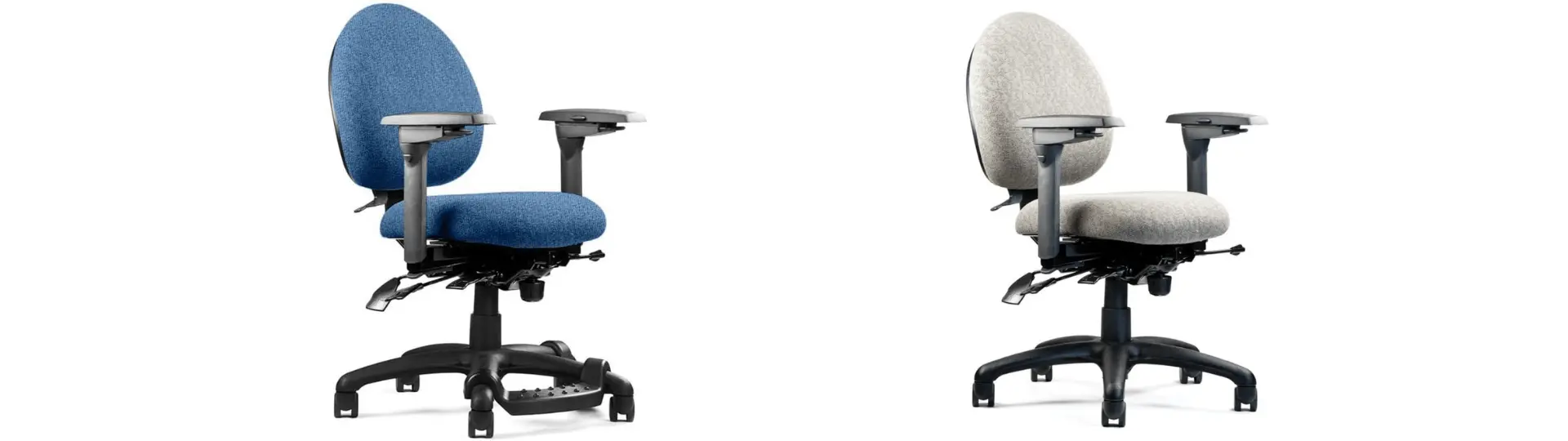
8. Neutral Posture XSM - Cushioned, but pricey with a learning curve
Specs:
- extra-small 17" x 17" seat
- seat height about 15.75-20.75"
- seat depth 15.5-18" (adjustable)
- arm height from 7"
- arm width from ~13.5"
- 4" cushioned seat
- optional headrest
- 10-year warranty
Every other chair here is firm, so if you would rather sink in than sit on taut mesh, the Neutral Posture XSM is the one. It is Neutral Posture's extra-small line, with a 17-inch-square seat and a genuinely soft, generously cushioned foam seat, and it is the most adjustable chair on this list: independent back angle, seat tension, forward tilt-stop, seat-depth and back-height adjustment, and an independent inflatable lumbar you can dial in to a short torso. On the models that carry one, the optional headrest sits lower for a shorter neck than a standard headrest perched too high, though it is not offered on the mid-back version. It ships fully assembled and is made in the USA.
The catch is that all that adjustment comes with a learning curve, so most people take a couple of weeks to dial it in, it is premium-priced, and there is no refurbished version to bring the cost down. If cushion and a headrest that actually fits are your priorities and you will put in the setup time, this petite office chair earns its place.
Pros
- Genuinely soft cushioned seat on a 17-inch-square petite pan
- The most adjustable chair here, including an inflatable lumbar
- Ships fully assembled, with a 10-year warranty
Cons
- Premium-priced, with no refurbished route to a lower cost
- Takes most people a couple of weeks to dial in
- The headrest is optional and not offered on the mid-back model
9. Clatina Executive Chair - Cheap, but built for the wrong body
Specs:
- low but deep fixed seat
- forward-set fixed-width arms
- fixed lumbar
- 400 lb capacity
The Clatina Executive is inexpensive and the seat drops low enough to keep most feet down, but it is a general-purpose chair proportioned for a larger body, and it shows the moment a small frame sits in it. Its 400 lb rating is the tell.
The seat is the real problem: it is deep enough that when I keep my feet flat on the floor, my back comes off the backrest, and you get foot support or lumbar contact, not both. Owners bear this out: one 5'7" buyer said their feet were "barely flat on the floor," and another noted that with feet down, their back "is not flush against the backrest." The armrests sit far forward and close together with no backward adjustment, so a narrow-shouldered user cannot pull them into a supportive position, and a 6'2" owner even added spacers to widen them. The low price is real, and so is the fact that almost nothing about the geometry is tuned for a small user. You can sit in it. It will not fit you.
Pros
- The cheapest chair on this list
- The seat drops low enough to keep most feet on the floor
Cons
- A deep fixed seat forces a choice between feet flat and lumbar contact
- Fixed-width arms sit far forward with no backward adjustment
- Geometry proportioned for a larger body, as the 400 lb rating suggests
How to choose
Two numbers tell you whether a chair is really petite: its minimum seat height and whether the seat depth adjusts. If it starts around 17 to 18 inches with a fixed depth, it is a standard chair no matter what the listing says. From there, choose by the thing you most need to get right.
Your main issue | The chair to choose |
Lower-back pain | ErgoChair Pro, or CabLady S2 |
Narrow shoulders | ErgoChair Ultra 2, or OM Paramount Petite |
Feet flat, no footrest | Herman Miller Aeron Size A, or Sidiz T25 |
Most adjustment for the money | Steelcase Leap V2, refurbished |
Cushion over firm mesh | Neutral Posture XSM |
A chair that lasts | ErgoChair Pro, or ErgoChair Ultra 2 |
Lowest price | Sidiz T25 |
Then set it up for your body, because the right chair at the wrong height still leaves you sore:
- Drop the seat as low as it goes, and if your feet do not sit flat, add a footrest rather than perching on the front edge of the seat.
- Shorten the seat depth until the front edge clears the backs of your knees by an inch or two.
- Check the desk. A short seat usually means a standard 30-inch desk is too tall, so lower it or add a keyboard tray to keep your forearms level.
.webp)
FAQs
What is the best office chair for a short person?
The best office chair for a short person combines a low or footrest-supported seat with adjustable lumbar, seat depth, and arm position so the chair fits a small frame instead of forcing you into it. Full adjustability and durable support matter more than seat height alone.
What is the chair height for a 5 ft person?
For someone 5 feet tall, a seat height of 14 to 16 inches keeps feet flat and knees at a natural angle. Chairs that start higher can still work with a footrest.
What is a good seat height for short people?
A good seat height for short people is generally 15 to 17 inches. If a chair starts slightly higher but offers better support and adjustability, a footrest closes the gap.
What is the best seat depth for petite people?
The best seat depth for petite people is 14 to 16 inches, so the seat front sits one to two inches from the back of the knees without pressing into them.
What seat height is best for 5'2"?
For a 5'2" person, a seat height of 15 to 17 inches gives proper alignment. A footrest lets you use chairs that bottom out a little higher.
What is a petite chair?
A petite chair is built for users under about 5'4", with a lower seat, shallower depth, and a smaller frame proportioned for shorter bodies.
What is the best office chair for back pain for a short person?
For a short person with back pain, the best chair has adjustable lumbar support that reaches the lower spine, plus seat height and depth adjustment. A fixed lumbar set for a taller user is the most common cause of mid-back pain in short people.
Which ergonomic office chair with lumbar support is best for short people?
The best options offer adjustable lumbar support that aligns with your natural spine curve. Chairs with adaptive or full-back support - rather than a single fixed bump - fit a short torso best.
What is the best office chair with a 14-inch seat height for short people?
A 14-inch seat height suits users under 5'2" who want feet flat without a footrest. Confirm the chair also adjusts in seat depth and lumbar, since a low seat alone doesn't guarantee a good fit.
What is the best office chair for a 5-foot person?
For a 5-foot person, look for a 14 to 16 inch seat height and shallow seat depth, or a chair that adjusts well paired with a footrest.
.webp)
Bottom line
If you are short and sore at your desk, you are not too picky and your body is not the problem, the chair is. Ignore the "petite" label and read two numbers, seat height and seat-depth adjustment, then pick by what you most need to fix: a lumbar you can place low, arms that pull in, or the lowest seat if you are closest to 5'0". The purpose-built petite chairs fit small bodies out of the box; the Autonomous chairs adjust to your frame with a footrest and are backed for life. Add a footrest, lower your desk, and the day-end ache usually goes with it.
References
- Occupational Safety and Health Administration (OSHA). Computer Workstations eTool: Chair. https://www.osha.gov/etools/computer-workstations/components/chairs
- Cornell University Ergonomics Web. Office Ergonomics Guidelines. https://ergo.human.cornell.edu/
- OSHA. Computer Workstations eTool: Good Working Positions. https://www.osha.gov/etools/computer-workstations/positions