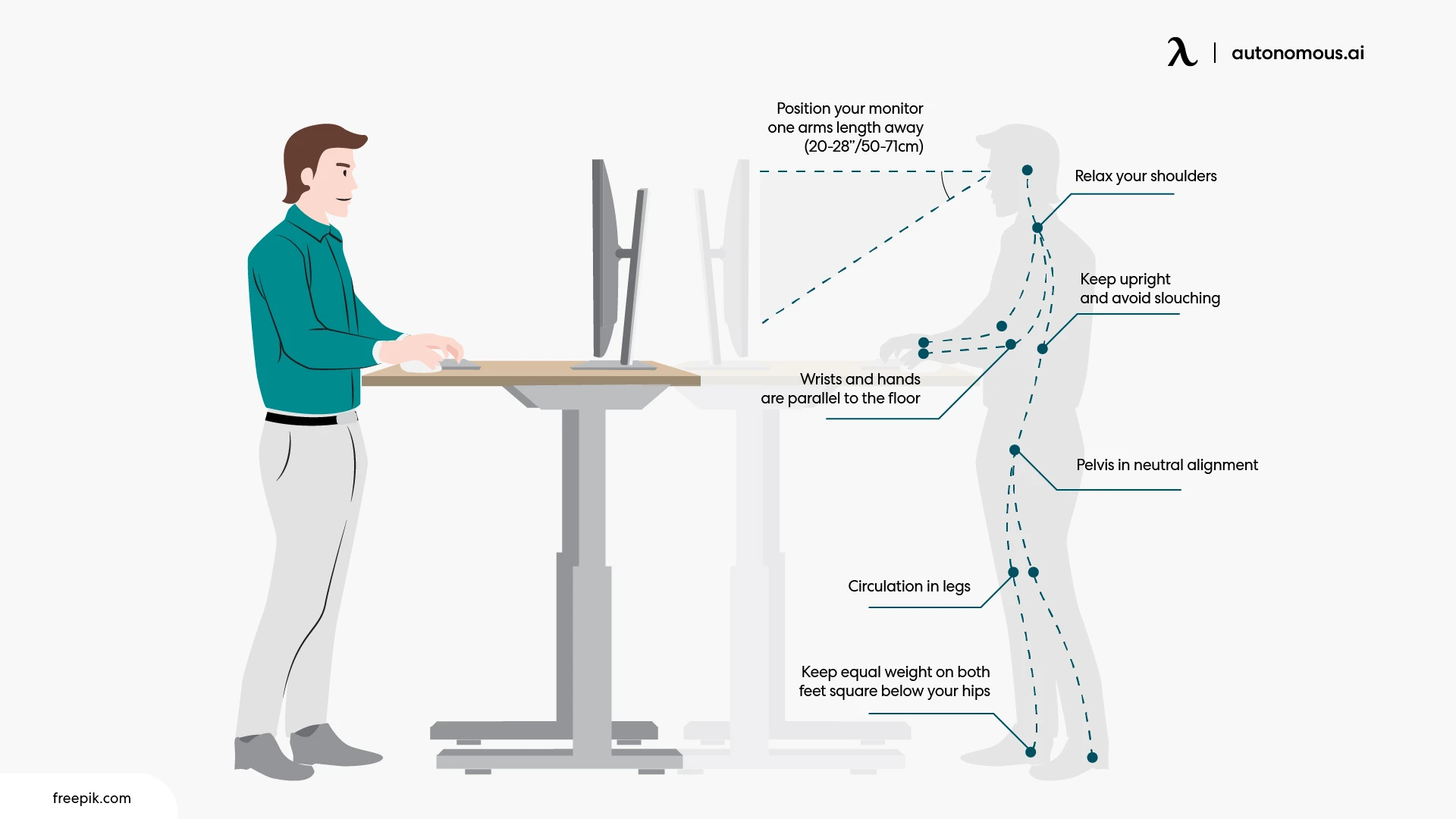
Standard Desk Height (29-30 in) and a Chart by Your Height
The standard desk height is 29 to 30 inches, and it fits almost nobody. That number was set around a person roughly six feet tall, so at 5'9" or shorter a standard desk pushes your shoulders up and bends your wrists for the whole workday.
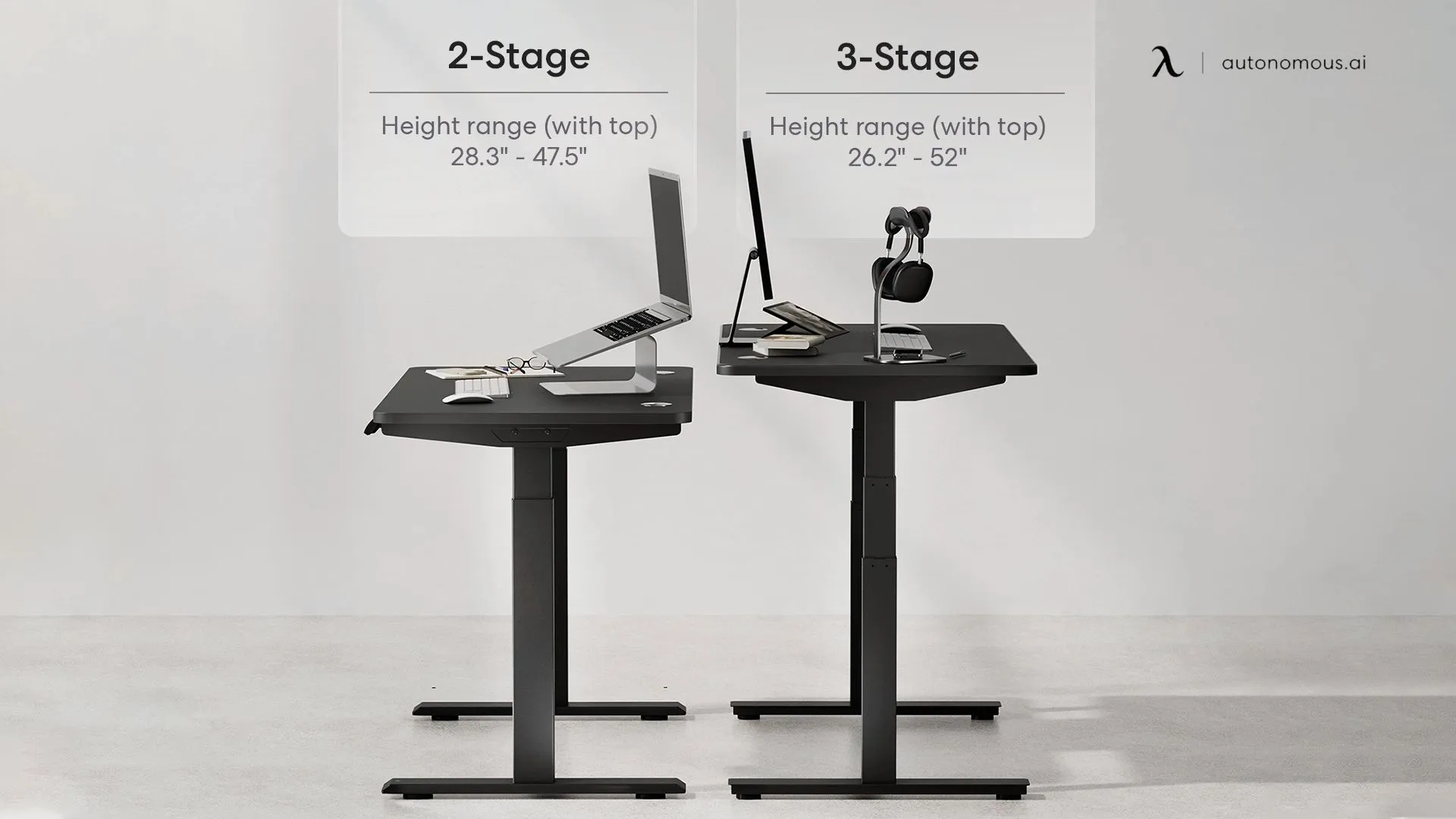
Your fix is a keyboard tray, a taller chair with a footrest, or a desk that drops low enough. Most standing desks do not drop low enough. Our own Desk Core stops at 29.4 inches with the top on and the Desk Pro at 29.5 inches, so neither goes below the standard height. The chart below gives you the sitting and standing number for your height, and the clearance figures that matter more than the surface height does.
Where the standard desk height comes from
No standard sets one correct desk height: 29 to 30 inches (74 to 76 cm) is a furniture convention for fixed desks, while ergonomic guidelines give ranges instead. The figures people quote come from different sources that measure different things.
| Source | What it covers | Figure |
|---|---|---|
| Furniture industry convention | Fixed office or computer desk, floor to top | 29 to 30 in (74 to 76 cm) |
| Cornell CUergo guidelines | Writing surface for most adults | 28 to 30 in |
| UBC purchasing guideline (in keeping with BIFMA G1-2013 and CSA Z412-17) | Recommended adjustable desk range for users 5'0" to 6'4" | 22.6 in or lower to 48.7 in or higher |
| UBC guideline | Fallback minimum low end; footrests for users under 5'5" | 25 in |
| OSHA Computer Workstations eTool | Open leg clearance under the desktop | 20 to 28 in (50 to 72 cm) |
Two things follow from that table. First, the sitting standard and the standing standard are not the same kind of number: the 29 to 30 inch figure describes a fixed sitting desk, and there is no fixed standing desk height at all, only the top of an adjustable range.
Second, UBC's guideline recommends adjustable desks that go down to 22.6 inches or lower and up to 48.7 inches or higher, a range it says fits the 5th to 95th percentile of adults, about 5'0" to 6'4", in keeping with BIFMA G1-2013 and CSA Z412-17. The same guideline tells buyers to avoid adjustable desks that do not go below 29 inches, since that is above seated elbow height for nearly all users.
The ANSI/BIFMA X5.5 desk standard you see on spec sheets tests strength, stability and durability. It does not prescribe a height, so a desk can be BIFMA certified and still sit too high for you.
Sitting and standing desk height by your height: the chart
The standard desk height is 29 to 30 inches, but your correct desk height is your elbow height, which for most adults is about 24 to 30 inches sitting and 38 to 46 inches standing. The chart gives both numbers for each height, plus the chair seat height that goes with the sitting figure.
| Your height (with shoes) | Sitting desk height | Chair seat height | Standing desk height | Standing range to test |
| 5'0" (60") | 25.0" | 16.0" | 37.4" | 36.4" to 38.4" |
| 5'2" (62") | 25.5" | 16.5" | 38.4" | 37.4" to 39.4" |
| 5'4" (64") | 26.0" | 17.0" | 39.4" | 38.4" to 40.4" |
| 5'6" (66") | 26.5" | 17.5" | 40.4" | 39.4" to 41.4" |
| 5'8" (68") | 27.1" | 18.1" | 41.4" | 40.4" to 42.4" |
| 5'10" (70") | 27.6" | 18.6" | 42.4" | 41.4" to 43.4" |
| 6'0" (72") | 28.1" | 19.1" | 43.4" | 42.4" to 44.4" |
| 6'2" (74") | 28.7" | 19.7" | 44.4" | 43.4" to 45.4" |
| 6'4" (76") | 29.2" | 20.2" | 45.4" | 44.4" to 46.4" |
Read across a row and the pattern is clear: only the 6'4" row has a sitting desk height inside the 29 to 30 inch standard. If you fall between two rows, start at the lower number. It is easier to add height with a keyboard tray or monitor riser than to subtract it.
Three checks to apply on top of the chart:
- Heels or thick soles: add the heel height to your standing height before reading the chart.
- Mechanical keyboard or wrist rest: subtract 0.5 to 1 inch from the desk height to compensate for the extra stack under your hands.
- Leg clearance when sitting: keep 20 to 28 inches of open height under the desktop, the range OSHA gives for seated work. A drawer or tray that eats into that space cancels the benefit of a lower surface.
How to measure your desk height
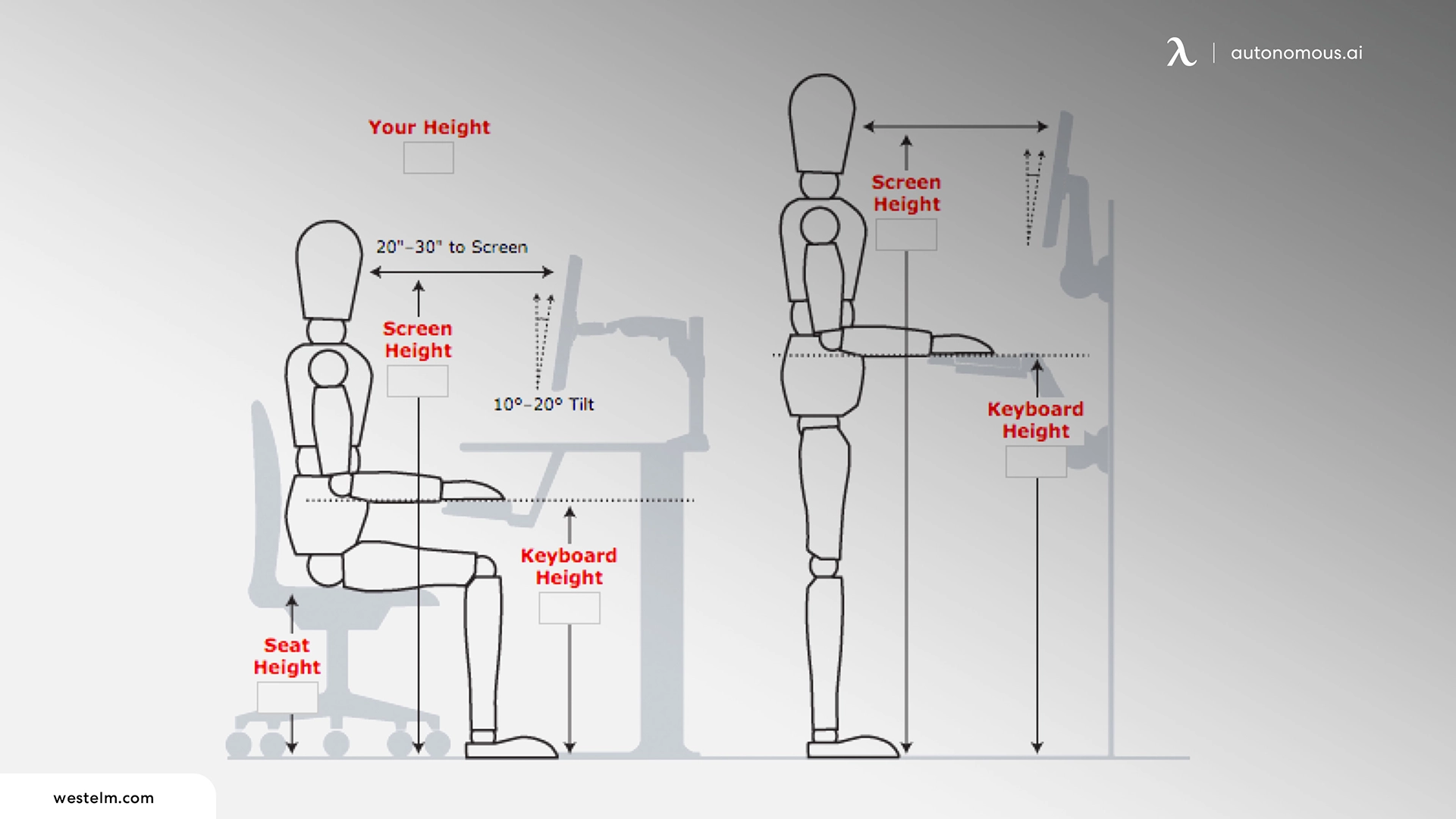
Measure from the floor to the top of the desktop at the front edge, then compare that number with your elbow height in the position you work in. The gap between the two tells you what to change.
- Measure the desk. Run a tape from the floor to the top surface at the edge where your forearms rest, not at the back or on a riser.
- Measure your sitting elbow height. Sit with your feet flat, thighs roughly level and shoulders relaxed, let your elbows bend to about 90 degrees, and have someone measure from the floor to the underside of your forearm.
- Measure your standing elbow height. Repeat in the shoes you wear at work, standing straight with your arms in the same position.
- Compare. A desk within about half an inch of your elbow height fits. If the desk is higher, raise the chair and add a footrest or fit a keyboard tray. If it is lower, add a riser for the keyboard and mouse.
For an adjustable desk, check the height display against your tape once. Some controllers read the frame height without the desktop, which can put the display off by the thickness of the top.
What to look for in an adjustable standing desk
An adjustable desk solves the height problem only if the adjustment range covers your full sit-stand window. Check three specs before buying.
Height range. The desk should reach at least 2 inches below your sitting elbow height at the low end and at least 2 inches above your standing elbow height at the high end. UBC's guideline asks for a range from 22.6 inches or lower to 48.7 inches or higher to cover users from 5'0" to 6'4"; if you are near either end of that height span, check the desk against it, not against the average.
Memory presets. Manual adjustment every transition kills the sit-stand habit. Memory presets save your sitting and standing positions so the desk hits the right height in one press.
Stability at full extension. Many desks rate stable up to 40 inches but wobble above 44. If you are over 6 feet, test the stability at your actual standing height, not at mid-range.
Among Autonomous standing desks, the Desk Pro AI has the widest range: it travels from 24.25 to 53.5 inches, floor to worksurface. That low end reaches the sitting height of most adults from about 5'5" up and meets UBC's 25-inch fallback, but not the preferred 22.6-inch low end, so shorter users should add a footrest.
The standard Desk Pro (29.5 to 48.5 inches) and the Desk Core (29.4 to 47.5 inches) reach standing height for most people but start above the seated elbow height of most people under six feet, the kind of low end UBC tells buyers to avoid for seated work, so plan on a keyboard tray for sitting work.
If you want the math worked out for your exact height, the desk height calculator returns the number directly.
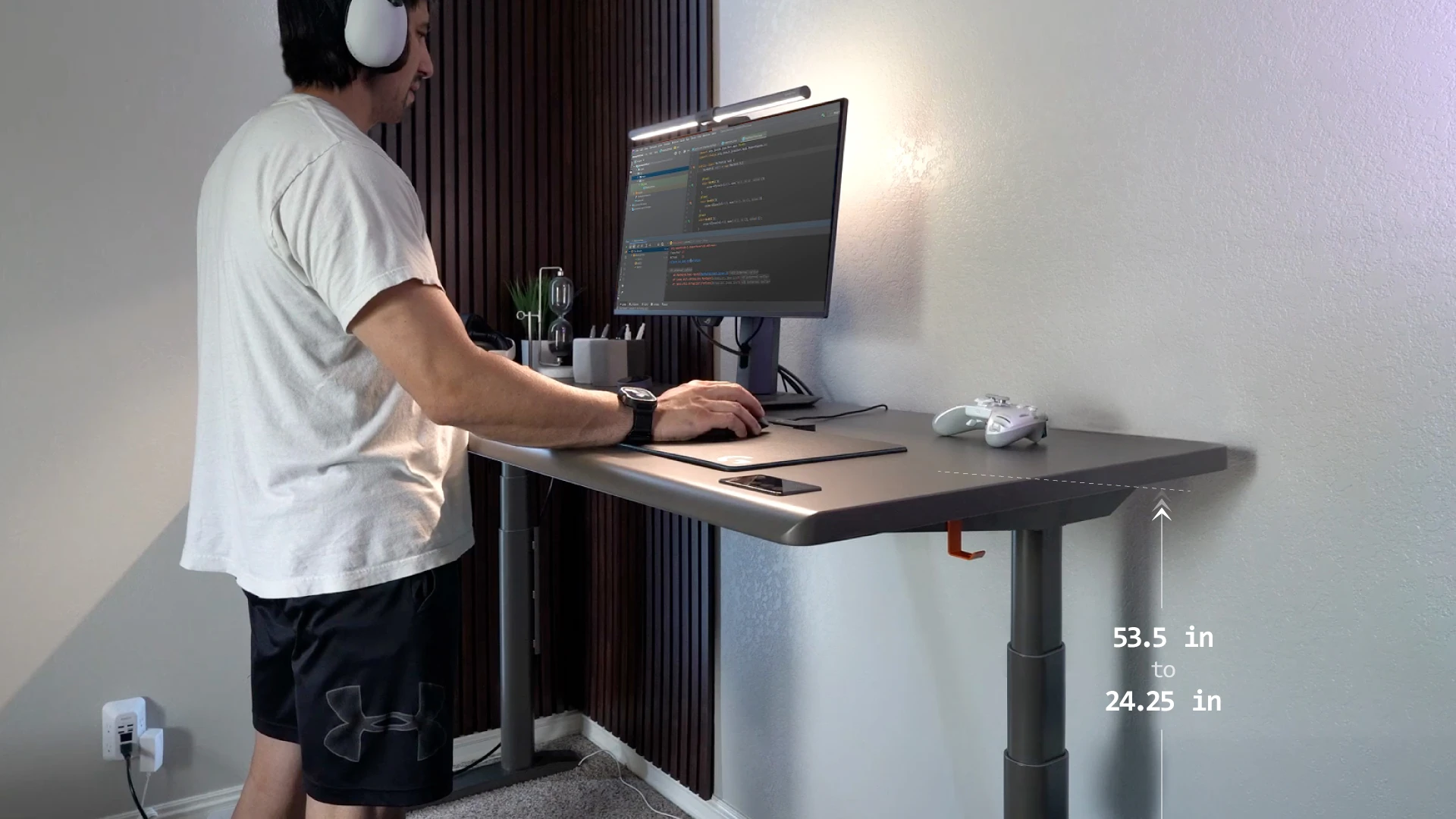
For stability, ask for a measured number instead of the word "stable." TÜV Rheinland measured the Desk Pro's worst-case oscillation at 0.2344 inches (report VN26FTMK 001), a figure you can compare against any other desk that publishes one.
FAQs
What is the standard desk height?
The standard desk height is 29 to 30 inches (74 to 76 cm) from the floor to the desktop. It is a manufacturing convention rather than an ergonomic recommendation, and it suits people around six feet tall. Most adults need a lower surface or a keyboard tray to keep their forearms level.
What is the standard height for a computer desk?
Computer desks use the same 29 to 30 inch standard as writing desks, even though typing needs a lower surface than writing does. That mismatch is why keyboard trays exist. Set your keyboard surface to your seated elbow height and let the desktop sit above it.
How tall is an average desk?
An average desk is 29 to 30 inches tall, measured from the floor to the top of the work surface. Cornell's CUergo guidelines put a writing surface at 28 to 30 inches for most adults, while a keyboard surface usually needs to sit lower than that.
Is there an official desk height standard?
No official standard fixes a single desk height. Ergonomic guidance works with adjustable ranges: UBC recommends desks that go from 22.6 inches or lower to 48.7 inches or higher for users 5'0" to 6'4", in keeping with BIFMA G1-2013. The ANSI/BIFMA X5.5 desk standard covers strength and stability, not height.
How high should a standing desk be?
A standing desk should place the worksurface at your standing elbow height, which is roughly 40.4 to 43.4 inches for adults between 5'6" and 6'0". Your elbows should rest near 90 degrees with relaxed shoulders. Raise your monitor separately so the top of the screen sits at eye level.
How high should a standing desk be for a 5'10" person?
A 5'10" person should set the standing desk to 42.4 inches, with a working range of 41.4 to 43.4 inches. Add height if wearing shoes with a thicker sole, and subtract half an inch if using a thick mechanical keyboard.
How high should a standing desk be for a 6 foot person?
A 6'0" person should set the standing desk to 43.4 inches, with a working range of 42.4 to 44.4 inches. The number assumes work shoes on and a standard low-profile keyboard.
Is 29 inches too tall for a desk?
For most people, yes. A 29-inch surface fits someone around 6'0", so anyone shorter ends up shrugging their shoulders or angling their wrists upward. Either lower the work surface, raise your chair and add a footrest, or fit a keyboard tray below the desktop.
Is it better to have a standing desk too high or too low?
Slightly too low is the safer error. A desk set too high forces shoulder elevation and causes trapezius and neck strain within hours. A desk slightly too low can be raised with a keyboard tray or by stacking a thin riser, but a too-high desk has no easy fix without lowering the whole surface.
What desk height do I need for my height?
Measure your seated elbow height with your feet flat and your back supported, then match the desktop to that number. The chart above lists sitting and standing figures for heights from 5'0" to 6'4". Test a range of roughly an inch either side before settling.
How does monitor height affect standing desk height?
Monitor height is set independently of desk height. The desktop surface should match your typing posture, and a monitor arm or riser brings the screen up so the top sits at or slightly below eye level. Lowering the desk to fix a low monitor causes wrist and shoulder problems.
Do I need a different desk height for sitting versus standing?
Yes. Most adults need about 24 to 30 inches when sitting and 38 to 46 inches when standing. An adjustable desk handles both. A fixed-height desk forces a compromise that suits neither position.
Conclusion
The standard desk height of 29 to 30 inches is a manufacturing habit, not a fit, and ergonomic guidance works in ranges instead: UBC recommends adjustable desks that reach 22.6 inches or lower and 48.7 inches or higher for adults from 5'0" to 6'4".
Set the work surface to your elbow height, about 24 to 30 inches sitting and 38 to 46 inches standing, keep 20 to 28 inches of leg clearance under the top, and raise the monitor on its own. If your desk cannot reach those numbers, close the gap with a keyboard tray or footrest, or choose an adjustable desk whose low end sits below your seated elbow height.