9 Parts of an Office Chair - When to Replace

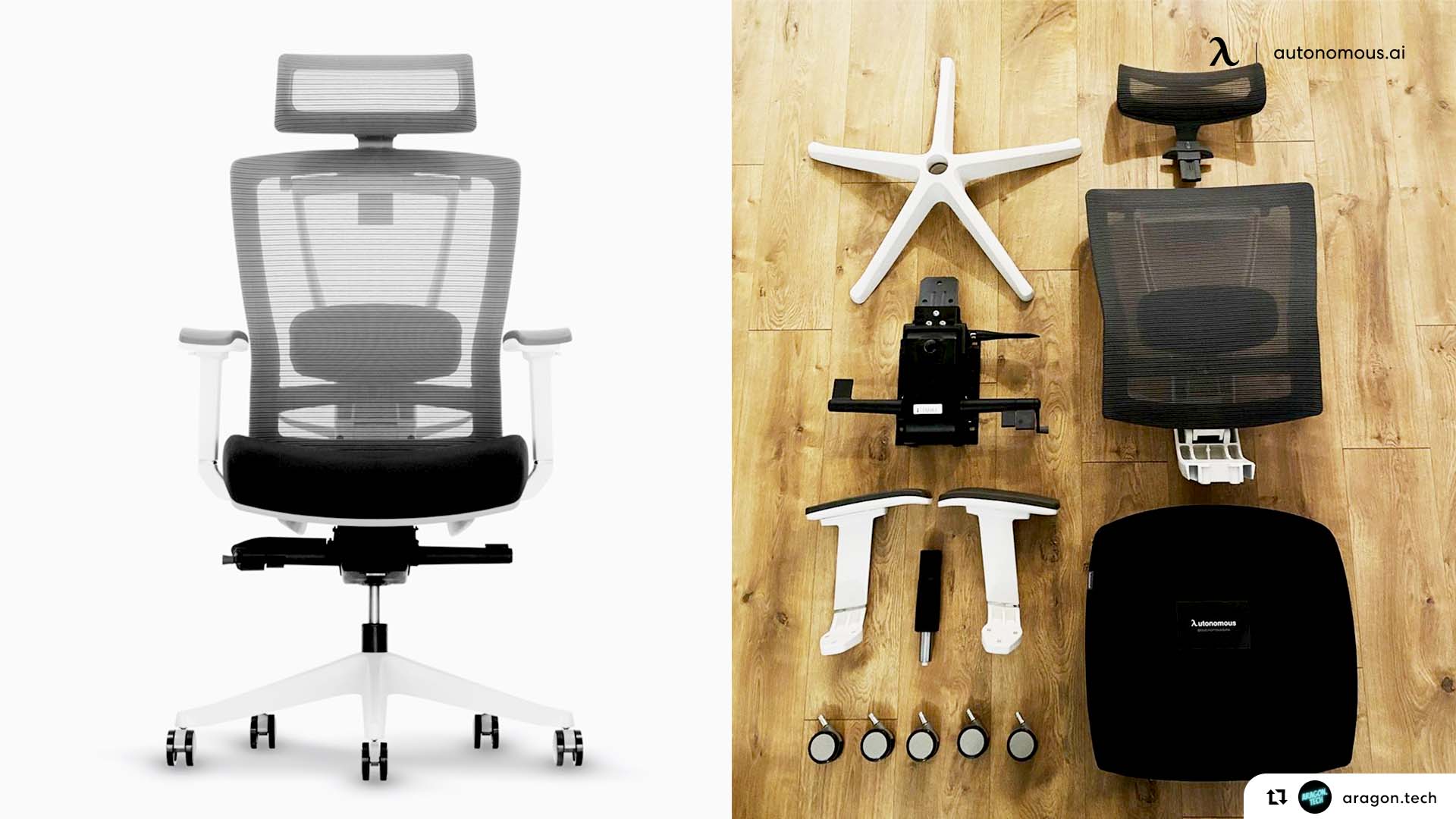
Every office chair runs on the same nine parts. Identify which one failed, and most repairs become a $30–$80 fix instead of a $500 replacement. This guide breaks down each component by role, common failure mode, and replacement path - whether you're maintaining a chair you already own or evaluating whether a chair on the market is worth buying.
The nine parts of an office chair
Part | Role | Common failure |
Base | The five-star foundation that holds the casters and connects to the gas lift | Cracks, wobble |
Casters (wheels) | Five wheels that allow the chair to roll | Hair clogs, broken stems, scratched floors |
Gas lift cylinder | Hydraulic column that adjusts seat height | Chair sinks under weight |
Seat pan | The platform under the cushion | Cracks (rare), worn padding above |
Tilt mechanism | Controls recline, lock, and tension | Locks fail, tension stops adjusting |
Backrest | The frame and surface that supports your back | Loose hinge, sagging mesh |
Lumbar support | Lower-back support, fixed or adjustable | Pad slides out of position, broken adjustment |
Armrests | Forearm support, fixed or 3D/4D adjustable | Loose mounting, worn padding |
Headrest | Optional support for head and neck | Loose stem, broken angle adjustment |
Two parts decide how a chair feels: the tilt mechanism and the lumbar support. Two parts decide how it lasts: the gas lift cylinder and the base. Everything else is replaceable in under 30 minutes with a basic tool kit.
1. Base
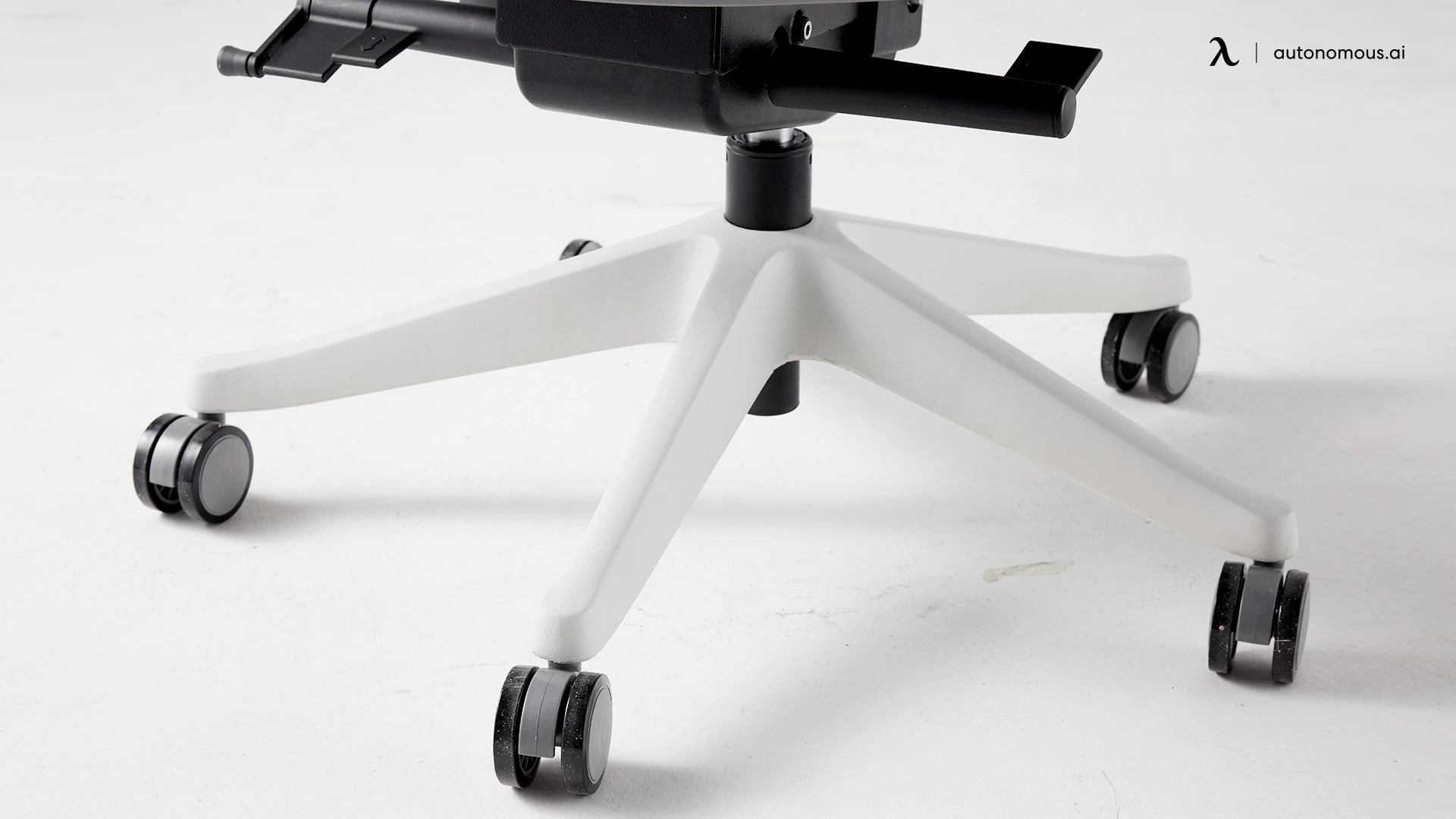
The base is the five-star structure that holds the casters and connects to the gas lift cylinder. It distributes your weight evenly across the floor and prevents the chair from tipping during recline. Most office chair bases are made of nylon-reinforced plastic, aluminum, or steel.
Material differences matter. Plastic bases work for users under 200 lb in light-duty use. Aluminum and steel bases are rated for heavier users and longer service life - aluminum runs lighter, steel is the most durable.
Replace when: the base develops visible cracks, the chair wobbles even on a flat floor, or a caster socket has split.
Replacement cost: $40–$120 depending on material and size.
2. Casters (wheels)
Casters are the five wheels at the base of the chair. They come in two types: hard casters for carpeted floors (better traction), soft casters for hard floors (won't scratch). Most chairs ship with hard casters by default; soft replacements are the most common upgrade.
Replace when: wheels squeak after cleaning, hair-clogged casters won't roll smoothly even after un-clogging, or one caster has broken at the stem.
Replacement cost: $20–$40 for a set of five. Standard stem size is 11mm × 22mm - verify before ordering.
3. Gas lift cylinder
The gas lift cylinder is the hydraulic column between the base and the seat pan. It uses a sealed gas spring to adjust seat height. This is the single most common failure point in an office chair after year five.
Replace when: the chair sinks under your weight within 5 minutes of sitting, the height lever no longer responds, or the cylinder makes hissing or grinding sounds when you adjust it. A sinking chair almost always means a worn cylinder - it's not a base or mechanism problem.
Replacement cost: $25–$60. Most cylinders are universal Class 3 or Class 4 - confirm the rating against your chair's weight capacity before ordering. Replacement takes 15 minutes with a rubber mallet.
4. Seat pan
The seat pan is the platform under the cushion that connects the seat to the tilt mechanism. It rarely fails directly - what fails is the padding above it. The pan itself is structural plastic, plywood, or a composite, and is replaceable but expensive enough that most users replace the whole chair instead.
Replace when: the pan has cracked or the bolt mounts have stripped. Worn cushion padding is a separate, cheaper fix.
Replacement cost: typically not sold as a standalone part. If the seat pan has failed, source the part through the chair's manufacturer or replace the chair.
5. Tilt mechanism
The tilt mechanism sits under the seat pan and controls every adjustment the chair makes - height, recline, recline lock, and tension. It's the most engineered part of the chair and the most expensive to replace.
The four mechanism types worth knowing:
- Knee tilt: the pivot point sits at the front of the seat. Feet stay grounded as you recline.
- Center tilt: the pivot is at the center of the seat. Your feet lift as you recline.
- Synchro-tilt: the seat and back tilt at different ratios (typically 2:1). The most ergonomic option - your spine stays supported through the recline.
- Forward tilt: tips the seat forward 5–10° for typing-intensive work. Found on higher-end chairs only.
Replace when: the recline lock fails, tension adjustment stops working, or the mechanism makes grinding sounds during height changes.
Replacement cost: $60–$150 if available from the manufacturer; often pushes users to replace the whole chair.
6. Backrest
The backrest is the frame and surface - mesh, fabric, or padded - that supports your back. The frame is structural; the surface wears over time. Mesh tension degrades over 3–5 years on heavy use, fabric stretches and stains, padded backrests develop permanent compression dents.
Replace when: the hinge is loose and can't be tightened, the mesh has visible sag or holes, or the padding is permanently compressed.
Replacement cost: $50–$150 depending on chair model. Hinge tightening is free.
7. Lumbar support
Lumbar support is built into the backrest at the lower section. Quality varies more here than on any other part. Three implementations:
- Fixed lumbar curve: the backrest is shaped with a built-in lumbar curve. No adjustment.
- Adjustable lumbar pad: a separate pad slides up and down the backrest to position the support.
- Adaptive lumbar: the backrest flexes across multiple zones, tracking the spine as you shift posture.
Replace when: the adjustment mechanism breaks, the pad falls off, or the support no longer reaches your lower back. For chairs with fixed lumbar, the only "replacement" is an external lumbar cushion ($25–$50).
8. Armrests
Armrests support your forearms and reduce shoulder load. The complexity range is wide:
- Fixed armrests: stationary, no adjustment.
- Height-adjustable: up-down only.
- 3D armrests: height, width, and forward/back.
- 4D armrests: all three axes plus pad rotation.
Replace when: the mounting bolt won't hold the arm in place, the padding is worn through, or an adjustment axis stops working.
Replacement cost: $30–$80 per pair, depending on adjustment axes. Verify the bolt pattern matches your seat pan before ordering.
9. Headrest
The headrest supports the head and cervical spine during recline. Most office chairs sell the headrest as an add-on rather than including it standard - including premium chairs like the Herman Miller Aeron, which doesn't offer one at any price.
Replace when: the stem has cracked, the angle adjustment won't hold, or the cushion has worn through.
Replacement cost: $40–$120 from the manufacturer. Universal aftermarket headrests rarely fit cleanly - match to your chair model.
When to replace a part vs replace the chair
Most failures fall into one of two categories: cheap fixes that extend the chair's life by years, or expensive fixes that don't. The decision:
Failure | Fix or replace chair |
Sinking chair (gas cylinder) | Fix - $25–$60 |
Squeaky or stuck casters | Fix - $20–$40 |
Loose armrest or worn pad | Fix - $30–$80 |
Wobbly base | Fix if part is in stock - $40–$120 |
Tilt mechanism failure | Replace chair if part runs over 40% of chair price |
Cracked seat pan | Replace chair |
Multiple failures within 6 months | Replace chair |
A chair under 5 years old with one failed part is almost always worth fixing. A chair past 8 years old with two or more failures has reached the end of its useful life - the next part will fail within 12 months.
When the chair has reached the end of its life
If your chair is past the warranty period and the third part has failed, replacement is the better economics. The Autonomous ErgoChair Ultra 2 is the chair worth considering if a full replacement is the call:
- Lifetime warranty on the frame and mechanism - the longest in the category
- 320 lb capacity across a Donati Italian tilt mechanism rated to 100,000 cycles
- In-house welded frame rather than bolted, which removes the joint slack most chairs develop after year three
- Three-zone adaptive lumbar that tracks the spine as you shift
- 4D armrests with full height, width, depth, and rotation
- $499

The Ultra 2 was engineered to eliminate the failure points this article covers - the parts that fail most often (gas lift, tilt mechanism, lumbar) are the parts most heavily reinforced. CAD files are published on GitHub for verification before purchase.
Frequently asked questions
What are the parts of an office chair called?
The nine main parts of an office chair are the base, casters, gas lift cylinder, seat pan, tilt mechanism, backrest, lumbar support, armrests, and headrest. Each handles a distinct function - structural support, mobility, height, recline, or ergonomic positioning.
Why does my office chair keep sinking?
A sinking office chair is caused by a worn gas lift cylinder. The gas spring inside the cylinder loses pressure over years of use and can no longer hold the seat at the set height. Replacement runs $25–$60 and takes 15 minutes with a rubber mallet. Verify the cylinder class (3 or 4) matches your chair's weight capacity before ordering.
Can I replace office chair casters myself?
Yes. Casters pull out of the base socket with firm upward force and snap into place by pressing the new caster's stem into the socket. The standard caster stem size is 11mm × 22mm - verify before ordering. A set of five replacement casters costs $20–$40 and the swap takes under 10 minutes.
Is it worth fixing a broken office chair?
Fixing a broken office chair is worth it when the failed part costs less than 40% of a new chair, the chair is under 5 years old, or the chair carries a warranty that covers the failure. Once a chair has had two parts fail within 6 months or is past 8 years of daily use, replacement is the better economics.
What's the most common failure point on an office chair?
The gas lift cylinder is the most common failure point, typically failing between years 5 and 8. After the cylinder, the most common failures are casters (hair-clogged or broken stems), followed by tilt mechanism components (recline lock, tension dial).
What's the difference between hard and soft casters?
Hard casters are designed for carpet, where they need traction against fabric. Soft casters have a polyurethane outer layer designed for hard floors - they roll smoothly without scratching tile, hardwood, or laminate. Most chairs ship with hard casters; soft is the most common upgrade.
Bottom line
Nine parts, four common failure modes, and most fixes run under $60. Identifying which part has failed turns most chair problems into a quick repair instead of a full replacement decision. If the chair has reached the end of its useful life, the ErgoChair Ultra 2 is the replacement worth considering - built to eliminate the failure points this article covers, backed by a lifetime warranty.