Best CO2 Monitor for Home in 2026 and How to Read It

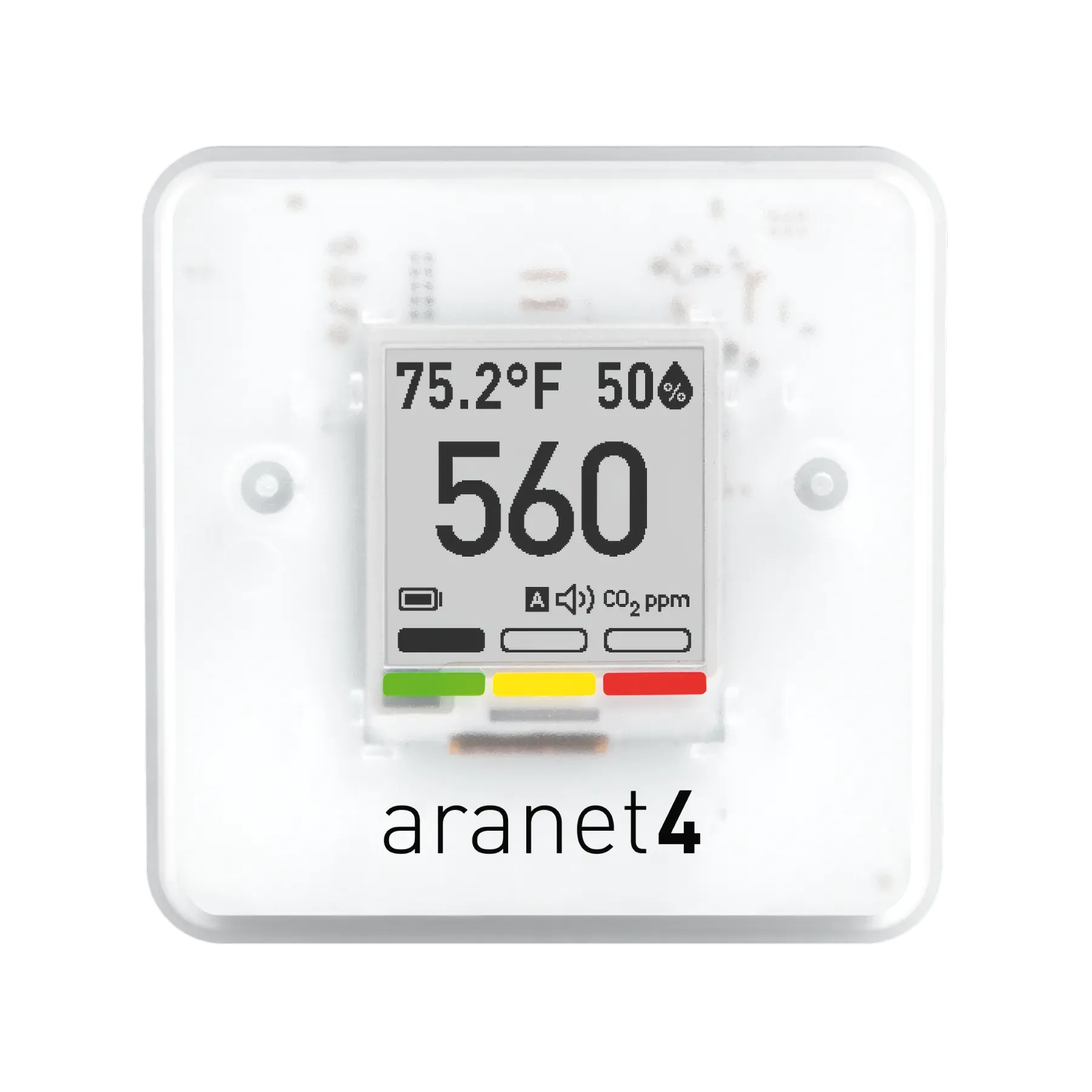
The best CO2 monitor for most homes is the Aranet4 HOME: it measures CO2 with a true NDIR sensor, Aranet publishes its accuracy as ±(30 ppm + 3% of reading), and it runs up to 4 years on batteries. The catch is that many "air quality monitors" never measure CO2 at all; they estimate it from a VOC sensor, and a CO2 monitor will not warn you about carbon monoxide. Below are seven monitors compared on sensor type, stated accuracy, power and data, plus how to place, calibrate and read one.
The best CO2 monitors at a glance
Five of the seven say they measure CO2 by NDIR, and four publish an accuracy figure. The "not listed" cells mean the maker's page does not say, which is worth knowing before you pay.
| Monitor | Best for | CO2 sensor (maker's wording) | Stated CO2 accuracy | Other readings | Display | Power | App or smart home |
|---|---|---|---|---|---|---|---|
| Aranet4 HOME | Most homes, travel | True NDIR | ±(30 ppm + 3%) | Temperature, humidity, pressure | E-ink | Battery, up to 4 years | Aranet Home app, history and export |
| Autonomous Desk Pro AI | CO2 tied to your time at the desk | Sensirion SCD41, photoacoustic NDIR | Not published | PM1 to PM10, VOC, NOx, combustion gas, sound level, temperature, humidity, presence | Phone app | Built into the desk | Autonomous app, ask in plain language |
| AirGradient ONE | Home Assistant, open data | SenseAir S8 (NDIR) | ±40 ppm ±3% (400 to 2,000 ppm) | PM, temperature, humidity, VOC, NOx | Small screen, LED bar | USB-C | Home Assistant, Homey |
| INKBIRD PTH-10C | Budget NDIR on the go | NDIR | Not listed | CO2 alert bands | Color LCD | Built-in battery, about 72 h | None listed |
| Qingping CO2 & Temp & RH Monitor | Logging one room for months | NDIR, Sensirion | ±15% of reading | Temperature, humidity | Screen | Rechargeable, about 99 days at a 30-min interval | Wi-Fi, LoRaWAN or NB-IoT versions |
| Awair Element | App-first, several pollutants | Not stated | ±75 ppm or 10% (400 to 5,000 ppm) | PM2.5, VOCs, temperature, humidity | On-device readout | AC adapter | Awair app, 2.4 GHz Wi-Fi |
| Temtop C1+ | Small monitor with app history | Sensirion (type not stated) | Not listed | Temperature, humidity | Screen | 800 mAh, up to 70 days in ECO mode | App with data history |
If you only want the short answer by need:
- One accurate monitor under $200: Aranet4 HOME at $189.
- Air readings that know when you are at your desk: Desk Pro AI, if you also need a standing desk.
- Home Assistant and raw data: AirGradient ONE at $230 assembled or $138 as a kit.
- Under $50 with a real NDIR sensor: INKBIRD PTH-10C at $45.99.
The 7 best CO2 monitors, by what you need
The order puts sensor type and published accuracy first, then how you will use the readings: on a screen, in an app, or in a smart home. Specs and prices come from each maker's own page; none of these claims come from our own lab tests.
1. Aranet4 HOME: best overall CO2 monitor for most homes
The Aranet4 HOME is the CO2 monitor to buy if you want one accurate number you can trust without setup. Aranet lists a "true NDIR (non-dispersive infrared) sensor" with a 0 to 9,999 ppm range and an accuracy of ±(30 ppm + 3% of reading), the tightest stated figure among the picks here.
It also reads temperature, humidity and air pressure on an E-Ink screen, which is why the battery lasts up to 4 years. It is factory-calibrated, runs automatic background calibration in rooms that get aired out regularly, and lets you calibrate by hand through the app or a switch sequence; Aranet suggests once a year. The free Aranet Home app keeps history and exports it through dashboard sharing.
The limits: Aranet mentions no smart-home integration, and it does not read particles or VOCs, so $189 buys CO2, temperature, humidity and pressure only. The warranty is 2 years, or 3 if you register it. This suits remote workers, parents checking a bedroom and anyone who wants a portable CO2 monitor for a classroom or a trip.
| Pros | Cons |
|---|---|
|
|
2. Autonomous Desk Pro AI: for CO2 readings tied to your time at the desk
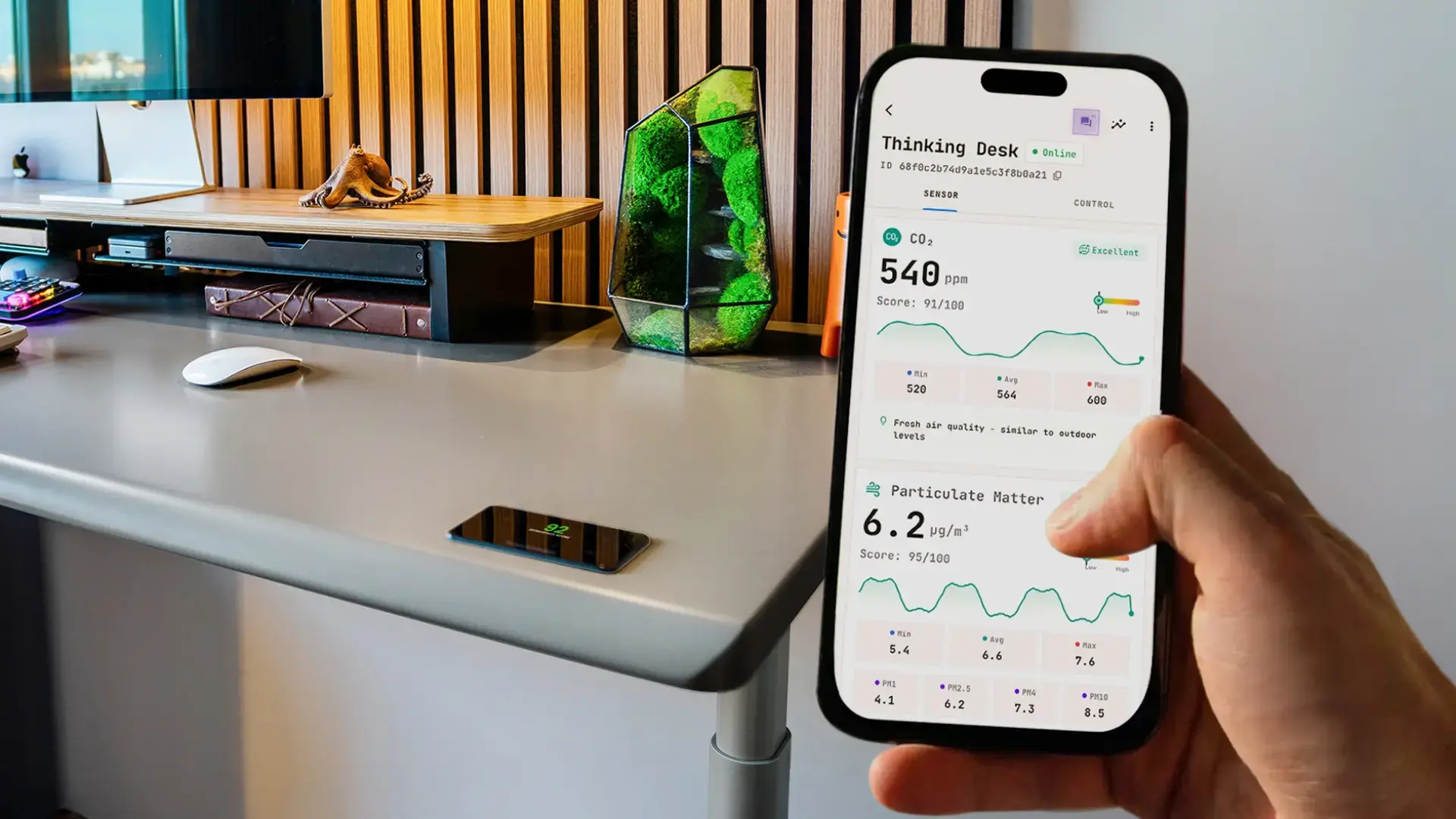
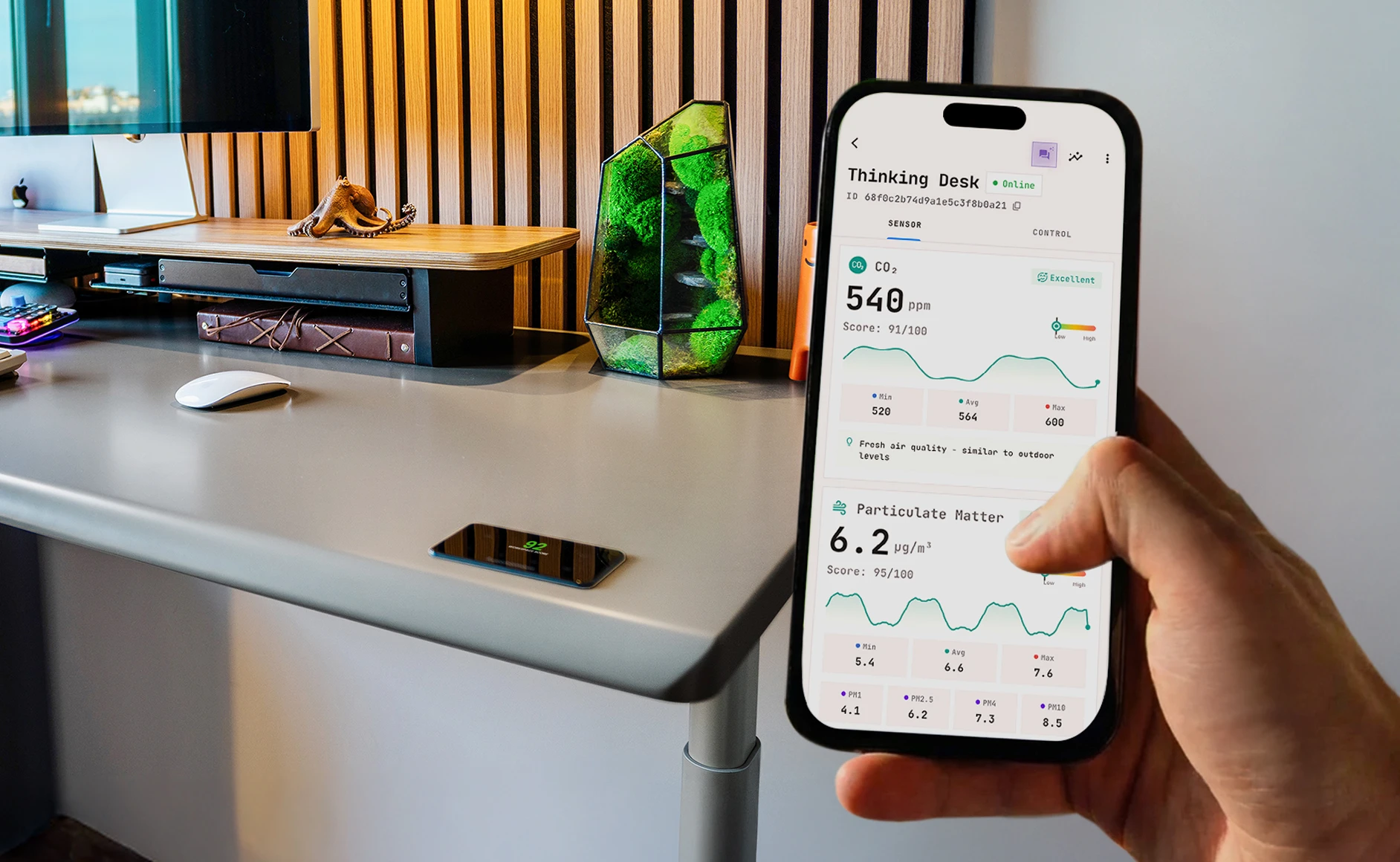
Desk Pro AI is a standing desk with a six-sensor hub, and its CO2 reading comes from a Sensirion SCD41 that Autonomous describes as photoacoustic NDIR, "measured directly, not estimated." It suits the remote worker whose 3 p.m. slump might be the room rather than the coffee.
The difference from a standalone monitor is context. The product page puts it this way: "Any monitor can read the room's CO₂. None of them know whether you were in the room." An mmWave radar senses presence and a time-of-flight sensor tells sitting from standing, so the desk can match its readings to the time you actually spent there.
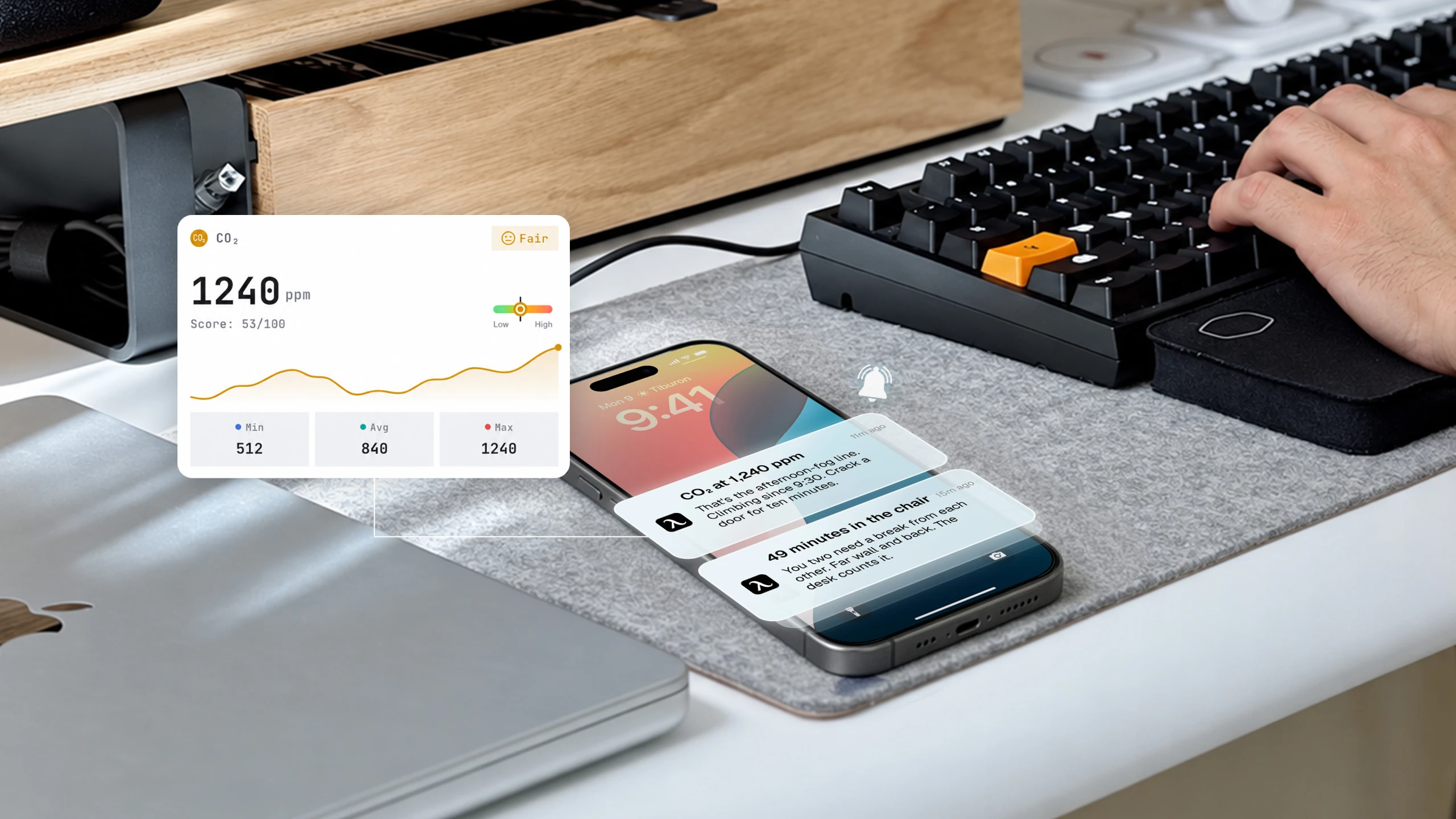
The hub also carries a SEN55 for particles (PM1 to PM10), VOC and NOx, a MiCS-5524 for combustion gas and a microphone that computes sound level on the device without recording audio. That makes 13 readings, 8 of them scored out of 100 in the app with the minimum, average and maximum for each session. When a reading crosses a line, you get one notification with what to do; the page's example is "CO₂ at 1,240 ppm, or 49 minutes in the chair."
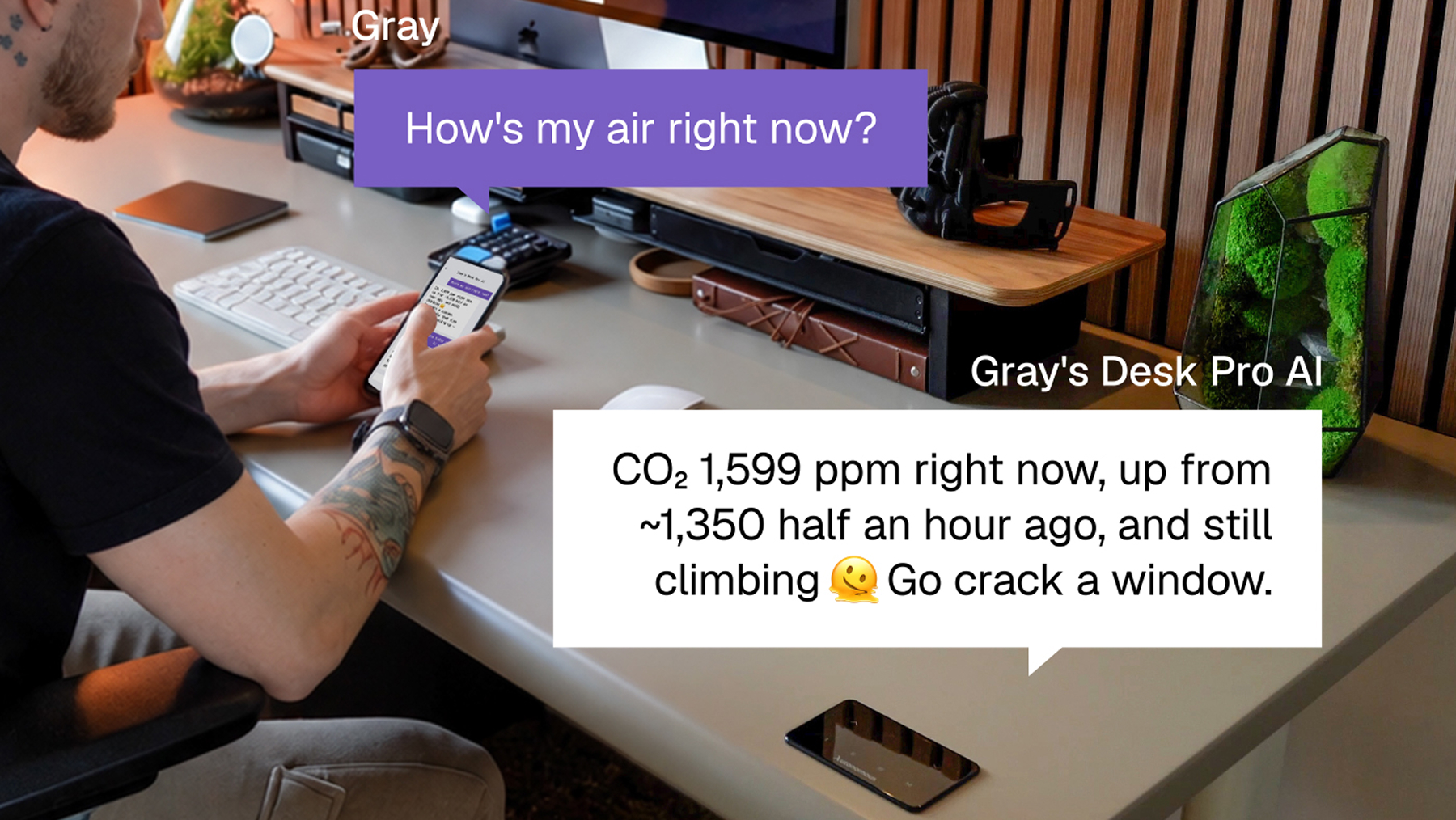
You can also ask in plain words, such as "How's the air around me?", and Autonomous Intelligence answers from your own desk data. Autonomous says "Nothing leaves the room." The desk itself is a dual-motor C-frame rated for 450 lbs, with a 24.25 to 53.5 in height range, a lifetime frame warranty and 2 years on the top.
The limits are real. It only reads the air where the desk stands, so it cannot follow you to the bedroom. Readings show in the phone app; Autonomous does not describe a CO2 readout on the desk itself. Autonomous does not publish an accuracy figure or a calibration method for the CO2 reading, and it is a desk purchase first, so it only makes sense if you need a standing desk anyway.
| Pros | Cons |
|---|---|
|
|

3. AirGradient ONE: for Home Assistant and open data
AirGradient ONE is the pick for anyone who wants CO2 data inside Home Assistant without cloud workarounds. AirGradient lists a SenseAir S8 NDIR sensor (some units use the S88) with a 0 to 10,000 ppm range and an accuracy of ±40 ppm ±3% of reading between 400 and 2,000 ppm.
It adds particles, temperature, humidity, VOC and NOx, shows them on a small screen with an LED bar, and runs on USB-C. The firmware is open source, with native Home Assistant and Homey support. Its automatic baseline calibration (ABC) runs every seven days by default, and you can change that.
The limits: it needs constant USB power, so it is not a travel monitor. The assembled unit costs $230 with a 12-month warranty; the $138 kit has no warranty and you build it yourself. It suits the skeptical tech buyer who wants to log, graph and automate rather than glance at a screen.
| Pros | Cons |
|---|---|
|
|

4. INKBIRD PTH-10C: for a budget NDIR check on the go
The INKBIRD Portable CO2 Detector (PTH-10C) is the cheapest way to get a real NDIR reading, at $45.99 on INKBIRD's store. INKBIRD says it "uses an advanced NDIR sensor," shows CO2 on a color LCD and runs about 72 hours on its built-in 1,000 mAh battery, which charges over USB in about 3 hours.
Its color bands run green from 400 to 699 ppm, yellow from 700 to 1,499 and red above that, with an alarm past 1,500 ppm that you can change. INKBIRD tells you to calibrate it by hand once outdoors on first use. That makes it a handy portable CO2 monitor for a classroom, an office meeting or a flight.
The limits: INKBIRD lists no accuracy figure and no sensor model, there is no app or logging, and three days of battery means frequent charging. A VEVOR listing also uses the PTH-10C name, so check the brand before you buy.
| Pros | Cons |
|---|---|
|
|

5. Qingping CO2 & Temp & RH Monitor: for logging one room over months
The Qingping CO2 & Temp & RH Monitor suits a bedroom, nursery or small office where you want a long record more than a live alarm. Qingping lists "NDIR CO2 Sensing Technology" with sensors from Sensirion, a 400 to 9,999 ppm range and a typical accuracy of ±15% of the measured value.
It runs on a rechargeable battery over USB-C, and Qingping's calculator shows about 99 days between charges when it reports CO2 every 30 minutes over Wi-Fi. It comes in Wi-Fi, LoRaWAN and NB-IoT versions, which tells you it was built for connected fleets as much as for homes. Its color scale calls 400 to 1,000 ppm normal, 1,000 to 1,400 slightly high and 1,400 and up high.
The limits: ±15% is loose next to Aranet4; at 1,000 ppm it allows about ±150 ppm. The long battery life depends on a slow 30-minute interval, Qingping mentions no HomeKit or Matter support, and its page shows no price.
| Pros | Cons |
|---|---|
|
|
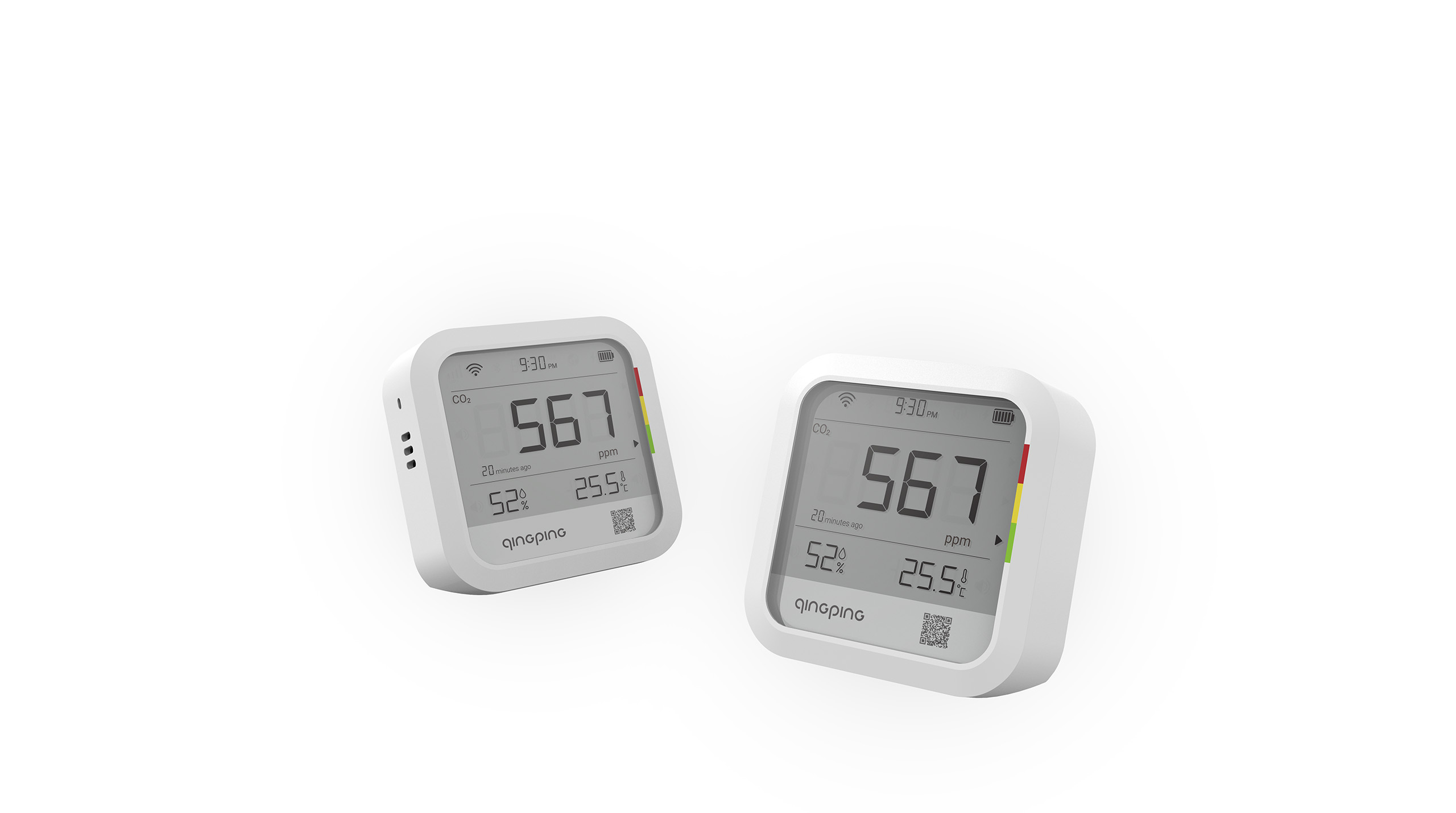
Qingping CO2 & Temp & RH Monitor
NDIR CO2 monitor with temperature and humidity and months of battery
6. Awair Element: for an app-first monitor with particles and VOCs
Awair Element fits someone who wants CO2, PM2.5 and VOCs in one app at $299, and does not need to carry it. Awair lists CO2 from 400 to 5,000 ppm at ±75 ppm or 10%, PM2.5 from 0 to 1,000 µg/m³, VOCs, temperature and humidity, all shown on the device and in the free Awair app.
The limits: Awair's page does not name the CO2 sensor type, so you are trusting the stated tolerance alone, and that tolerance is wider than Aranet4's or AirGradient's. It runs on a 5V/2A adapter rather than a battery and needs 2.4 GHz Wi-Fi.
| Pros | Cons |
|---|---|
|
|

7. Temtop C1+: for a small monitor with app history
The Temtop C1+ is a compact CO2, temperature and humidity monitor for someone who wants a phone history without a smart-home setup. Temtop lists a "high-precision Sensirion CO2 sensor," an 800 mAh battery that lasts up to 70 days in ECO mode, an app with data history, a 1-year warranty and 30-day returns.
The limits: the C1+ page does not say whether the sensor is NDIR and lists no accuracy figure. Temtop lists it on sale, so confirm the current US price on its store before you buy.
| Pros | Cons |
|---|---|
|
|

Other monitors worth knowing
If radon is your bigger worry, Airthings View Plus pairs radon with CO2, particles and VOCs; Target lists it at $329.99 with six AA batteries. We could not confirm its CO2 sensor type on the maker's page, so it is not ranked here.
Skip any monitor that lists "eCO2," "equivalent CO2" or only "TVOC" in place of a CO2 sensor, and any that shows an air score with no CO2 line at all. Those are useful for other things, but they cannot tell you how stuffy a room is.
NDIR vs eCO2: why cheap CO2 monitors disagree
An NDIR monitor measures CO2 directly by how much infrared light the gas absorbs, while an eCO2 monitor guesses CO2 from a VOC sensor. That is why two monitors on the same shelf can read 600 and 1,400 ppm at once: only one of them is measuring the gas.
The eCO2 guess assumes the VOCs in the room come from people breathing. Spray a cleaner, use hand sanitizer or put on perfume and the "CO2" number climbs, though no extra CO2 is there. Those devices are really reporting a TVOC reading converted to ppm.
Photoacoustic NDIR, used in the Sensirion SCD41 inside Desk Pro AI, is a smaller variant: it pulses infrared light and listens for the tiny pressure wave CO2 gives off as it absorbs it. Both count as real CO2 measurement.
How to tell from a spec sheet, in under a minute:
- Look for the words: "NDIR," "photoacoustic NDIR" or a sensor model such as SCD41 or SenseAir S8 means measured CO2.
- Look for the warning signs: "eCO2," "equivalent CO2" or "calculated from TVOC" means an estimate.
- Look for a tolerance: a stated accuracy in ppm plus a percentage, such as Aranet4's ±(30 ppm + 3%). At 1,000 ppm that works out to about ±60 ppm for Aranet4, ±70 ppm for AirGradient ONE and ±150 ppm for Qingping.
- Try the sanitizer test: rub hand sanitizer near the monitor. Alcohol vapor usually sends a VOC-based eCO2 reading up within seconds, while an NDIR reading stays close to where it was.
How CO2 monitor calibration works
Many NDIR monitors recalibrate themselves by assuming the lowest reading they see over several days is fresh outdoor air, then shifting their baseline to match. AirGradient runs this automatic baseline calibration (ABC) every seven days by default, and Aranet4 does the same in rooms that get aired out regularly.
It goes wrong in a room that never airs out. A bedroom with the windows shut all winter, or an office occupied around the clock, never drops near outdoor levels, so the monitor treats a stale 700 ppm as its new 400 and reads low from then on. ASHRAE's position document on indoor CO2 calls sensor performance, location and calibration "critical" to reading the numbers correctly.
Manual (forced) calibration fixes it:
- Take the monitor outdoors, away from people, cars and exhaust vents.
- Let it sit until the reading settles, usually several minutes.
- Trigger calibration in the app or with the button sequence in the manual. Aranet suggests once a year; INKBIRD asks for it once outdoors on first use.
The check: open a window or step outside once a month. A healthy sensor should settle in the low 400s. If yours reads under 400 ppm indoors, its baseline has drifted low.
What should a CO2 monitor read?
A CO2 monitor should read about 425 ppm outdoors and, in an occupied room, stay under roughly 1,000 ppm. NOAA's Mauna Loa record put the September 2026 monthly mean at 426.07 ppm, so any reading near that number means the room is getting plenty of outdoor air.
- About 425 ppm: outdoor air.
- Under 1,000 ppm: the EPA says levels below this "generally indicate that ventilation is adequate" for the people in the room; peaks above it in the breathing zone point to a ventilation problem.
- About 700 ppm above outdoor: the ASHRAE 62-2001 limit for occupied classrooms that the EPA's schools guide cites, set to keep body odor from becoming offensive.
- 5,000 ppm: OSHA's 8-hour workplace limit; NIOSH recommends the same time-weighted level.
Treat 1,000 ppm as a ventilation signal, not a health line. ASHRAE removed a 1,000 ppm limit from its ventilation standard because people misread it as one, and it calls the evidence for direct health effects at typical indoor levels inconsistent.
Still, in a Harvard-led study of 24 office workers, cognitive scores were 61% higher on low-VOC "Green" days and 101% higher on "Green+" days, which added twice the outdoor air, than on conventional days. The authors found CO2 and VOCs were each linked to scores on their own. The full ranges, symptoms and fixes are in our guide to what CO2 levels should be indoors.
Where should a CO2 monitor be placed?
Place a CO2 monitor at breathing height, about two feet or more from anyone's face, and away from windows, doors and air vents. The EPA's measurement guide says to keep CO2 readings away from exhaled breath and describes the breathing zone as at least two feet from it.
- At a desk: put it at the back corner of the desk, not beside the keyboard where you breathe on it.
- In a bedroom: a dresser or shelf across the room beats the nightstand by your pillow.
- Away from drafts: a window, door or supply vent shows you fresh air, not the room.
- Away from flames: gas stoves and heaters make CO2, so a kitchen reading is not a living-room reading.
Give a new spot 10 to 15 minutes to settle before you trust the number. In occupied buildings, the EPA says CO2 tends to peak in the mid- to late afternoon, so that is the time to read it. For a whole-office check with more than CO2, follow an indoor workplace air quality test.
Is a CO2 monitor a carbon monoxide detector?
No, a CO2 monitor does not detect carbon monoxide, and it is not a substitute for a CO alarm. Carbon dioxide (CO2) is the gas you breathe out; carbon monoxide (CO) comes from incomplete burning in furnaces, stoves and cars and is dangerous at far lower levels.
Keep a UL-listed CO alarm near bedrooms and fuel-burning appliances, whatever monitor you buy. A CO2 monitor also will not detect a natural gas leak. Desk Pro AI's hub includes a MiCS-5524 combustion gas sensor, but it is a desk sensor feeding an app, not a listed life-safety alarm, so treat it the same way.
How to choose the best CO2 monitor for your home
Choose the sensor first, then the way you want to see the data, then power. Each check below comes from a limit named in the picks above.
- Sensor: NDIR or photoacoustic NDIR, named on the spec sheet. Skip eCO2.
- Stated accuracy: a ppm plus percentage tolerance. Aranet4 and AirGradient ONE publish the tightest here.
- Calibration: automatic baseline plus a manual option, so you can fix a room that rarely airs out.
- Power: battery for travel and bedrooms (Aranet4, INKBIRD), USB or mains for logging (AirGradient, Awair).
- Data: a screen for a glance, an app for history, Home Assistant for automation, or a desk that ties readings to your work sessions.
- Extras: particles and VOCs (AirGradient, Awair, Desk Pro AI) matter if you cook, have pets or live near traffic.
FAQs
What is the most accurate CO2 detector?
Among the monitors here, the Aranet4 HOME publishes the tightest accuracy: ±(30 ppm + 3% of reading) from a true NDIR sensor. AirGradient ONE is close at ±40 ppm ±3% between 400 and 2,000 ppm. Any NDIR monitor drifts without calibration, so check it outdoors now and then.
Are CO2 monitors worth it?
Yes, if you spend long hours in one room with the door shut, such as a home office, bedroom or meeting room. A CO2 monitor shows when ventilation is falling behind, so you know when to open a window. It is not worth it if the device only estimates eCO2.
What is a CO2 monitor?
A CO2 monitor is a device that measures carbon dioxide in the air in parts per million (ppm). Indoors, CO2 rises mainly because people breathe it out, so the reading works as a gauge of how much fresh air a room is getting.
Where should a CO2 monitor be placed?
Place it at breathing height, at least two feet from where people breathe, and away from windows, doors, vents and gas stoves. At a desk, use the back corner. In a bedroom, a shelf across the room works better than the nightstand.
Does a CO2 monitor detect a gas leak or carbon monoxide?
No. A CO2 monitor measures carbon dioxide only; it does not detect carbon monoxide or natural gas. Keep a UL-listed carbon monoxide alarm near bedrooms and fuel-burning appliances, and use a gas detector if you are worried about leaks.
How do you calibrate a CO2 monitor?
Take it outdoors away from people and traffic, let the reading settle for several minutes, then start calibration in the app or with the button sequence in the manual. The monitor sets that outdoor level, about 425 ppm, as its baseline. Aranet suggests doing it once a year.
What should a CO2 monitor read indoors?
Indoors, a reading under about 1,000 ppm generally means ventilation is keeping up, and readings near 425 ppm match outdoor air. Sustained readings well above 1,000 ppm mean the room needs more fresh air. OSHA's workplace limit is 5,000 ppm over 8 hours.
What is an NDIR CO2 sensor?
An NDIR (non-dispersive infrared) sensor measures CO2 directly by how much infrared light the gas absorbs. It is the standard for real CO2 readings. Cheaper sensors that report eCO2 estimate the number from VOCs instead, so they can be far off.
Conclusion
The best CO2 monitor is the one that measures the gas instead of guessing it. For most homes, that is the Aranet4 HOME. Desk Pro AI fits if you want air readings tied to the hours you spend at your desk, AirGradient ONE if you run Home Assistant, and INKBIRD PTH-10C if the budget is under $50. Whatever you pick, place it away from your breath, check it outdoors now and then, and keep a separate CO alarm.
References
- NIOSH Pocket Guide to Chemical Hazards: Carbon dioxide
- U.S. EPA: Common IAQ Measurements, Appendix A of Building Air Quality
- U.S. EPA: Reference Guide for Indoor Air Quality in Schools
- ASHRAE Position Document on Indoor Carbon Dioxide
- Allen JG et al. (2016). Associations of Cognitive Function Scores with Carbon Dioxide, Ventilation, and Volatile Organic Compound Exposures in Office Workers. Environmental Health Perspectives 124(6):805-812
- NOAA Global Monitoring Laboratory: Trends in Atmospheric Carbon Dioxide