Acoustic Panels for Office Noise and How Many You Need


Acoustic panels for office walls absorb the echo that makes voices, calls and keyboards build up inside a room, but they do not stop sound passing through a wall to the next room. For a private office, the US General Services Administration (GSA) calls for panels rated NRC 0.8 or higher on about 25% of two adjacent walls. Below: what panels do, how to read NRC, how many you need, where to hang them, and five panels compared by their listed ratings.
What Acoustic Office Panels Do and Do Not Do
Acoustic office panels are sound-absorbing panels: they absorb sound that hits them, so less of it bounces back into the room. That cuts echo and the build-up of noise in hard rooms, and it makes speech on calls sound clearer and closer.

They do not block sound from passing through walls, doors or ceilings. Acoustimac, which sells panels, says so on its own product page: panels "have no impact on the amount of sound transmitted through walls, windows and crevices." That is why "soundproofing panels" is a misleading name. Two ratings separate the jobs:
- NRC (noise reduction coefficient): how much sound a material absorbs, from 0 to about 1. This is the panel rating.
- STC (sound transmission class): how much sound a wall, door or ceiling stops. GSA uses about STC 40 between private offices for normal privacy and 45 for confidential talk.
Check which problem you have before you buy. Clap once in the empty room: a ringing or fluttering tail means hard surfaces are bouncing sound, and panels fix that. If the problem is hearing the next room clearly, panels will not, and the fixes for soundproofing a home office or a work office start with seals and mass.
What NRC Rating Should Office Acoustic Panels Have?
Office acoustic panels should be rated NRC 0.8 or higher, the minimum in GSA's office guide, and the three 2-inch fabric-wrapped panels in this guide list NRC 1.00 to 1.15. NRC is the average of how much a material absorbs at 250, 500, 1,000 and 2,000 Hz, rounded to the nearest 0.05. Those bands carry most of the sound of speech, which is why NRC suits offices.
The single number hides three things worth checking:
- Low hum: NRC skips 125 Hz. ATS lists its 2-inch panel at NRC 1.00 but 0.12 at 125 Hz, while Acoustimac's 2-inch panels test 0.39 at 125 Hz. Labs and mounting differ, but the low end is where air handling and traffic rumble sit.
- Paint: Primacoustic's paintable 2-inch panel tests NRC 1.00 raw, 0.50 after roller painting and 1.05 after spray painting. A roller can halve it.
- Thin felt: Felt Right lists its flat 9 mm PET felt tiles at NRC 0.35. Thin felt looks good and takes the edge off, but it absorbs far less than 2-inch panels.
| Panel type | Thickness | NRC the maker lists |
|---|---|---|
| Fabric-wrapped mineral wool (Acoustimac) | 2 in | 1.15 |
| Fabric-wrapped glass wool (Primacoustic Broadway) | 2 or 3 in | 1.00 |
| Burlap-wrapped mineral wool (ATS) | 2 in | 1.00 |
| PET felt desk divider (AW Office Furniture) | Not listed | 0.85 |
| 3D PET felt tiles (Felt Right Peak) | 0.35 in | 0.55 |
| Paintable glass wool, roller painted (Primacoustic) | 2 in | 0.50 |
| Flat PET felt tiles (Felt Right) | 9 mm | 0.35 |
Check the test, too. A rating with a named lab or standard (ASTM C423 is the usual one) is worth more than a number in a listing title.
How Many Acoustic Panels Does an Office Need?
Acoustic panels for office rooms are sized by wall area: about 25% of two adjacent walls in a private office. An open-plan office needs absorbent material on the whole ceiling plus about 25% of the walls, based on GSA's office guide. These are the targets it sets:
| Room | Coverage GSA sets | Minimum NRC |
|---|---|---|
| Open-plan workspace | 100% of the ceiling and 25% of the walls | 0.9 ceiling, 0.8 walls |
| Private office | 25% of two adjacent walls | 0.8 |
| Meeting or teleconference room | 50% of the ceiling and 25% of two adjacent walls | 0.8 |
Here is the math for a 12 by 12 ft private office with an 8 ft ceiling. Each wall is 96 sq ft, so two adjacent walls make 192 sq ft, and 25% of that is 48 sq ft: six 2 by 4 ft panels or twelve 2 by 2 ft panels. Subtract doors, windows and any wall your office layout fills with shelves, then place the rest.
Start there and clap-test again. Add panels while the ring is still there, and stop when speech sounds dry and close. Plants do not count: GSA lists office plants as a noise myth and says "it would take a veritable jungle of plants to absorb much sound."
Where to Place Acoustic Panels in an Office
Place acoustic panels where sound first bounces on its way to your ears: the side walls beside your desk, the wall you face on calls, and the ceiling above open desks. Hang them after the furniture is in, because the desk sets where your head is.
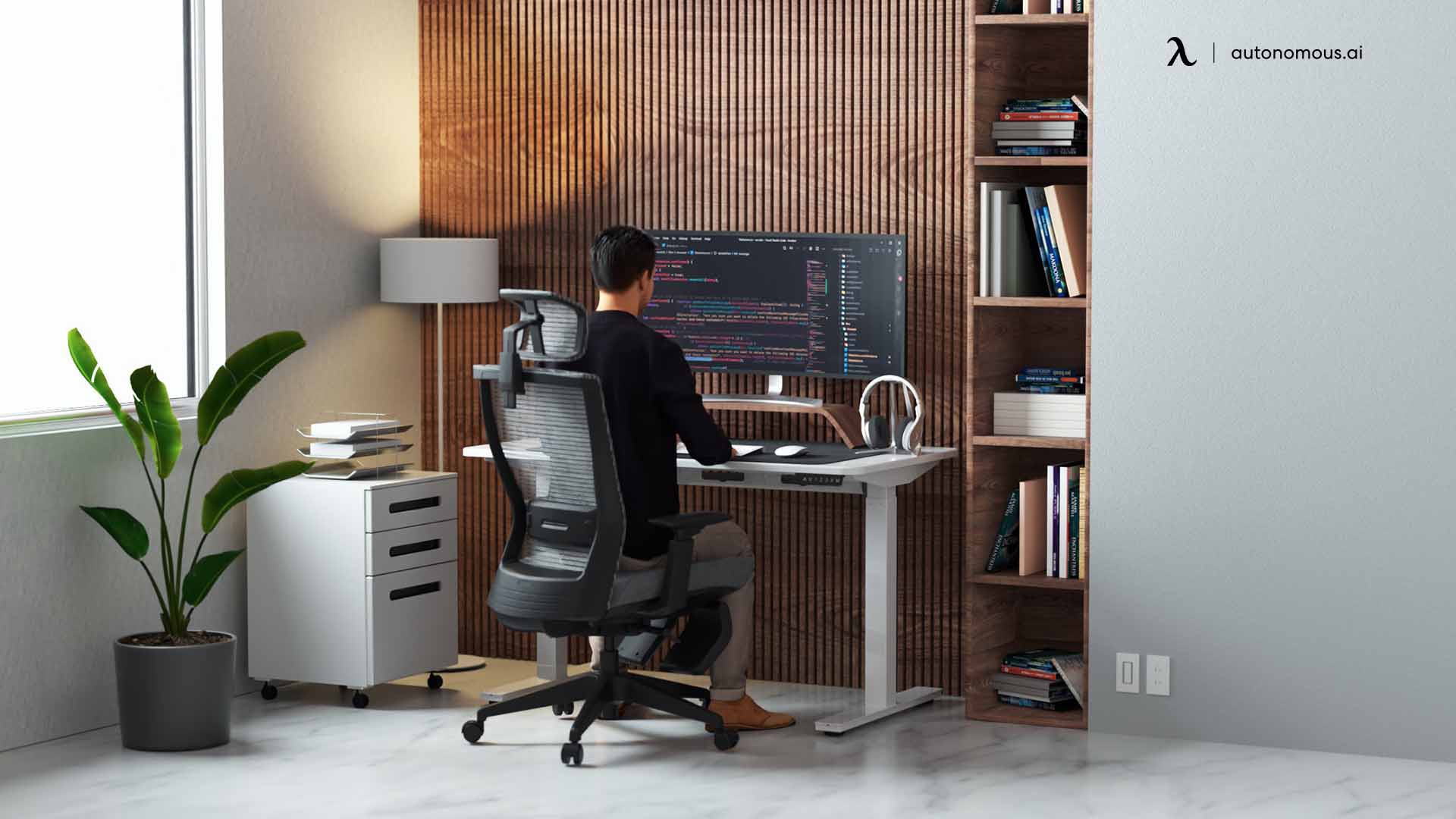
- Side walls at ear height: sit in your usual office chair while someone slides a mirror flat along the wall. Where you see your own face, hang a panel.
- Tall panels for standing work: a standing office desk lifts your head well above seated height, so hang 2 by 4 ft panels upright to cover both positions.
- The wall you face on calls: your voice hits it first and bounces back into the mic. A panel there cuts the echo your mic picks up.
- Facing pairs of bare walls: treat at least one wall of each pair and stagger the panels, which stops flutter echo.
- Glass: glass walls, common in executive office design, reflect like any hard wall, so treat the wall opposite the glass.
- Ceiling in open plans: GSA calls the ceiling "typically the most significant contributor to sound absorption." Use acoustic ceiling tiles, or clouds and baffles above desk clusters.
In a commercial office, check the fire rating before you buy. Look for an ASTM E84 Class A rating, and note that GSA says hanging panels must be coordinated with the sprinklers and may need fire marshal approval.
5 Acoustic Panels for Office Spaces Compared
These five acoustic panels for office and home workspaces cover the main jobs: high-NRC wall panels, a fire-tested commercial line, a budget panel for a small room, a desk divider for open plans, and a decorative felt option. They are ordered by the NRC each maker lists, highest first; a tie goes to the panel with a published fire test. Specs and prices come from each maker's page, not from our own testing.
| Panel | Type and size | NRC listed | Fire rating listed | Price from |
|---|---|---|---|---|
| Acoustimac DMD Acoustic Panel | Fabric-wrapped mineral wool, 4 x 2 ft x 2 in | 1.15 | ASTM E84 test report linked (Intertek) | $84.95 |
| Primacoustic Broadway Wall Panels | Fabric-wrapped glass wool, 2 or 3 in | 1.00 | ASTM E84 tested | Dealer price |
| ATS Acoustic Panel 24 x 24 x 2 | Burlap-wrapped mineral wool, 2 x 2 ft x 2 in | 1.00 | Not fire rated | $49.95 |
| AW Office Furniture Acoustical Felt Privacy Panel | PET felt desk divider, 20 in high, 23 to 71 in wide | 0.85 | Not listed | $109 (minimum order 3) |
| Felt Right Peak Dimensional Tiles | 3D PET felt tiles, 0.35 in | 0.55 | ASTM E84 Class A | From $299.95 |
Prices change; check each maker's page before you order.
1. Acoustimac DMD Acoustic Panel: for the highest listed NRC
The Acoustimac DMD panel is a 4 by 2 ft, 2-inch panel with a mineral wool core wrapped in DMD mesh fabric. Acoustimac shows a Riverbank Acoustical Laboratories test for its 2-inch panels on the DMD panel page: NRC 1.15 and 0.39 at 125 Hz, more than three times the ATS figure below.
You can swap the core for EcoCore or Owens Corning 703 at extra cost, and the backing adds a quarter inch to the depth. The page links an Intertek ASTM E84 fire test report for its panels; confirm it covers the core you choose before a commercial install.
| Pros | Cons |
|---|---|
| Highest listed NRC here, from a named lab Large 4 by 2 ft panel covers 8 sq ft at once Choice of core materials | Fire test report dates from 2010 and covers its panels in general The 1.15 chart covers Acoustimac 2-inch panels in general |
2. Primacoustic Broadway Wall Panels: for commercial offices with a fire code
Primacoustic's Broadway line uses high-density glass wool panels, tested at NRC 1.00 in both 2- and 3-inch fabric versions, with matching ceiling clouds at the same rating. The Broadway wall panel page lists fire tests including ASTM E84 and CAN/ULC-S102, the paperwork a landlord or fire marshal asks for.
The paintable version tests NRC 1.00 raw and 0.50 after roller painting, so spray it if you paint it. Primacoustic sells through dealers and lists no price on its own site.
| Pros | Cons |
|---|---|
| Fire tests listed by the maker Wall panels, clouds and baffles in one line Paintable option to match walls | No price on the maker site; buy through a dealer Roller paint halves the paintable panel's NRC |
3. ATS Acoustic Panel 24 x 24 x 2: for a small office on a budget
The ATS Acoustic Panel is a 2 by 2 ft, 2-inch panel with a ROCKWOOL mineral wool core in a wood frame, covered in jute burlap. ATS lists NRC 1.00 from independent testing, builds each panel to order and ships in one to two weeks.
At 6 lb, it hangs on the included clips and anchors and leaves holes like a picture hook, which suits a rented office. Two limits: this version is not fire rated (ATS sells a fire-rated option), and it absorbs only 0.12 at 125 Hz, so it does little for low hum.
| Pros | Cons |
|---|---|
| Lowest price per panel here Mounting kit included Small size fits between furniture | Not fire rated in the base version Weak at 125 Hz |
4. AW Office Furniture Acoustical Felt Privacy Panel: for open-plan desks
The AW Acoustical Felt Privacy Panel is a clamp-on divider made from recycled PET felt, 20 inches high (19 inches once clamped), in six widths from 23 to 71 inches. It absorbs speech between facing desks and gives each person a visual edge.
AW lists NRC 0.85 but calls it a "sound masking rating"; it is an absorption figure, and the listing names no test. A divider this height does not stop a voice carrying over the top. The minimum order is three.
| Pros | Cons |
|---|---|
| Clamps on with no wall work Six widths for most desk runs Limited lifetime warranty | Minimum order of three No named test or fire rating in the listing |
5. Felt Right Peak Dimensional Tiles: for a decorative feature wall
The Felt Right Peak tiles are 3D PET felt shapes, 0.35 inch thick, with 50% post-consumer recycled content and an ASTM E84 Class A fire rating. They stick on with adhesive tabs and come in 42 colors.
Felt Right lists NRC 0.55 as configured. That takes the edge off a hard room but will not fix a loud one, so use them where looks matter or on top of thicker panels elsewhere in the room.
| Pros | Cons |
|---|---|
| Class A fire rating No screws; adhesive tabs Designs that read as wall art | NRC 0.55, about half a 2-inch panel Higher price for the absorption you get |
Office Acoustic Solutions When Panels Are Not Enough
When panels are not enough, the fix is to block sound or cover it. GSA's office guide calls the full approach "absorb, block, cover," and panels only do the first part.
Carpet, Ceiling Tiles and Soft Furnishings
Soft surfaces add absorption without extra panels. GSA notes carpet is "especially effective" against footfalls, while marble and ceramic tile do the opposite. Rugs, upholstered seats and curtains work into most office design ideas, and acoustic ceiling tiles do the most in open plans.
Sealed Walls and Doors to Block Sound
Blocking takes mass and airtight seals. GSA's private office spec runs the wall full height to the slab above and seals it all around, because sound leaks through gaps at the ceiling. A solid door with seals and a sweep matters as much as the wall. Sound-deadening walls cover the build options.
Sound Masking to Cover Speech
Masking adds a low, steady sound tuned to speech, so words carry less far. GSA sets it at 45 to 48 dBA in open plans. Panels and masking work together: office white noise covers what the panels let through.
A Closed Pod for Calls on an Open Floor
Panels will not stop your call being overheard, and neither will masking at close range. An acoustic office pod puts the first two, absorb and block, in one closed room on the floor.
Spaceship, Autonomous's indoor one-person office pod, shows the absorb and block split in its wall. The 2.5-inch wall has five layers: aluminum, plywood, an acoustic foam core, more plywood, and PET felt inside. The felt handles echo; the mass and a sealed 10 mm glass door do the blocking. Autonomous lists 30 dB of speech reduction, measured two desks away and marked preliminary.
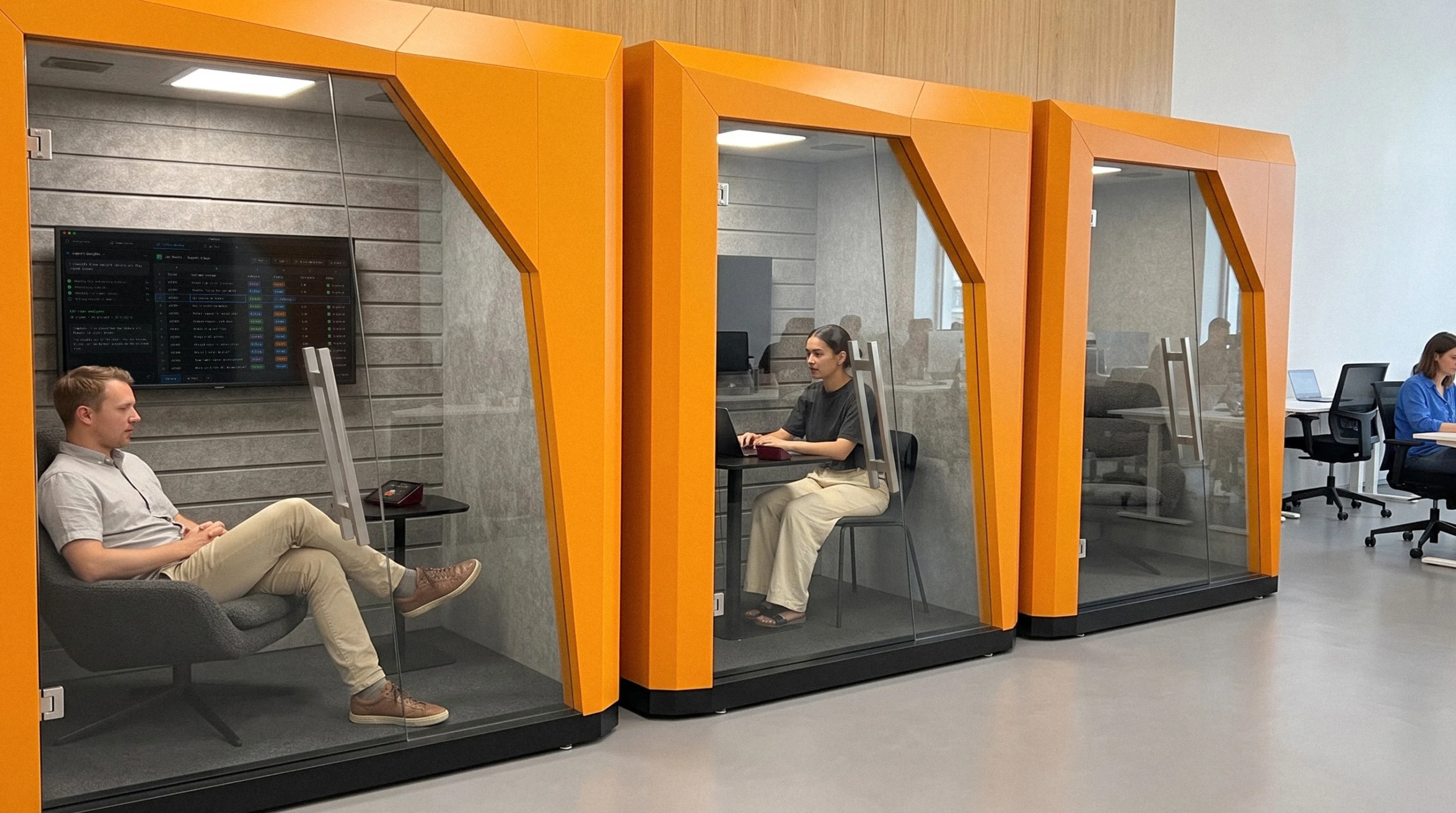
It is built for calls, focused work, recording and a two-person sync, around a lounge chair, laptop table and wall screen rather than a desk; that furniture is sold separately. Two 8-inch roof vents run all the time at up to 32 dB(A). It needs 8'2" by 5'6" of floor, weighs about 950 lb and is assembled on site, so plan it as a fixture.

FAQs
What are the best acoustic panels for an office?
The best acoustic panels for an office are 2-inch fabric-wrapped mineral wool or glass wool panels rated NRC 0.8 or higher; the ones in this guide list 1.00 to 1.15. In a commercial space, pick a line with an ASTM E84 Class A rating, and add ceiling treatment in open plans.
How do I soundproof my office at work?
To soundproof an office at work, seal the door with gaskets and a sweep, close gaps around the ceiling, and add mass to the walls. Panels then handle echo, and sound masking covers speech in the hallway. For private calls on an open floor, use a closed room or an office pod.
Do soundproofing panels actually work?
Soundproofing panels work for echo, not for blocking sound. They absorb sound inside a room, so calls sound clearer and noise builds up less, but they do little to stop a voice passing through a wall or door. Blocking needs mass, airtight seals and a solid door.
How do you place acoustic panels in an office?
Place acoustic panels on the side walls beside your desk at ear height, on the wall you face during calls, and on at least one wall of each bare facing pair. In open plans, treat the ceiling above desk clusters. Use a mirror from your chair to find first reflections.
How many acoustic panels do I need for a small office?
A small office needs panels covering about 25% of two adjacent walls, the GSA target for private offices. For a 12 by 12 ft room with an 8 ft ceiling, that is about 48 sq ft: six 2 by 4 ft panels or twelve 2 by 2 ft panels.
Are foam acoustic panels good for an office?
Foam acoustic panels can cut echo in an office, but check two things first: a listed NRC and an ASTM E84 fire class. Many marketplace foam listings give neither, and thin foam absorbs less than 2-inch fabric-wrapped mineral wool, so it needs more wall area for the same result.
What is an acoustic office divider?
An acoustic office divider is a sound-absorbing screen that clamps to a desk or stands on the floor between workstations. It soaks up speech between facing desks and gives visual privacy, but it does not block a voice carrying over the top or around the ends.
What is an acoustic office pod?
An acoustic office pod is a closed, sound-insulated room that stands inside an office for calls, meetings or focused work. Its walls block sound and its lining absorbs echo, so it keeps a conversation in far better than panels or masking. Most fit one or two people.
Conclusion
Acoustic panels for office spaces fix echo and noise build-up inside a room; they do not stop sound passing through walls. Buy panels rated NRC 0.8 or higher, cover about 25% of two adjacent walls in a private office, hang them where sound first bounces, and check the fire rating in a commercial space. For calls that must stay private, add blocking or a closed room. A quieter room is one of the cheaper productivity improvements an office can make.