Slant Roof Sheds: Designs, Pitch, Kits and What to Build

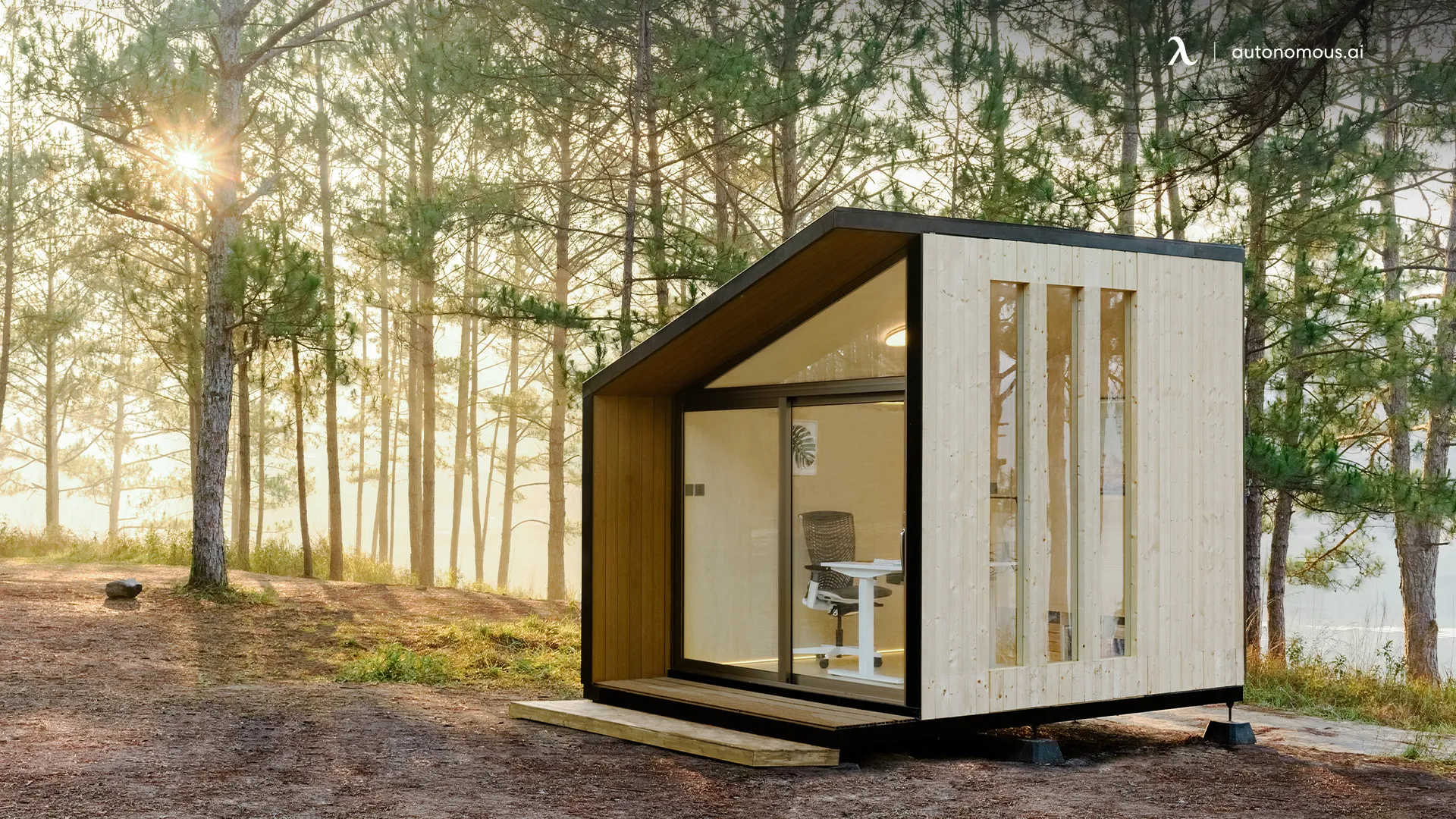
You have probably seen the same shed called four different things. Slant roof shed, single slope shed, mono-slope, skillion. They are all one roof with one plane, tilted in one direction, and the naming mess is the reason this style is harder to shop for than it should be. That single plane is also why it is the cheapest roof to frame, the easiest to fit solar to, and the one most likely to leak if you get the pitch wrong. This guide covers what the style is actually called, the pitch it needs, how designs and kits compare, and the order to build one in.
What is a slant roof shed called?
A slant roof shed is any shed with a single roof plane pitched in one direction, and it goes by at least five names: slant roof, single slope, mono-slope, skillion, and pent. Builders and retailers use them interchangeably, so searching one name will hide most of the market from you.
The one term worth separating out is lean-to. A lean-to also has a single sloped plane, but it attaches to an existing wall and takes some of its support from that structure. A slant roof shed is freestanding. The difference matters when you get to permits and to flashing, because anything attached to your house pulls the house into the job.
Here is the vocabulary in one place.
Name | Means | Where you see it |
Slant roof | Single pitched plane | US retailers and shed builders |
Single slope | Same thing | Prefab barn companies |
Mono-slope or monoslope | Same thing | Metal building suppliers |
Skillion | Same thing | Australian and NZ suppliers |
Pent roof | Same thing | UK garden buildings |
Lean-to | Single plane, attached to an existing wall | Everywhere, and often confused with the above |
If you are shopping, search at least three of these. Stock and pricing differ a lot between suppliers who use different words for the same building.
Slant roof versus gable roof: which to build
A slant roof costs less to frame and gives you more usable wall height on one side, while a gable roof gives more headroom in the middle and sheds snow off two faces instead of one. For a shed you plan to work in rather than store things in, the slant roof usually wins on usable volume per dollar.
The trade-offs are real in both directions.
Slant roof | Gable roof | |
Framing | Simplest, no ridge, fewer cuts | Ridge board, two rafter sets |
Cost to build | Lower | Higher |
Tall wall | One high side, good for windows | Even walls |
Headroom | Uneven, low at one edge | Best in the centre |
Snow | Sheds to one side, needs somewhere to go | Splits the load two ways |
Loft or storage above | Poor | Good |
Solar | Easiest, one plane, one angle | Needs the right orientation |
The thing most people underestimate is where the water and snow end up. A single plane sends everything to one edge. If that edge faces your patio, your path, or your neighbour's fence line, you have created a problem you will be solving with guttering later. Decide the slope direction before you decide anything else.
What roof pitch does a slanted roof shed need?
A slanted roof shed needs a minimum pitch of 2:12 to use asphalt shingles at all, and 4:12 or steeper for standard shingle application. Below 2:12 you are building a low-slope roof and need a membrane such as EPDM or TPO rather than shingles.
Those numbers come from the International Residential Code, and they are the single most useful thing to know before you cut a rafter. The common mistakes are building at 1:12 because it looks sleeker, then wondering why the shingles lift, or building at 2:12 without the doubled underlayment the code calls for in the 2:12 to 4:12 range.
Practical guidance by situation:
3:12 to 4:12 suits most backyard sheds. It drains properly, takes ordinary shingles, and keeps the tall wall from towering.
5:12 and steeper is worth it in snow country. Snow slides rather than sits, which matters because accumulated snow load is what collapses light shed framing. Ground snow loads are set regionally under ASCE 7, so check your county figure rather than guessing.
Under 2:12 is a deliberate choice, not a shortcut. Go there only if you want the flat modern look and you are prepared to buy a membrane roof and detail the edges properly.
Pitch also decides your material options, so settle it before you price shed roofing material.
Slant roof shed designs and sizes
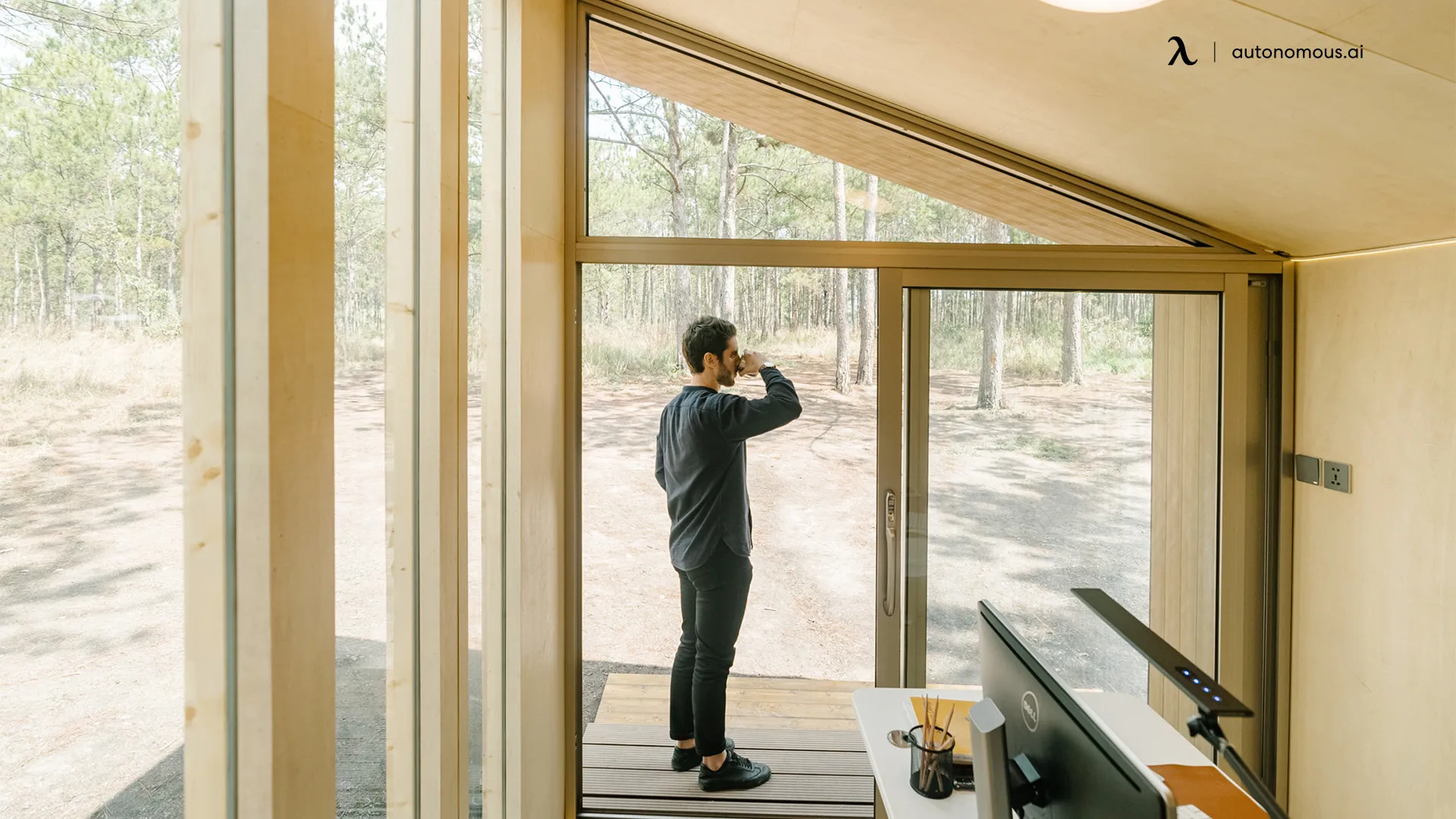
The design decision that matters most is which wall you make tall, because that sets your window wall, your door position, and where water lands. Everything else is finish.
Four layouts cover almost every slant roof shed built.
Tall wall at the front.
Door and windows go in the high wall, roof slopes back and away from you. The most common backyard layout, and the best one if the shed faces your house, because you see the tall handsome side.
Tall wall at the back.
Roof slopes toward the approach. Cheaper to build against a boundary and it keeps the shed low from the street, but you get a low door wall and less light.
Tall wall to the side.
Useful on a narrow lot where you want a long run of glass down one flank. This is the layout that reads most like a modern studio.
Tall wall to the sun.
Ignore appearance and orient the tall wall and roof plane for solar. If you plan to add panels, one plane at one angle is the easiest roof there is to fit, and it is the main practical argument for this style over a gable.
On size, 8x10 and 10x12 are the two footprints most kits and plans are built around. A 10x12 gives you room to work rather than just store, and if you are planning an office rather than storage, an 8x10 office shed is about the smallest that stays comfortable.
Slant roof shed kits versus building from plans
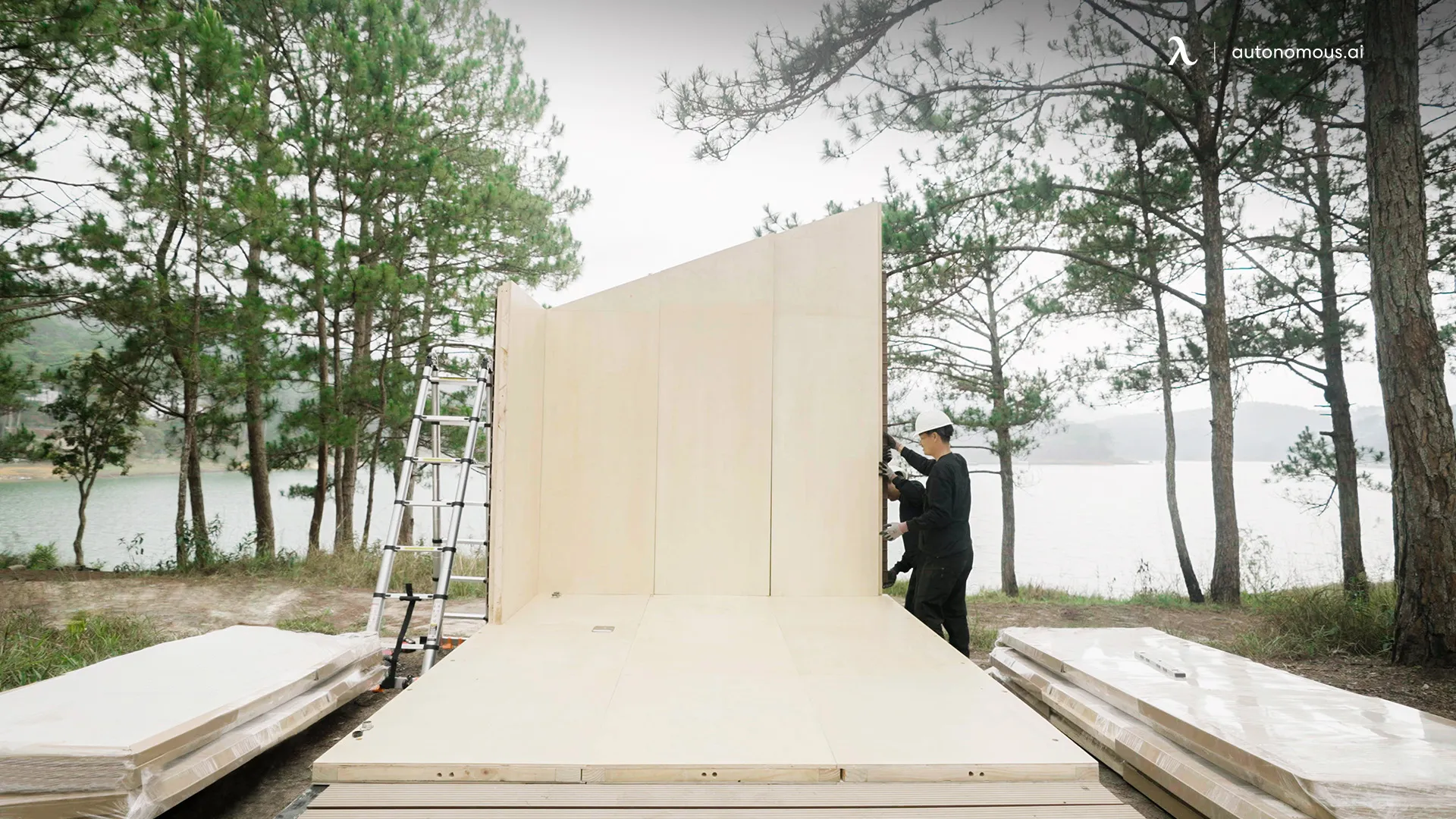
A kit saves you the framing maths and the cutting, and costs roughly 30 to 60 percent more than the same shed built from plans and a materials list. Buy the kit if you want it standing in a weekend. Build from plans if you want a size or a window layout no kit offers.
What a kit typically includes: pre-cut framing, wall panels, roof sheathing, fasteners, and instructions. What it usually does not include: the foundation, the roofing material, insulation, and anything electrical. That gap is where kit buyers get surprised.
Building from plans gives you two things a kit cannot. You can set the pitch yourself rather than accepting the manufacturer's, which matters in snow country. And you can put the tall wall where your site wants it rather than where the kit assumes.
A middle path worth knowing about is the modular shed kit, which ships as panels you bolt together and lets you change the footprint later.
How to build a slant roof shed, step by step
Build in this order, because the pitch and the slope direction are decided by the framing and cannot be changed once the walls are up.
1. Set the foundation and get it level
Level the base before anything else, because a slant roof exaggerates every error in the foundation. A shed with an uneven base and a single-plane roof will drain toward a corner rather than an edge, and you will see it as a stain on the wall within a season. Shed foundation blocks on compacted gravel are the usual answer for this size of building, set with an air gap under the floor deck.
2. Frame the two side walls at different heights
Build one side wall tall and the opposite side short, and the difference between them is your pitch. For a 10-foot span at 3:12, that is a 30-inch height difference. Work out the drop before you cut a single stud, and check the diagonal on each wall to confirm it is square before standing it.
3. Run the rafters across the slope
Set rafters at 16 or 24 inches on centre, running from the tall wall down to the short wall. Use a birdsmouth cut at each bearing point so the rafter sits flat on the top plate rather than on an edge. Add an overhang of at least 12 inches on the low side, because that is where every drop of water leaves the building.
4. Sheath, underlay, and roof
Sheath in the same direction as the slope, then underlay before you leave the site. A single-plane roof is fast to sheath and unusually easy to leave exposed overnight, which is how most shed builds get their first soaking. If your pitch sits between 2:12 and 4:12, use the doubled underlayment the code calls for.
5. Side the walls and cut the openings
Side the tall wall first so you can see how the openings sit under the roof line. On a slant roof the head heights are not equal across the building, and a window that looks right on the plan can end up two inches under a rafter. Cut openings after the siding is on and you can see the real geometry.
6. Insulate and line, if it is going to be a room
Insulate all six surfaces if this is going to be anything other than storage, because the low corner of a slant roof is the coldest point in the building. Shed insulation in the roof cavity matters more here than in a gable shed, since the roof plane is a larger share of the total envelope.
7. Deal with the water at the low edge
Gutter the low edge and take the water somewhere. This is the step people skip and then regret. One plane concentrates the entire roof area into a single line of runoff, so a 10x12 shed drops the same water on one edge that a gable shed splits over two. Run it to a butt, a soakaway, or a drain.
When a prefab pod makes more sense than building
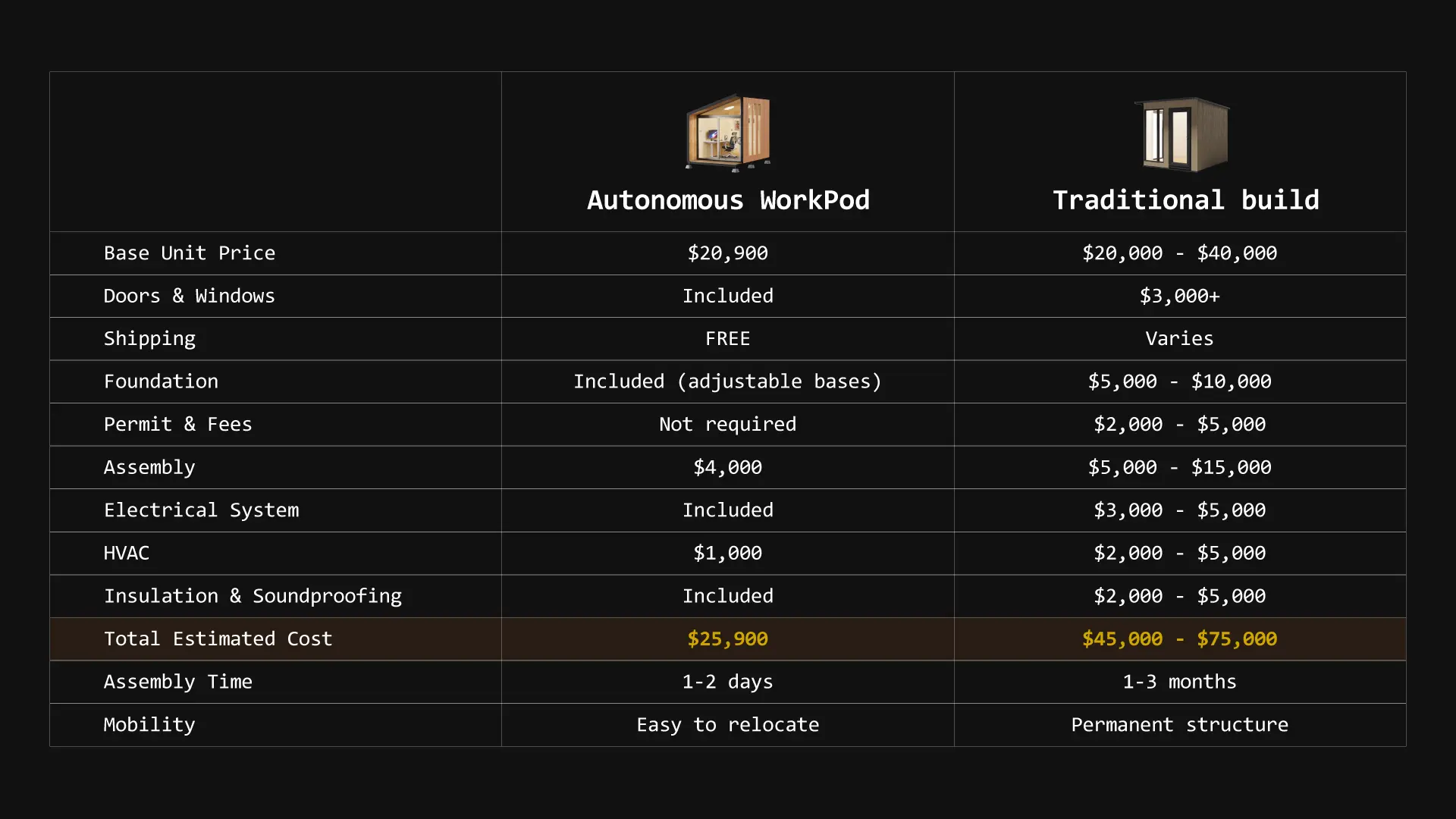
A slant roof shed is the right project if you want storage, a workshop, or a garden room and you enjoy building. If what you actually want is a working office in the garden, the maths changes, because insulation, wiring and climate control are most of the cost and none of them come with a shed kit.
Worth knowing if you are looking at this style specifically for an office: the WorkPod is the only unit in the Autonomous line with a sloped roof, running 6.8 to 9.3 feet across the span. The MetroPod and StudioPod both use a 7.25 foot flat ceiling. So if the reason you are drawn to a slant roof is the headroom and the tall window wall, the WorkPod is the one that gives you it.
Slant roof shed, built | WorkPod | |
Roof | Yours to design | Sloped, 6.8 to 9.3 ft |
Materials or price | $1,500 to $5,000 shell only | $20,900 |
Insulation | You add it | 6 layers |
Rated comfort range | None | 45 to 100 F |
Wiring | Separate job, permitted | Pre-wired, 3 outlets, ceiling light, ventilator |
Foundation | You level it | 6 adjustable feet, up to 5 degrees |
Time | Weekends | 1 to 2 days |
Warranty | None | 1 year |
The honest read: a shed shell is far cheaper and a pod is finished. If you are building for storage, do not buy a pod. If you are building for eight hours a day at a desk in January, price the full conversion before you decide, because the shell is the small part.
.webp)
FAQs
What is a sloped roof shed called?
A sloped roof shed with a single pitched plane is called a slant roof, single slope, mono-slope, skillion, or pent roof shed, depending on who is selling it. A lean-to is the same roof shape but attached to an existing wall rather than freestanding.
What are the disadvantages of a slanted roof?
The three real drawbacks are uneven headroom, concentrated runoff, and poor loft space. All the water leaves at one edge, so guttering is not optional. The low corner is the coldest and most cramped part of the building, and there is no ridge space for storage above.
How do I build a slanted roof on a shed?
Frame one side wall taller than the other, then run rafters from the tall plate down to the short plate with a birdsmouth cut at each bearing point. The height difference between the two walls sets the pitch. For a 10-foot span at 3:12, that difference is 30 inches.
What pitch should a slant roof shed be?
Between 3:12 and 4:12 for most backyard sheds. Asphalt shingles need at least 2:12 under the IRC, with doubled underlayment below 4:12. Go steeper than 4:12 in snow country so snow slides rather than accumulating, and use a membrane rather than shingles below 2:12.
Are slant roof shed kits cheaper than building from plans?
No, kits usually run 30 to 60 percent more than the same shed built from plans and a materials list. What you buy is the framing maths, the pre-cut lumber and the weekend. Kits also rarely include the foundation, roofing, insulation or wiring.
Do I need a permit for a slanted roof shed?
Usually not for the structure itself, since the IRC exempts detached accessory buildings up to 200 square feet and many local codes use a 120-square-foot line. Check whether you need a permit for a 10x12 shed in your jurisdiction, and treat any wiring as separate permitted work.
Can you put solar panels on a sloped roof shed?
Yes, and it is the easiest shed roof to fit them to. One plane at one angle means no split arrays and no shading between faces. Orient the tall wall so the roof plane faces the sun, and decide this at the framing stage rather than after.
Final thoughts
The two decisions that make or break a slant roof shed are the pitch and which way it drains. Get the pitch right for your roofing material and your snow load, point the low edge somewhere you are happy for water to go, and the rest of the build is the simplest roof there is. Before you shop, search all five names for this style, because half the market is hiding behind a word you are not using. And if the reason you want the slant is a tall window wall to work under, price the finished cost, not the shell.
References
- International Code Council, International Residential Code, roof covering minimum slope requirements and accessory structure permit exemptions, iccsafe.org
- American Society of Civil Engineers, ASCE 7, minimum design loads including regional ground snow loads, asce.org
- National Roofing Contractors Association, low-slope versus steep-slope roofing definitions and underlayment guidance, nrca.net
- United States Department of Energy, Insulation recommendations and R-value by climate zone, energy.gov