How to Charge an Apple Mouse (All Models)

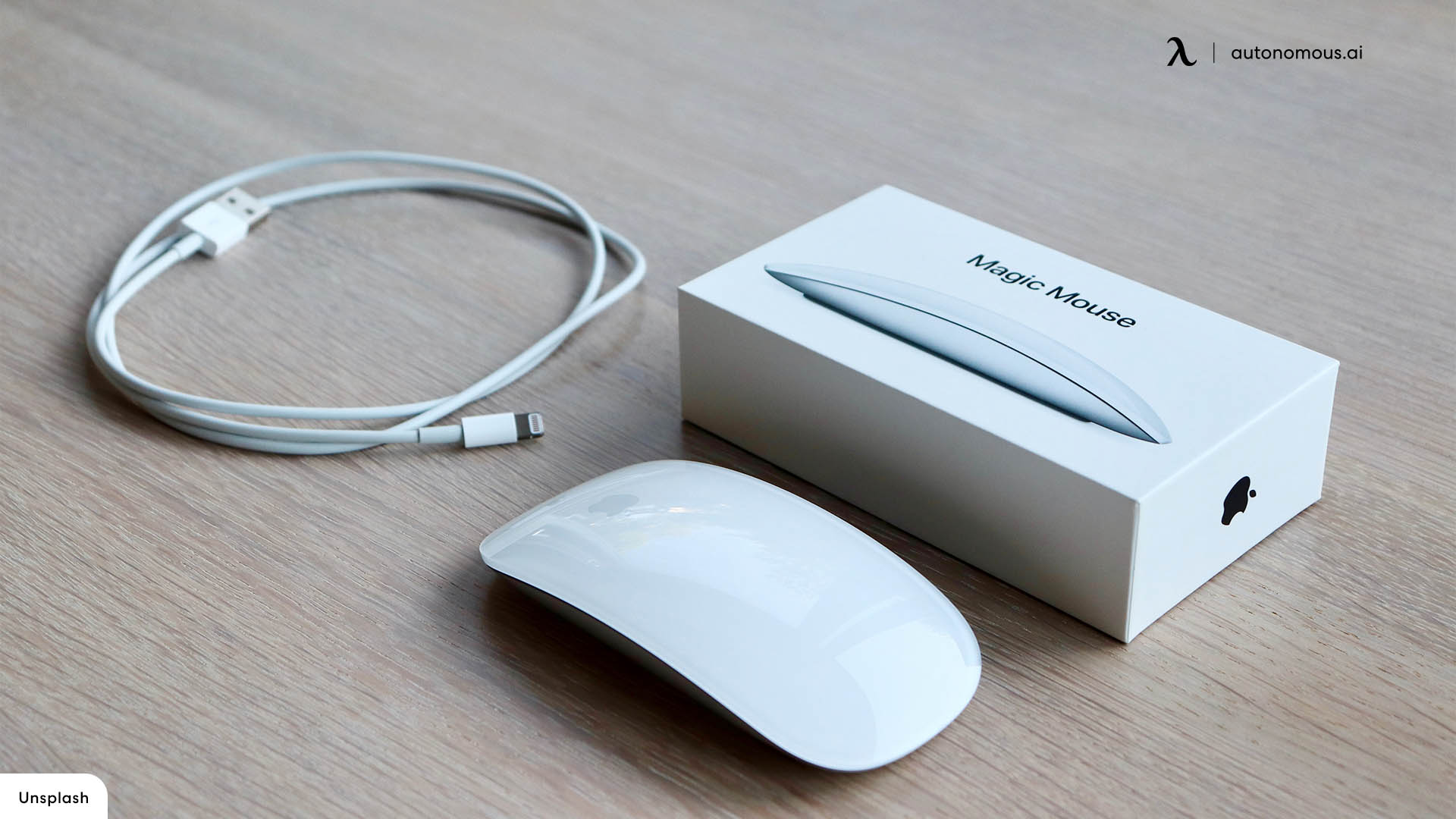
Table of Contents
- Which Magic Mouse Do You Have?
- How to Charge the Original Magic Mouse
- How to Charge the Magic Mouse 2 (Lightning)
- How to Charge the USB-C Magic Mouse (Current Model)
- How to Check Your Magic Mouse Battery Level
- Troubleshooting: Apple Mouse Not Charging
- How to Extend Magic Mouse Battery Life
- FAQs
- Final Thoughts
Your Magic Mouse stopped working mid-session. You flip it over, find the port on the underside, plug it in — and realize the mouse is now face-down and unusable until it has enough charge to function again.
That sequence catches most people off guard the first time. This guide covers how to charge an Apple Mouse across all three current models — the original Magic Mouse (AA batteries), Magic Mouse 2 (Lightning), and the current USB-C version — along with how to check battery level, how long charging takes, and what to do when the battery dies completely.
Which Magic Mouse Do You Have?
The Magic Mouse has been sold in three distinct versions, each with a different battery system and charging method. Identifying your model before anything else prevents the most common mistake: using the wrong cable or following instructions that don't apply to your hardware.
The quickest way to identify your model is to flip the mouse over and look at the underside.
Model | Battery Type | Charging Cable | How to Identify |
Original Magic Mouse | 2× AA batteries (removable) | None — batteries replaced, not recharged | Sliding battery compartment door on underside |
Magic Mouse 2 | Built-in rechargeable | Lightning to USB-A or USB-C | Lightning port (small, oval) on underside; no battery door |
Magic Mouse (USB-C) | Built-in rechargeable | USB-C | USB-C port (small, rounded rectangle) on underside; no battery door |
The Magic Mouse 2 and the current USB-C model look nearly identical from above. The only physical difference is the port shape on the underside. If you're unsure, check the port: Lightning is narrower and oval; USB-C is slightly wider with fully rounded corners.
The USB-C model became the standard retail unit in late 2023, shipping with all new iMac purchases from that point. If you bought an iMac or a standalone Magic Mouse after late 2023, you almost certainly have the USB-C version.
One thing all three models share: none of them display a charging indicator light. Knowing how to check battery status through macOS is covered in a later section. If you're using the Magic Mouse with a Windows PC, the pairing process differs from Mac — how to connect Magic Mouse to Windows walks through the full setup.
How to Charge the Original Magic Mouse
The original Magic Mouse does not have a built-in battery. It runs on two AA batteries, which means charging the original Magic Mouse is simply a matter of replacing the batteries when they run out.
- Flip the mouse over and slide the battery compartment door toward the back of the mouse to open it.
- Remove both AA batteries.
- Insert two fresh AA batteries, matching the polarity markings (+ and −) inside the compartment.
- Slide the battery door back until it clicks into place.
- Turn the mouse back on using the power switch on the underside.
Standard AA batteries work fine. Rechargeable AA batteries are also compatible and cost less over time if you go through batteries frequently.
One thing worth noting: the original Magic Mouse has a physical power switch on the underside. If the mouse isn't responding after a battery swap, check that the switch is in the on position before troubleshooting further.

How to Charge the Magic Mouse 2 (Lightning)
The Magic Mouse 2 charges through a Lightning port located on the underside of the mouse. To charge the Magic Mouse 2, connect a Lightning cable to the port on the bottom, then connect the other end to a USB port on your Mac or a USB power adapter.
Here's the full sequence:
- Locate the Lightning port on the underside of the mouse — it sits near the bottom edge, below the regulatory text.
- Connect the Lightning end of your Magic Mouse 2 charging cable to that port.
- Plug the other end into a USB-A port on your Mac, or into a USB power adapter connected to a wall outlet.
- Leave the mouse to charge. No confirmation screen or indicator light will appear — this is normal.
The mouse cannot be used while charging. The port placement on the underside requires the mouse to be inverted, which makes it physically unusable during this time. This is a design limitation, not a malfunction.
For charging the Apple Magic Mouse 2, a wall adapter generally delivers more consistent output than a Mac's USB port — on older Mac models in particular. If you have the choice, the wall adapter is the more reliable option.
According to Apple, a full charge takes approximately 2 hours from 0%. A 2-minute charge delivers roughly 9 hours of use — enough to get through a full work session if the battery dies unexpectedly. If you're mid-work and the mouse just died, plug it in for 2 minutes, set it aside, and keep working via keyboard or trackpad while it recovers enough charge to function.
How to Charge the USB-C Magic Mouse (Current Model)
The USB-C Magic Mouse charges through a USB-C port on the underside of the mouse. The process is identical to the Magic Mouse 2, with one difference: the cable is USB-C to USB-C instead of Lightning.
- Flip the mouse over and locate the USB-C port near the bottom edge, below the regulatory text.
- Connect one end of the USB-C cable to the port on the mouse.
- Plug the other end into a USB-C port on your Mac or a USB-C power adapter.
- Leave the mouse to charge. No indicator light will appear during charging — this is expected behavior.
Charge time is the same as the Magic Mouse 2: approximately 2 hours for a full charge, and 2 minutes for enough power to last a full work session.
One detail worth knowing: the USB-C Magic Mouse does not support fast charging. It draws a fixed low-wattage rate regardless of the adapter you use. A 20W and a 65W charger will produce the same result. Use whichever USB-C adapter is available — upgrading to a higher-wattage charger will not speed things up.
The USB-C cable included in the box also pairs the mouse to your Mac simultaneously, which is relevant for first-time setup. If the mouse isn't connecting wirelessly after initial use, plug it in via USB-C for a moment to re-establish the pairing.
Like the Magic Mouse 2, the USB-C model cannot be used while the Apple Magic Mouse charge port is in use. The underside placement is unchanged from previous versions.
How to Check Your Magic Mouse Battery Level
The Magic Mouse battery level is visible in macOS through the Bluetooth menu — but only when the mouse is connected wirelessly, not while it is physically charging via cable.
Method 1: Control Center
- Click the Control Center icon in the top-right corner of the menu bar (the two-toggle icon).
- Click Bluetooth.
- Your Magic Mouse will appear in the device list with a battery percentage next to it.
Method 2: Bluetooth Menu Bar Icon
If you have the Bluetooth icon enabled in your menu bar:
- Click the Bluetooth icon.
- Hover over or click your Magic Mouse in the device list.
- Battery percentage will appear alongside the device name.
One thing to keep in mind: after unplugging the mouse from charging, give it a few seconds to reconnect via Bluetooth before checking the percentage. The reading won't update instantly.
macOS sends a low battery notification at approximately 10%. If you respond to that alert, you won't need to check manually. If you prefer to monitor it yourself, Control Center is the most direct path.
Troubleshooting: Apple Mouse Not Charging
Most Apple mouse charging problems come down to one of three situations: a connection issue, a completely depleted battery, or faster-than-expected battery drain. Each has a specific fix.
1. Mouse Won't Charge at All
If the mouse isn't responding after being plugged in, work through these checks in order:
- Reseat the cable. Disconnect both ends of the cable and reconnect firmly. Lightning and USB-C connections can sit slightly loose without appearing to be.
- Check the port for debris. The charging port on the underside of the mouse accumulates lint over time. Use a dry toothpick to clear any visible debris. Do not use compressed air directly into the port.
- Try a different cable. Cable faults are more common than port faults. If a replacement cable works, the original cable is the problem.
- Try a different power source. Switch from charging through your Mac to a wall adapter, or vice versa.
- Reset Bluetooth on your Mac. Open System Settings → Bluetooth, turn Bluetooth off, wait 10 seconds, turn it back on, then try the cable again. Occasionally a Bluetooth state conflict prevents the Mac from recognizing the mouse as connected, which can affect charging status reporting.
If none of these steps resolve it, the issue is likely hardware-related and warrants a visit to Apple Support or an Apple Authorized Service Provider.
2. Mouse Died Completely — No Input Device Available
When the Magic Mouse battery is fully depleted, it cannot be used while charging. If it's your only input device, this creates an immediate problem.
The fix is straightforward: plug the mouse in and wait 2–3 minutes. A brief charge is enough for the mouse to power on and function. Do not attempt to use it immediately — give it the full 2–3 minutes before unplugging.
While you wait, macOS is fully navigable by keyboard:
- Tab moves between interface elements
- Space or Return activates the selected element
- Arrow keys navigate menus and lists
- Command + Space opens Spotlight — the fastest way to launch apps or open files
- Command + Tab switches between open applications
- Command + Q quits the current application
If you're on a MacBook, the built-in trackpad remains fully functional regardless of what's happening with an external mouse. If you're looking for an alternative pointing device that charges without this limitation, the best USB-C mouse for Mac options include several that support charging and use simultaneously.
Keeping a short USB-C or Lightning cable within reach at your desk eliminates this scenario before it starts. A cable stored in a drawer is easy to forget until the moment you need it.
3. Battery Drains Faster Than Expected
If the Magic Mouse battery is depleting significantly faster than the approximately one-month estimate, two factors are most likely responsible.
First, gesture load. Running multiple gestures simultaneously — natural scrolling, page swipes, and Mission Control enabled together — increases power draw noticeably. Go to System Settings → Mouse and disable any gestures you don't actively use.
Second, Bluetooth range. A mouse operating near the edge of its Bluetooth range draws more power maintaining the connection. If your Mac is across the room or behind obstacles, move it closer or remove the obstructions.
If battery life has degraded gradually over time rather than suddenly, the built-in battery may have worn down through charge cycles. This is normal behavior for lithium batteries after several years of use. Apple Support can assess battery health if degradation is significant.
.webp)
How to Extend Magic Mouse Battery Life
The Magic Mouse battery lasts approximately one month under typical use, but a few simple habits can help maintain that runtime and protect the battery's long-term health.
- Charge before it hits 10%
Lithium batteries wear down faster when repeatedly drained to zero. macOS sends a low battery alert at around 10% — use that as your prompt to charge rather than waiting for the mouse to die completely. This applies to both the Magic Mouse 2 and the USB-C model.
- Turn the mouse off when not in use
The physical power switch on the underside of the mouse is there for a reason. If you're stepping away from your desk for an extended period — a few hours or overnight — switching the mouse off stops it drawing power entirely. Most users never touch this switch, which means the mouse sits idle in a low-power Bluetooth state rather than being fully off. Over days and weeks, that difference adds up.
- Disable gestures you don't use
As covered in the troubleshooting section, running multiple gestures simultaneously increases power draw. Go to System Settings → Mouse and review what's enabled. Turning off gestures you don't actively rely on is one of the most direct ways to extend battery life between charges.
For a full breakdown of which gestures are worth keeping, Magic Mouse tips covers the complete gesture system and how to configure it.
- Store it correctly during extended breaks
If you won't be using the mouse for a week or more, turn it off and store it at a partial charge rather than fully depleted or fully charged. Both extremes accelerate lithium battery wear over time. Around 50% is the commonly recommended storage level for lithium batteries.
None of these habits require significant effort. The power switch and gesture settings together cover most of the gap between a mouse that lasts three weeks and one that consistently reaches the full month.
FAQs
How do I charge an Apple Magic Mouse?
To charge an Apple Magic Mouse, connect the included cable to the port on the underside and plug the other end into a Mac or power adapter. The process is the same for first-time and regular charging, and the mouse pairs automatically during the first connection.
What cable do I need to charge an Apple Magic Mouse?
You need a Lightning or USB-C cable, depending on your model. The Magic Mouse 2 uses a Lightning cable, while the current Magic Mouse uses USB-C. Any standard cable of the correct type will work.
Can you charge a Magic Mouse with an iPhone charger?
Yes, if the cable type matches your model. A Lightning iPhone charger works with Magic Mouse 2, and a USB-C iPhone charger works with the USB-C Magic Mouse. Charging speed remains the same across compatible adapters.
How long does it take to charge an Apple mouse fully?
A full charge takes about 2 hours. A quick 2-minute charge provides roughly 9 hours of use, which is usually enough to keep working.
Why can't I use my Magic Mouse while it's charging?
The charging port is on the underside of the mouse, so it must be flipped over while plugged in. This makes it unusable during charging. Apple’s Magic Keyboard and Trackpad do not have this limitation.
How do I know when my Apple mouse is fully charged?
There is no indicator light on the mouse. To check battery level, open Control Center → Bluetooth on your Mac and view the percentage. A reading near 100% indicates a full charge.
Can I charge my Magic Mouse and use my Mac at the same time?
Yes. Your Mac works normally while the mouse charges. The limitation applies only to the mouse — you can use a trackpad or keyboard to continue working.
Does the Magic Mouse charge faster with a higher-wattage adapter?
No. The Magic Mouse draws a fixed low-wattage rate regardless of the adapter's output. A 20W and a 65W USB-C adapter will charge the mouse at the same speed. Using a higher-wattage charger will not reduce charge time.
How do I charge an Apple mouse when the battery is completely dead?
Plug the mouse in using its charging cable and wait 2–3 minutes. A brief charge is sufficient for the mouse to power on and function. While waiting, macOS can be navigated using keyboard shortcuts — Command + Space opens Spotlight, and Tab moves between interface elements.
Is it bad to leave the Magic Mouse charging overnight?
No, occasional overnight charging is not harmful. The mouse stops drawing current once fully charged. That said, charging before the battery drops below 10% and unplugging once charged is a better long-term habit for preserving battery health over years of use.
Why is my Apple mouse not holding a charge like it used to?
Battery capacity decreases over time with normal use. If battery life drops significantly from the typical one-month range, the internal battery may need servicing through Apple or an authorized provider.
Where is the charging port on an Apple Magic Mouse?
The charging port is located on the underside of the mouse. This placement requires the mouse to be flipped over while charging, which is why it cannot be used during that time.
Why is my Magic Mouse not charging?
This is usually caused by a loose or incompatible cable, debris in the charging port, or a faulty adapter. Try a different cable, clean the port gently, and connect to a known working power source. If the issue persists, the battery or port may need servicing.
Do all Apple mice need to be charged?
No. The original Magic Mouse uses replaceable AA batteries, while the Magic Mouse and newer models have built-in rechargeable batteries that require charging.

Final Thoughts
Knowing how to charge an Apple mouse comes down to one thing first: identifying which model you have. The cable, the steps, and the expectations around charge time all follow from that. The original uses AA batteries, the Magic Mouse 2 uses Lightning, and the current model uses USB-C — but all three share the same core limitation of not being usable while plugged in.
Keep the right cable within reach, respond to the 10% battery alert rather than waiting for a full shutdown, and the Magic Mouse rarely becomes an inconvenience.