AI for Mental Health in the Workplace

Table of Contents
- What Does “AI for Mental Health” Mean at Work?
- Why Mental Health Challenges Are Hard to Address in Offices
- How AI Is Being Used to Support Mental Health at Work
- Benefits of AI-Supported Mental Health in the Workplace
- Where AI Has Clear Limits
- Ethics, Privacy, and Trust
- The Overlooked Link Between Workspaces and Mental Health
- Bringing Mental Health Awareness Into Everyday Work
- FAQs
- Conclusion
Mental health at work has become harder to ignore. Long hours, constant context switching, remote and hybrid schedules, and always-on communication have changed how people experience stress. Yet most workplace mental health efforts still rely on reactive solutions - programs that activate only after burnout, disengagement, or absenteeism has already surfaced.
This gap has led to growing interest in AI for mental health in the workplace. Not as a replacement for human care or clinical treatment, but as a way to introduce awareness earlier, reduce friction around support, and help people recognize strain before it escalates. In this context, artificial intelligence is less about diagnosis and more about understanding patterns, habits, and environments that influence how people feel day to day.
What Does “AI for Mental Health” Mean at Work?
When people hear phrases like AI in mental health care or AI powered mental health companion, it’s easy to assume therapy bots or clinical tools. In workplace settings, the meaning is more limited - and intentionally so.
Using AI for mental health at work typically refers to systems that:
- Support emotional awareness and wellbeing
- Help identify patterns related to stress, overload, or fatigue
- Offer non-clinical guidance or self-reflection prompts
- Reduce barriers to accessing support
These tools are not designed to diagnose mental health conditions or replace professional care. Instead, they operate in the space between “everything is fine” and “something is wrong,” where many employees spend most of their time. For those struggling with attention or impulse control, some therapist chair offer an adhd test free to explore if further evaluation could help.
This distinction matters. The most effective AI mental health tools at work are those that remain supportive, optional, and respectful of boundaries.
Why Mental Health Challenges Are Hard to Address in Offices
Workplace mental strain rarely appears suddenly. It builds gradually through long stretches of cognitive load, limited recovery time, and environments that quietly demand more than they give back.
Several factors make mental health difficult to address at work:
- Invisible progression: Stress accumulates slowly and often goes unnoticed until performance drops.
- Stigma: Employees may hesitate to raise concerns, even in supportive cultures.
- Delayed signals: Managers often see outcomes - missed deadlines, disengagement - without seeing the underlying causes.
- Environmental blind spots: Noise, posture, lighting, and temperature are rarely considered mental health factors, despite their impact.
Because these signals are subtle and distributed over time, traditional wellness programs often miss the moments when intervention would be most helpful.
How AI Is Being Used to Support Mental Health at Work
AI’s role in workplace mental health is expanding, but most applications fall into a few practical categories.
1. Pattern Awareness and Early Signals
Rather than focusing on individual behavior, AI systems often look at patterns across time. This might include identifying prolonged workdays, limited breaks, or recurring periods of high cognitive load.
The value here isn’t labeling stress, but highlighting trends that suggest recovery may be missing. When used responsibly, this kind of insight helps organizations and individuals recognize when workload balance needs attention.
2. Digital Support and Self-Guided Tools
Many AI apps for mental health in the workplace function as low-pressure support tools. These can include:
- Check-in prompts that encourage reflection
- Journaling or mood-tracking features
- Short guided exercises for focus or stress reduction
Because these tools are available on demand and don’t require disclosure to others, they can feel safer than traditional programs for some employees. Some platforms are also starting to blend self-guided tools with more structured support. AI-powered coaching tools like Marlee, for example, offer programs such as Vital Wellbeing, which help remote workers build healthier routines and manage stress through personalized online coaching.
3. Work Rhythm and Recovery Insights
AI can also support mental health by observing work rhythms rather than emotions directly. Long periods without breaks, irregular schedules, or frequent late-day activity often correlate with mental fatigue.
By making these patterns visible, AI helps people recognize when rest and recovery are missing - not as a judgment, but as information.
4. Environmental Context Awareness
Mental strain is often amplified by physical environments. Poor air quality, constant noise, uncomfortable posture, or static work patterns can increase cognitive fatigue even when workload remains constant.
Some AI-supported systems connect environmental awareness with mental wellbeing, helping people understand how their surroundings influence focus and stress throughout the day.
Benefits of AI-Supported Mental Health in the Workplace
When implemented carefully, AI for mental health offers several advantages over traditional approaches.
- Earlier awareness: Signals appear before burnout becomes visible.
- Lower stigma: Neutral data reduces the emotional weight of asking for help.
- Scalability: Support can reach large, distributed teams consistently.
- Personalization: Guidance adapts to individual patterns rather than one-size-fits-all programs.
- Continuity: Support exists daily, not just during scheduled initiatives.
Importantly, these benefits depend on trust. AI works best when employees understand its purpose and feel in control of how it’s used.
Where AI Has Clear Limits
AI is not a mental health professional, and treating it as one creates risk. Responsible workplace use acknowledges clear boundaries.
AI should not:
- Diagnose mental health conditions
- Replace therapy, counseling, or medical care
- Make performance evaluations or employment decisions
- Operate without transparency or consent
The strongest implementations frame AI as a companion to existing support systems, not a substitute for them. When escalation is needed, human care remains essential.
Ethics, Privacy, and Trust
Mental health data is sensitive. Even when AI systems avoid clinical information, trust depends on how data is handled and communicated.
Key considerations include:
- Transparency: Employees should know what data is collected and why.
- Consent: Participation should be voluntary wherever possible.
- Aggregation: Insights should focus on trends, not individual surveillance.
- Boundaries: Clear separation between wellbeing data and performance metrics.
Organizations that treat AI as a support tool rather than a monitoring system are far more likely to see positive outcomes.
The Overlooked Link Between Workspaces and Mental Health
Mental health at work is often discussed as a purely psychological issue, but the physical environment plays a meaningful role. Cognitive fatigue doesn’t come only from tasks - it’s also shaped by posture, movement patterns, noise, and air quality over the course of the day.
When people remain static for long periods, work in uncomfortable conditions, or lack cues to pause and reset, mental strain tends to build faster. Over time, this can contribute to focus lapses or the kind of mental blocks in the workplace that make even familiar tasks feel harder than they should.
These environmental factors rarely trigger immediate alarms, yet they influence how resilient people feel across the day. This helps explain why many mental health issues caused by the workplace are linked not just to workload or pressure, but to how work is physically experienced. As a result, mental health support is often most effective when it’s paired with awareness of how work actually happens - not only how it’s planned or scheduled.
Bringing Mental Health Awareness Into Everyday Work
One emerging approach to workplace wellbeing is bringing awareness closer to where work happens instead of relying solely on HR programs or periodic check-ins.
Rather than asking people to reflect after the fact, AI-supported systems can help surface patterns in real time:
- Long stretches without movement
- Extended focus without recovery
- Environmental conditions that contribute to fatigue
This kind of awareness supports self-regulation. Small adjustments - standing sooner, stepping away briefly, or adding light movement such as seated stretches - often happen naturally once people can see the patterns forming. For physical tension that builds during prolonged sitting, simple stretches for neck tension or targeted sitting sciatica stretches can help reduce discomfort before it compounds into mental fatigue.
Awareness can also support cognitive recovery. Brief resets, such as morning brain exercises, help restore focus without disrupting the workday, making mental health support feel like part of everyday work rather than a separate intervention.
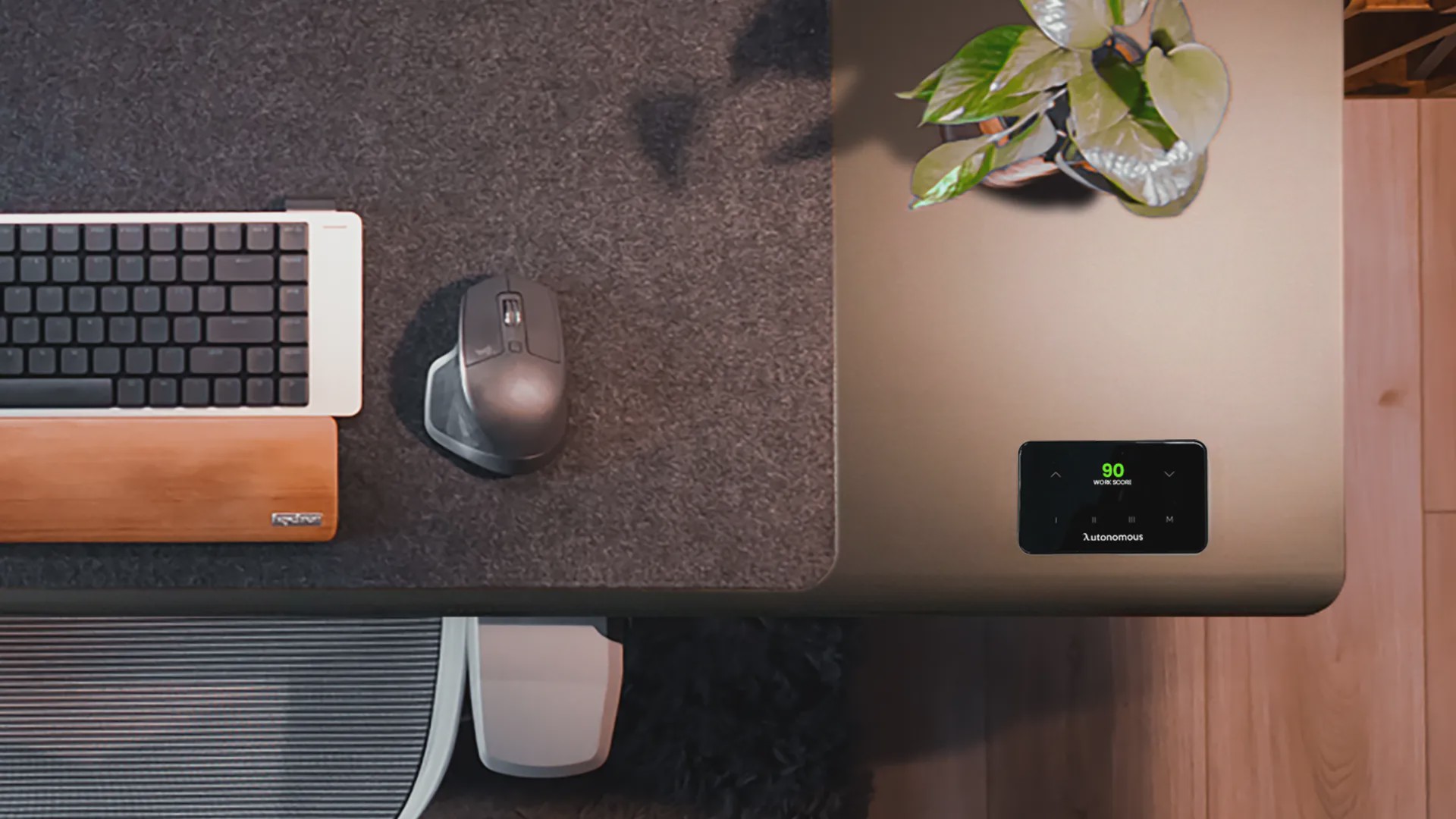
In this broader context, tools like Autonomous Desk AI fit as part of an ecosystem rather than a standalone solution. By combining environmental sensing, movement awareness, and habit insights at the workstation level, desks like these help mental wellbeing become part of everyday work rather than a separate initiative.
FAQs
How can AI help mental health in the workplace?
AI supports mental health by identifying patterns related to stress, workload, and recovery, helping people recognize strain earlier and adjust before burnout develops.
Is AI replacing human mental health support at work?
No. AI is meant to complement human care, not replace it. Professional support remains essential when deeper intervention is needed.
Can AI detect burnout?
AI does not diagnose burnout, but it can highlight patterns - such as prolonged overwork or lack of breaks - that are commonly associated with burnout risk.
Are AI mental health tools safe for employees?
They can be when implemented transparently, ethically, and with clear boundaries around data use and privacy.
What’s the difference between AI for wellbeing and AI in mental health care?
AI in mental health care often refers to clinical applications. Workplace wellbeing tools focus on awareness, habits, and prevention rather than treatment.
Do employees need training to use AI mental health tools?
Most tools are designed to be intuitive, but clear communication about purpose and use helps build trust and adoption.
Conclusion
AI for mental health in the workplace works best when it stays quiet, supportive, and human-centered. Its value isn’t in replacing care or enforcing behavior, but in helping people notice patterns that are easy to miss during busy workdays. This kind of awareness complements a broader understanding of wellbeing, including the distinction between mental health and emotional health, which are often discussed together but experienced differently at work.
As work continues to evolve, the most effective mental health strategies will be those that integrate awareness into everyday routines - where strain begins, not where it ends. Whether through environmental cues, habit insights, or supportive tools such as emerging mental wellness apps, thoughtful use of AI can help workplaces move from reactive support toward earlier, more sustainable care for the people inside them.