6 Best Adjustable Desk Legs for the Tabletop You Already Own

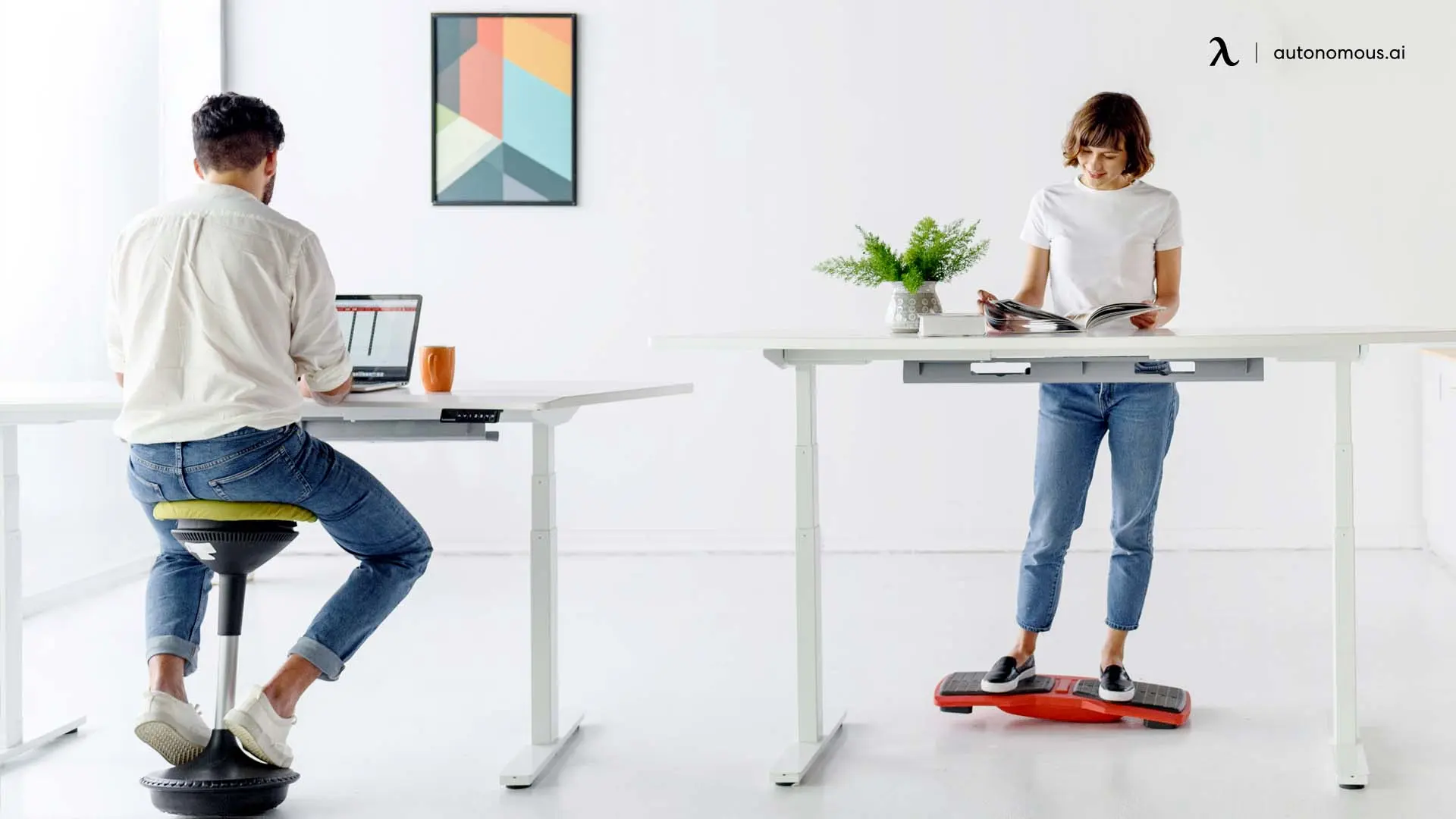
The best adjustable desk legs for most people with their own tabletop are a dual-motor, two-leg frame that lifts at least 250 lb and reaches your standing elbow height once the top is on. The catch is that lift capacity includes the top, and a solid wood butcher block can use about 70 lb of it before a monitor goes on. Below are six legs-only frames, how to match one to your height and top, and what assembly involves.
Which adjustable desk legs should you buy?
Start with the Autonomous Desk DIY 2-Stage for a 48 to 60 in top on a budget, the UPLIFT V3 2-Leg if you need the widest height range, the Autonomous Desk DIY L-shape for a corner, and the VertDesk v3 Plus for heavy loads. The IKEA IDÅSEN underframe suits light setups you want to pick up in a store, and the NewHeights Elegante XT is the high-cost option built for long-term stability.
| Leg set | Best for | Lift capacity | Height range |
|---|---|---|---|
| Autonomous Desk DIY 2-Stage | Most 48-60 in tops | 250 lb | 27.2-46.5 in (no top) |
| UPLIFT V3 2-Leg | Short and tall users | 355 lb | 22.6-48.7 in (with 1 in top) |
| Autonomous Desk DIY L-shape | Corner or L-shaped tops | 400 lb | 28.4-47 in (no top) |
| VertDesk v3 Plus | Heavy loads | 450 lb | 25.9-46.4 in |
| IKEA IDÅSEN underframe | Light setups, store pickup | 165 lb | 23.3-48.9 in |
| NewHeights Elegante XT | Long-term stability | 325 lb | 22.9-49.9 in |
Makers measure height in different ways. Autonomous lists the frame without a top, UPLIFT says its range is "with 1" thick desktop", and the others do not say. Add your own top's thickness to any "no top" figure before you compare.
6 best adjustable desk legs for a top you already own
All six are sold as legs only, with no desktop included. Specs and list prices come from each maker's or retailer's product page, not from our own testing.
1. Autonomous Desk DIY 2-Stage: for most 48 to 60 in tops
The Autonomous Desk DIY 2-Stage is a two-leg, dual-motor frame rated for 250 lb, with a height range of 27.2 to 46.5 in measured without a top. It moves at 1.1 in per second at 45 dB, and the frame stretches from 39.8 to 59 in long. Autonomous recommends tops from 48 to 60 in long and 26 to 32 in deep.
This is the same frame that sits under the Autonomous Desk 2, so the video shows it with a factory top. It suits someone with a standard-size top and a one or two monitor setup who wants motorized desk legs without paying for a commercial frame. The honest limit is the low end: with a 1 in top the lowest desk height is about 28.2 in, so measure your seated elbow height first if you are on the short side.
| Pros | Cons |
|---|---|
|
|
It comes in white or black, and the optional cable tray and a matching top sit with it in the Autonomous frame collection.

2. UPLIFT V3 2-Leg Standing Desk Frame: for very short or very tall users
The UPLIFT V3 2-Leg frame has the widest height range in this list, 22.6 to 48.7 in with a 1 in top, from 3-stage legs and two motors. UPLIFT lists 355 lb in its spec table, lists a frame width of 41.3 to 72.2 in for tops 42 to 80 in wide and 24 or 30 in deep, and covers it with a 15-year warranty. UPLIFT lists it at $469, rated 4.95 from 1,691 reviews.
This frame suits households where one person is well under or well over average height, because the 22.6 in low end reaches seated heights the 2-stage frames cannot. The trade-off is cost: the keypad upgrades and accessories in UPLIFT's configurator add up quickly over the base price.
| Pros | Cons |
|---|---|
|
|

3. Autonomous Desk DIY L-shape: for a corner desk
The Autonomous Desk DIY L-shape is a three-leg frame with a motor in each leg, rated for 400 lb with a height range of 28.4 to 47 in without a top. It lifts at 2.3 in per second at 50 dB, the main run adjusts from 42 to 71 in, and it has anti-collision on its spec sheet. One cable tray is included.
The same frame carries the Autonomous Desk 2 L-Shaped, where the short side attaches at either end with no extra parts, as this clip shows.
It suits a corner setup with two or three monitors, or a top you had cut in an L. The limit is the top itself: an L-shaped top is heavy and awkward, so plan for two people at assembly, and check that your return depth fits the 27.5 in feet. For more corner frames, compare this one with the picks in our L-shaped standing desk frame roundup.
| Pros | Cons |
|---|---|
|
|
Like the 2-Stage, it carries a 10-year frame warranty and comes in white or black.

4. VertDesk v3 Plus: for heavy loads
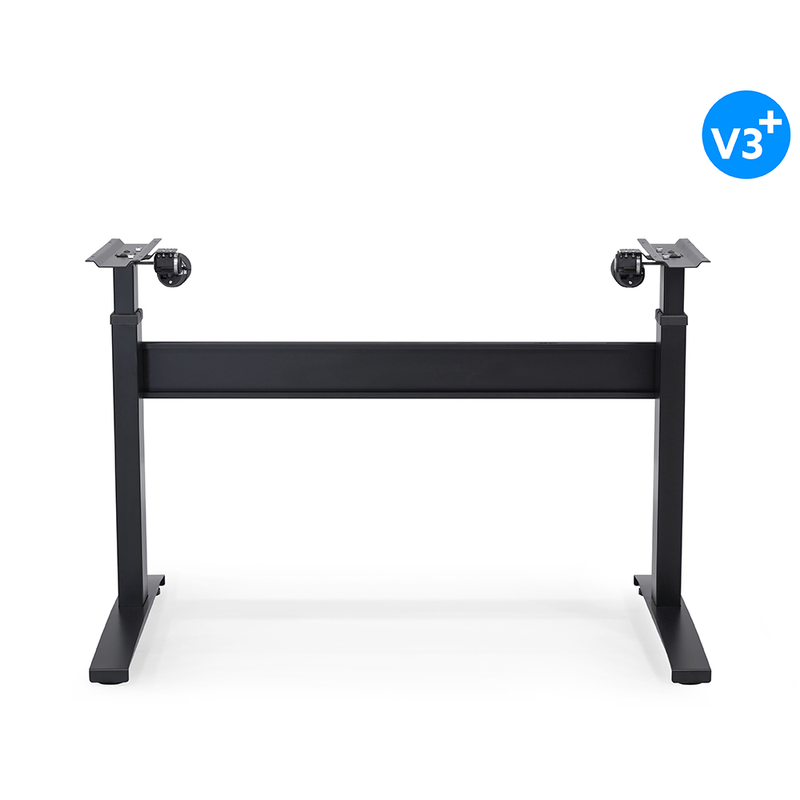
The VertDesk v3 Plus base lifts 450 lb, the most in this list, with dual motors and a single-piece steel cross support. BTOD lists a height range of 25.875 to 46.375 in, an adjustment speed of 1.24 in per second, collision avoidance, a lifetime warranty and 60-day returns.
The frame comes in four fixed widths from 33.125 to 69.125 in rather than one telescoping size, so you pick the width that matches your top. White is offered only in the three larger widths. It suits a heavy hardwood top with monitor arms, a large tower or audio gear. Its limit is the top end: at 46.375 in it reaches less high than UPLIFT or NewHeights, which matters if you are tall.
| Pros | Cons |
|---|---|
|
|
5. IKEA IDÅSEN sit/stand underframe: for light setups and store pickup
The IKEA IDÅSEN underframe is a legs-only frame rated for a 165 lb maximum load, with a minimum height of 23¼ in and a maximum of 48⅞ in on its spec sheet. IKEA also describes the desk height as 24¾ to 50 in, carries a 10-year warranty and allows returns within 365 days. IKEA lists it at $600, rated 4.6 from 84 reviews.
It suits someone who wants to collect the frame from a store and can live with a light load. The 165 lb rating is the lowest here, so a solid wood top plus two monitors on arms can get close to it. IKEA designs it around its own IDÅSEN tops of 47¼ x 27½ in and 63 x 31½ in; other tops need your own pilot holes.
| Pros | Cons |
|---|---|
|
|

6. NewHeights Elegante XT: for long-term stability on a big budget
The NewHeights Elegante XT base uses extruded aluminum columns and German Ketterer dual motors, rated for 325 lb at 1.55 in per second. BTOD's spec list gives an adjustment range of 22⅞ to 49⅞ in, while its summary says 24 to 51 in. It carries a lifetime warranty with 60-day returns, and BTOD lists it at $1,990.99.
It suits a buyer who wants a frame to outlast several tops and is willing to pay several times the price of the others for it. Note that the cross support is an option at checkout, not a default, so add it if lateral wobble worries you.
| Pros | Cons |
|---|---|
|
|
If you would rather skip the build and buy a complete office standing desk, the same frames are sold with a top attached.
How much weight can adjustable desk legs hold?
Adjustable desk legs in this list hold 165 to 450 lb, but that rating covers the top as well as everything on it. Subtract the top's weight first to see what is left for monitors, arms and a computer.
Solid wood is where the math surprises people. Hard maple and red oak have a specific gravity of about 0.63 at 12% moisture in the USDA Wood Handbook, which works out to roughly 44 lb per cubic foot. A 60 x 30 x 1.5 in butcher block is 1.56 cubic feet, so it weighs about 69 lb on its own. A 72 x 30 x 1.75 in slab is closer to 96 lb.
Here is what that 69 lb top leaves on each frame:
| Leg set | Rated lift | Left after a 69 lb top |
|---|---|---|
| Autonomous Desk DIY 2-Stage | 250 lb | 181 lb |
| UPLIFT V3 2-Leg | 355 lb | 286 lb |
| Autonomous Desk DIY L-shape | 400 lb | 331 lb |
| VertDesk v3 Plus | 450 lb | 381 lb |
| IKEA IDÅSEN underframe | 165 lb | 96 lb |
| NewHeights Elegante XT | 325 lb | 256 lb |
To check your own setup, multiply length x width x thickness in inches, divide by 1,728 for cubic feet, and multiply by your wood's weight per cubic foot. Then add your gear, and leave some headroom: a frame running near its limit lifts slower and works its motors harder.

Spread the load, too. Two monitors on one clamp near a corner put more strain on one leg than the same weight centered over the crossbar.
How to choose adjustable desk legs
Choose adjustable desk legs by checking height range first, then motor count, column stages, frame width, stability and controls, with warranty and price last. Lift capacity comes from the load section above: subtract your top, then compare.
Height range for your height
The height range should cover your seated and standing elbow height once your top is on. Sit and stand with your arms relaxed and your elbows bent near 90 degrees, then measure from the floor to the underside of your forearm in the shoes you work in. OSHA's workstation guidance asks for straight wrists and elbows close to the body, which is what that measurement gives you.
Now add your top's thickness to the frame's "no top" range. The DIY 2-Stage at 27.2 to 46.5 in becomes 28.7 to 48 in with a 1.5 in butcher block. If your standing number sits above that, look at UPLIFT or NewHeights. Our desk height guide has charts by body height.
Single, dual or triple motor legs
Dual-motor legs put a motor in each column, so both sides lift on their own power instead of sharing one motor through a drive shaft. Five of the six picks list dual or triple motors; IKEA does not state a motor count. Triple-motor frames like the DIY L-shape add a motor for the third leg of an L. For a closer look at what is inside a leg, see our breakdown of motorized standing desk parts.
2-stage vs 3-stage columns
A 3-stage column has three telescoping sections, which gives a lower minimum and a higher maximum than a 2-stage column of the same collapsed size. UPLIFT's 3-stage V3 starts at 22.6 in with a top; the 2-stage DIY frame starts at 27.2 in without one. If nobody at the desk is very short or very tall, 2-stage is enough.
Frame width vs your top size
The frame's width range has to sit inside your top with some overhang on each side. The DIY 2-Stage frame spans 39.8 to 59 in for 48 to 60 in tops, UPLIFT lists tops of 42 to 80 in, and VertDesk sells four fixed widths from 33.125 to 69.125 in. BTOD's VertDesk FAQ suggests no more than 9 in of overhang at the sides and 8.5 in at the front.
Stability and wobble at standing height
Wobble grows as the legs extend, because less of each column overlaps the one below it. Longer feet, a crossbar or cross support, a thicker top and a spot against a wall all help. To check a frame you already own, raise it to your standing height and push the front edge side to side with one hand. Our post on 4-leg standing desk frames covers when a four-leg base is worth it.
Controller, presets and anti-collision
A keypad with memory presets saves you from holding a button every time you switch. Look for at least two presets, one for sitting and one for standing. Anti-collision stops and reverses the legs when they hit something, which matters if a chair arm or drawer sits under the desk. Check the spec sheet, not the marketing copy, since the two do not always agree.

Warranty and list price
Warranties on these leg sets run from 10 years to lifetime, and the price gap is wider than the spec gap:
| Leg set | List price | Frame warranty |
|---|---|---|
| Autonomous Desk DIY 2-Stage | $349 | 10 years |
| UPLIFT V3 2-Leg | $469 | 15 years |
| Autonomous Desk DIY L-shape | $799 | 10 years |
| VertDesk v3 Plus | $898.99 | Lifetime |
| IKEA IDÅSEN underframe | $600 | 10 years |
| NewHeights Elegante XT | $1,990.99 | Lifetime |
For more frames in the lower price band, see our list of desk frames under $400.
Electric vs crank vs hydraulic desk legs
Electric desk legs are the practical choice for anyone who changes height more than once a day, because a button press does the work. Crank legs raise the top with a hand crank, which is cheap and quiet but slow enough that many people stop switching. Hydraulic and pneumatic legs use a gas spring or fluid cylinder and suit lighter tables, since the spring has to be matched to the load.
If you plan to stand for part of every day, buy electric. A crank frame only makes sense for a desk you set once per user, such as a shared workbench. Our guide to metal standing desks covers the full-desk side of this choice.
How to fit your tabletop to adjustable desk legs
Most adjustable desk legs fit any flat top at least 1 in thick that covers the frame's width with a few inches of overhang. Before you buy, check these points:
- Thickness: 1 in is the common minimum. VertDesk's FAQ lists 5/8 in self-tapping wood screws, so a thin top risks screws coming through the surface.
- Depth: OSHA suggests a monitor at least 20 in from your eyes, so a 24 in deep top gets tight with a monitor stand. A 30 in depth gives more room.
- Pilot holes: mark them with the frame upside down on the top, then drill with a depth stop.
- Weight: weigh or calculate the top before you order, using the formula in the load section.
If you do not have a top yet, the Autonomous Desk Surface comes pre-drilled for the Desk 2 frame in 53 x 29 in or 70.5 x 30 in, 1 in thick.
How long does it take to assemble adjustable desk legs?
Autonomous lists 15 to 30 minutes for the DIY frames once the top is ready, and most two-leg frames take a similar time with a drill and the included hex key. Drilling pilot holes in a custom top adds time.

Plan for two people. The DIY 2-Stage ships in one 67 lb box, the L-shape in two boxes of 51 and 55 lb, and a solid wood top can weigh more than the frame. Assemble upside down on a soft surface, then flip the desk with help. For a full walkthrough, follow our DIY adjustable desk legs steps.
FAQs
How many pounds can standing desk legs hold?
The leg sets in this list hold 165 to 450 lb, depending on the frame. The IKEA IDÅSEN is rated for 165 lb, the Autonomous Desk DIY 2-Stage for 250 lb and the VertDesk v3 Plus for 450 lb. Subtract your top's weight from the rating to find what is left for equipment.
Are dual-motor desk legs worth it?
Dual-motor desk legs are worth it for most setups with a full-size top or monitors. Each leg has its own motor, so the frame lifts more weight and keeps both sides level more easily than one motor driving two legs. Single-motor legs only make sense for a small, light desk.
Can I put adjustable legs on any desktop?
You can put adjustable legs on most flat desktops that are at least 1 in thick and wider than the frame's minimum width. Check the frame's recommended top size, the screw length and the top's weight. Glass, very thin particle board and hollow-core doors are poor fits.
How tall should adjustable desk legs go for my height?
Adjustable desk legs should reach your standing elbow height once the top's thickness is added. Measure from the floor to your forearm with elbows bent near 90 degrees, in your work shoes. Compare that number with the frame's maximum plus your top thickness.
How do I stop a standing desk from wobbling?
To stop a standing desk from wobbling, tighten every frame bolt, level the feet, and add a crossbar or cross support if the frame offers one. A thicker top, a spot against a wall and keeping the desk below its maximum height also cut sway.
Are electric desk legs better than hydraulic legs?
Electric desk legs are better than hydraulic legs for desks you raise and lower every day. They lift heavy tops at the press of a button and hold presets. Hydraulic and gas-spring legs need little power but suit lighter tables and loads that do not change much.
Conclusion
Pick adjustable desk legs by your heaviest realistic load and your standing elbow height, then check that your top fits the frame width. The Autonomous Desk DIY 2-Stage covers most standard tops, the UPLIFT V3 covers the widest range of heights, the DIY L-shape handles corners, and the VertDesk v3 Plus takes heavy hardwood. Do the top-weight math once before you order and the rest is a short build.