Podcast Desk vs Standing Desk and How to Choose Yours

A podcast desk is any desk or table that holds your mic arms, audio interface and screen steady at the height you record, with room and cable routing for every host who sits at it. A solo host can use an ordinary standing desk or L-shaped desk as a podcast desk. Two to four hosts facing each other usually need a round, curved or wide podcast table instead, because every mic arm needs its own mounting spot and every guest needs knee room.
Below: how a podcast desk differs from a standing desk, the desk types, what to check before you buy, and picks from Autonomous and podcast-table makers.
Podcast desk vs standing desk: what is the difference?
A dedicated podcast table is a fixed-height table where two to four hosts face each other with a mic arm each. A standing desk is a single-user desk whose motors move the whole top between sitting and standing height. The table below shows where they differ.
| Feature | Podcast table | Standing desk |
|---|---|---|
| Hosts | 2 to 4, facing each other | 1, or 2 who share one height |
| Height | Fixed, about 28 to 29 inches (PodDesk Max 28, Forecast CL-L 29) | Motorized range, for example 29.4 to 48 inches on the Desk 2 L-Shaped |
| Shape | Round, clover, curved or wide straight front | Rectangle or L-shape |
| Mic mounting | Bolt-through holes or a rail | Clamp on the edge or through a grommet |
| Cables | Built-in power and grommets on many models | Under-desk tray; cables need slack for the height change |
| Noise | None from the desk | Motor noise only while it moves (under 30 dB on the Desk Pro, up to 50 dB on the Desk 2 L-Shaped) |
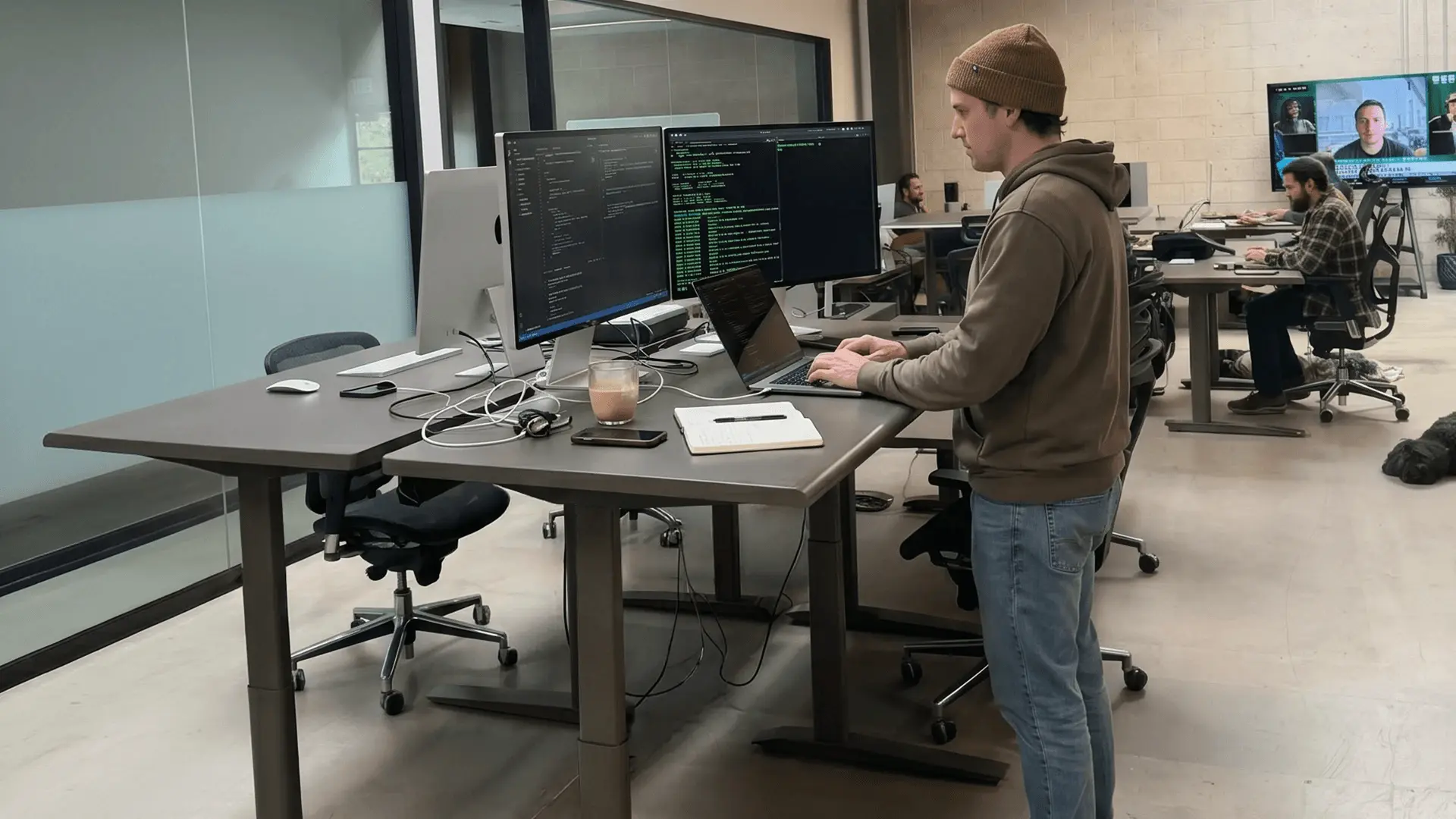
A standing desk works well for podcasting when one host records alone, or when two co-hosts sit side by side and are happy at the same height. If you set your sitting and standing presets to elbow height, your mouth sits about the same distance above the desktop in both positions. A mic arm clamped to the desk rises with it, so it needs little re-aiming when you switch.
A standing desk is the wrong pick for three or more people facing each other, for guests of very different heights at one surface, or for anyone who would change height during a take. Never move the desk while recording: even a quiet motor shows up on a sensitive mic.
Types of podcast desks
Five podcast desk types cover almost every setup, and the right one depends on how many people sit at it, how much gear you run and how much floor you have.
L-shaped desks for a solo host with gear
An L-shaped podcast desk gives one host a recording side and an editing side: mic, interface and headphones on the short return, monitors and keyboard on the long run. It also seats two co-hosts at the corner, angled toward each other, as long as they agree on one height.
Standing desks for one host who switches positions
Adjustable standing desks suit a host who edits seated and records standing, or who just wants to change position across a long session. Check the top depth: a mic arm in front and a monitor behind need more room than a laptop alone.

Round and curved podcast tables for two to four hosts
A round, clover or curved podcast table puts every host at an equal distance from the center, so each mic faces a mouth and the camera can catch everyone. A podcast table for 4 runs about 60 by 60 inches in a clover shape or 72 by 36 inches with a straight front, based on the two models in the picks below.
Compact desks for bedrooms and small rooms
A compact desk holds one mic arm, an interface and a laptop, and leaves floor space in a bedroom or shared apartment. Pair it with wall shelves for headphones and spare cables. Our list of small desk for bedroom picks covers sizes that fit next to a bed.
DIY and custom podcast tables
A DIY podcast table usually starts as a used kitchen or conference table with holes drilled for grommets and bolt-through mic arms. Place the mic arms and chairs first, mark the spots, and drill only once you have checked that every host can reach the mic without leaning. Wood takes screws and hole saws; plastic and glass do not.
What to check before you buy a podcast desk
Check six things before you buy a podcast desk: depth, the edge for mic arm clamps, stability, cable routing, height and motor noise. Here is what to look for in each.
Depth and width: Give each host enough depth for the mic in front and a screen behind it. OSHA's workstation guidance puts the monitor at least 20 inches from your eyes and notes that a corner unit adds depth for large monitors. On a four-seat table, the PodDesk Max gives each host about 18 inches of its 72-inch front.
The edge for a mic arm: Clamp-on mic arms list a maximum desk thickness, so compare it with your top (1 inch on the Desk 2 and Desk 2 L-Shaped, 1.2 inches on the Desk Pro). A lip or rim under the edge, common on bar-height tables, can block the clamp.
Stability: A mic arm extended over the desk shakes with the top. Look for a published stability or cycle test rather than "sturdy" in the description, and test at your recording height, since desks sway most near full height.
Cable routing: An under-desk cable management tray holds the power strip and keeps cables off the floor. On a standing desk, leave every cable that runs to the floor or wall at least as much slack as the desk's travel: about 18.6 inches on the Desk 2 L-Shaped and 19 inches on the Desk Pro.
Height: The standard desk height typically ranges from 28 to 30 inches, and OSHA suggests 20 to 28 inches of leg clearance under the top. Fixed podcast tables sit in that range; a standing desk lets each preset match a different host or position.
Motor noise: Autonomous lists under 30 dB for the Desk Pro, under 45 dB for the Desk 2 and 50 dB at the loudest point for the Desk 2 L-Shaped. That only matters if you adjust mid-session, so set heights before you press record.
Storage is the last check. If your gear lives on the desk, standing desks with drawers and shelves keep microphones, headphones and adapters within reach without crowding the surface.
Podcast desk picks for solo hosts and groups
These picks start with Autonomous standing desks for one or two hosts, then two podcast tables for four, then a one-person recording pod for when the room, not the desk, is the problem. Autonomous specs come from our product pages; the podcast tables come from their makers' and sellers' listings, not from testing by us.
Autonomous Desk 2 L-Shaped: for a solo host with gear or two hosts at the corner
The Autonomous Desk 2 L-Shaped is an electric corner desk with a 77-inch run and a 35-inch return, which fits a recording side and an editing side on one frame. The short side mounts left or right, three motors lift up to 400 lb at 2.3 inches per second, and it travels from 29.4 to 48 inches with four height presets.
The frame is SPCC steel, bench-tested past 50,000 lift cycles and lab-tested to ANSI/BIFMA X5.5, with a 1-inch MDF top. A cable tray comes in the box. The frame carries a 10-year warranty and the top 2 years.
One limit for co-hosts: both arms of the L move together, so the whole surface sits at one height. The triple motor also peaks at 50 dB, the loudest of the three Autonomous desks here, so set your height before recording.
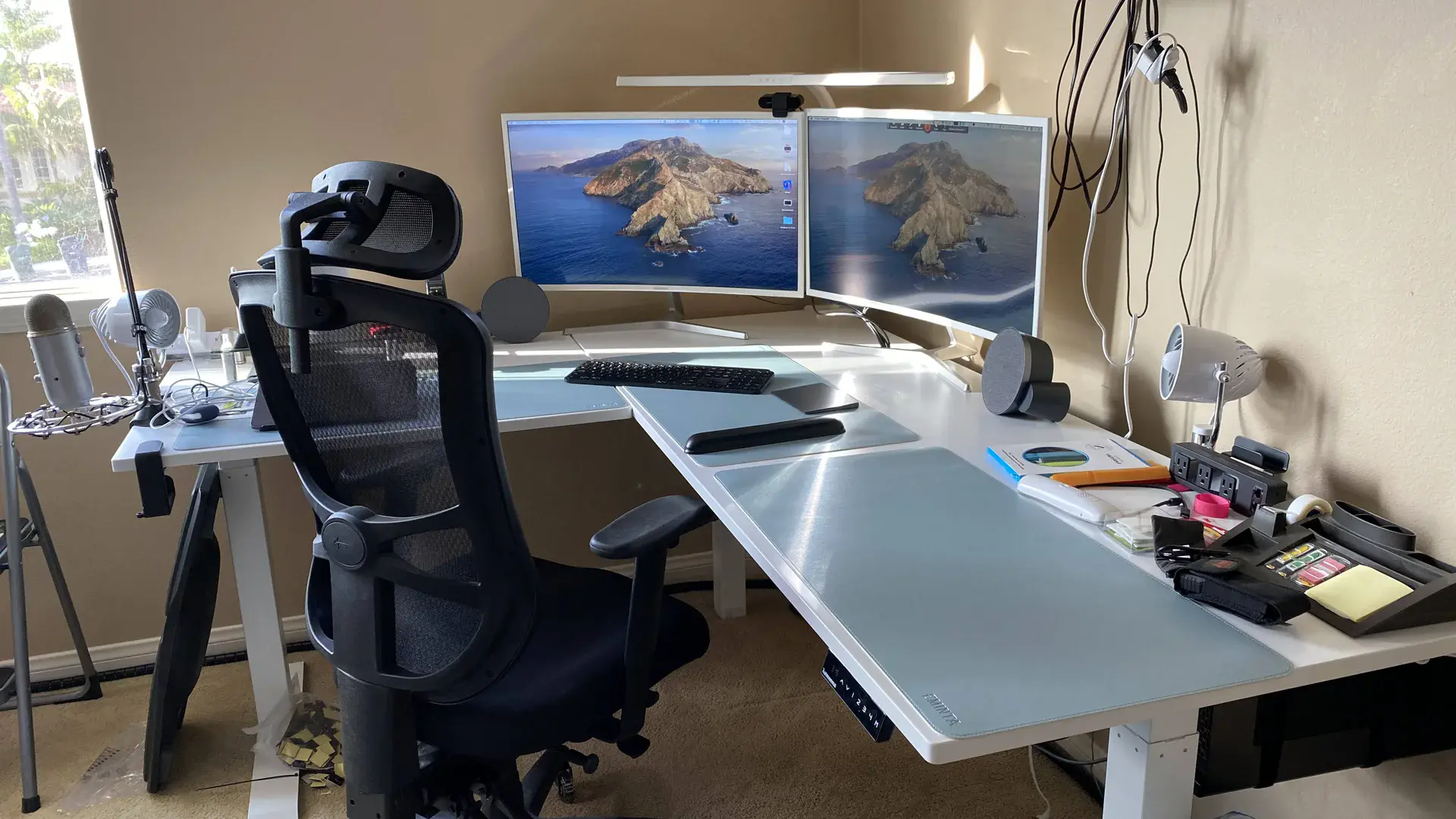
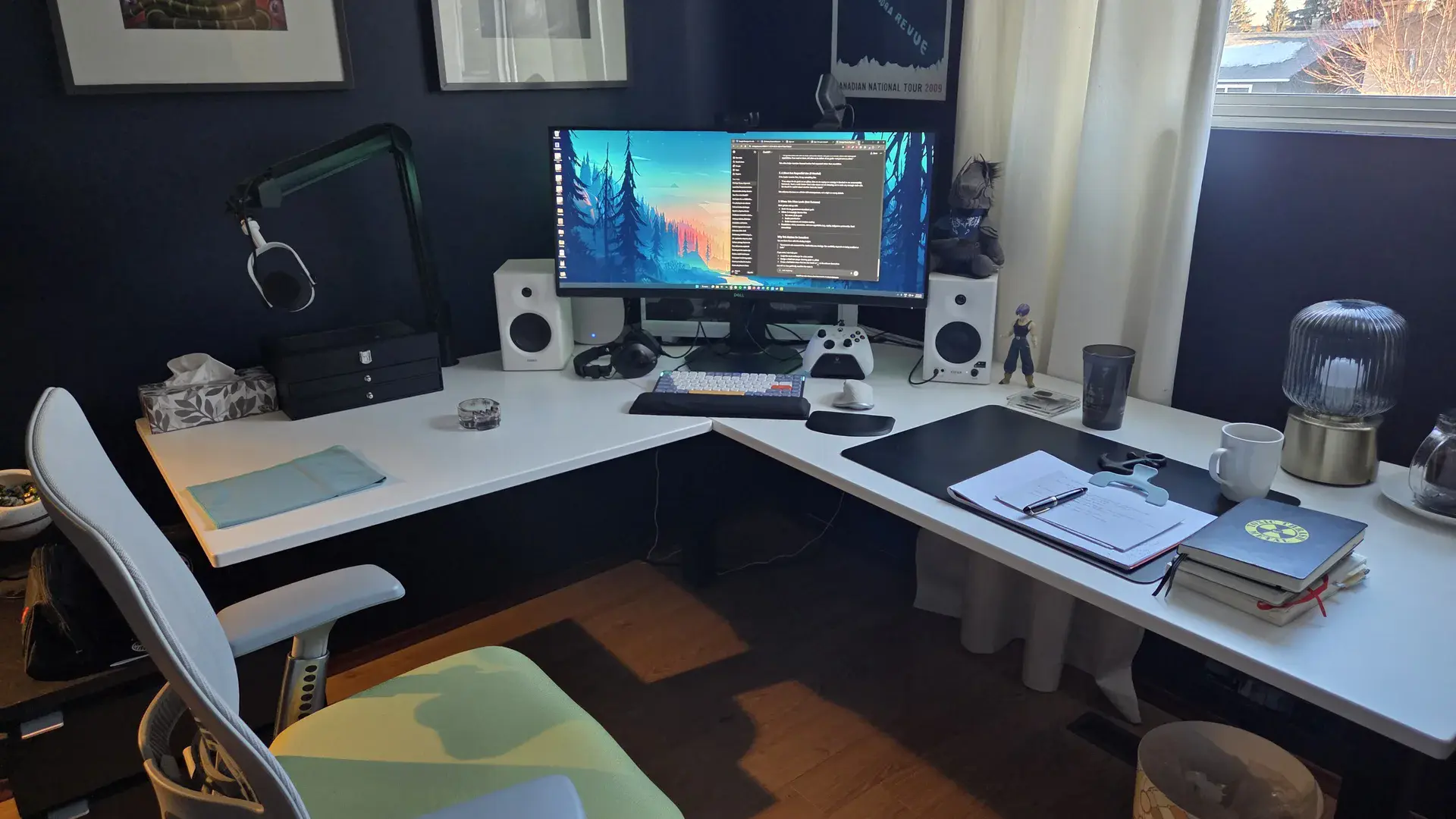
This suits a host who runs a mixer, two monitors and a mic arm, or two co-hosts who record side by side at the corner.
Autonomous Desk 2: for a first setup or a small room
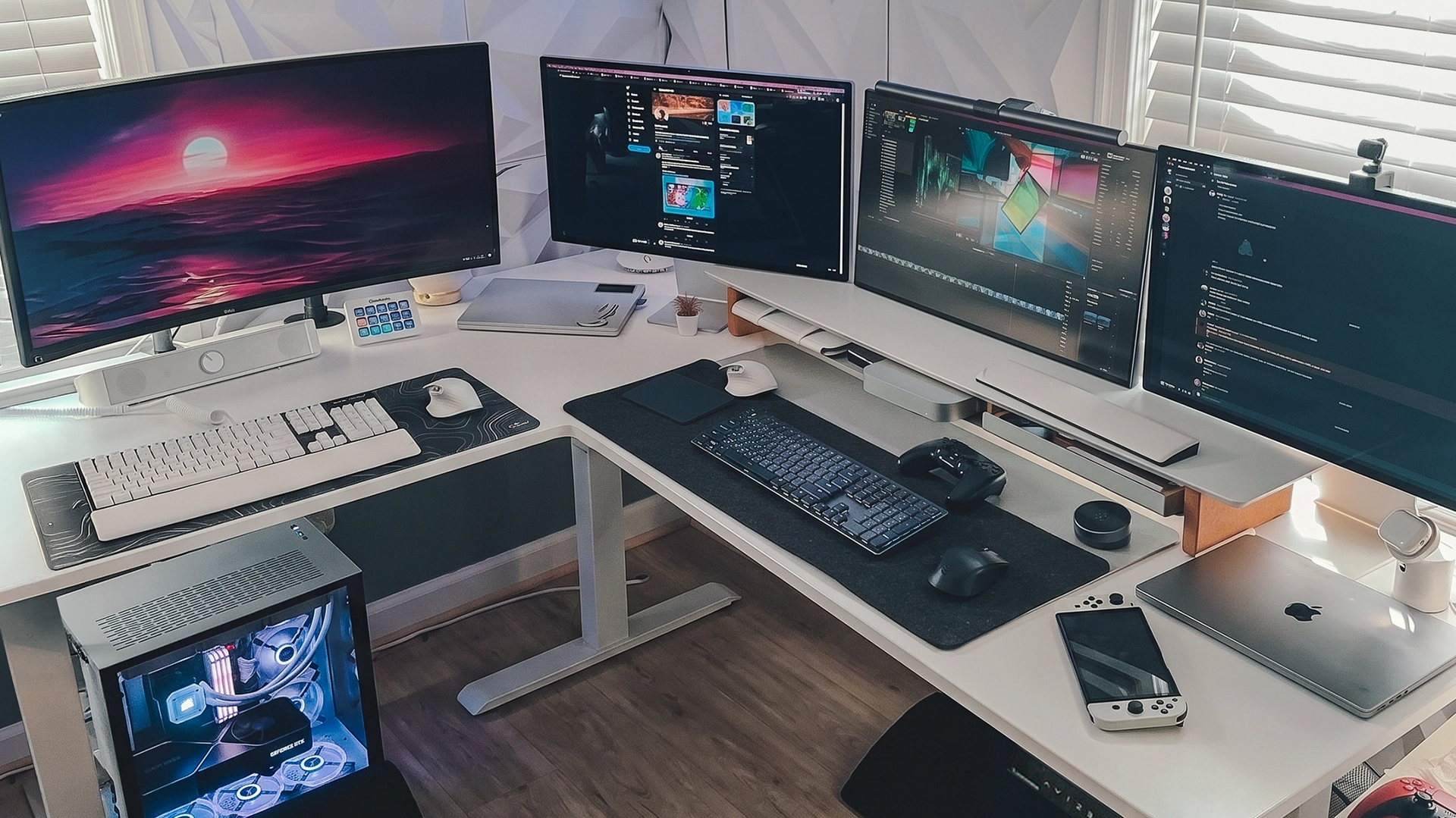
The Autonomous Desk 2 is a dual-motor standing desk with a 53 by 29 inch top, or 70.5 by 30 inches in the XL size, which holds one host's mic arm, interface and one or two monitors. The frame travels from 27.2 to 46.5 inches (measured without the top) at 1.1 inches per second, and lifting stays under 45 dB.
It carries 250 lb, stops on contact with anti-collision, saves four presets, and is certified to ANSI/BIFMA and UL. The frame has a 10-year warranty and the top 2 years. The cable tray is an add-on here, and the narrower top is tight for two hosts.
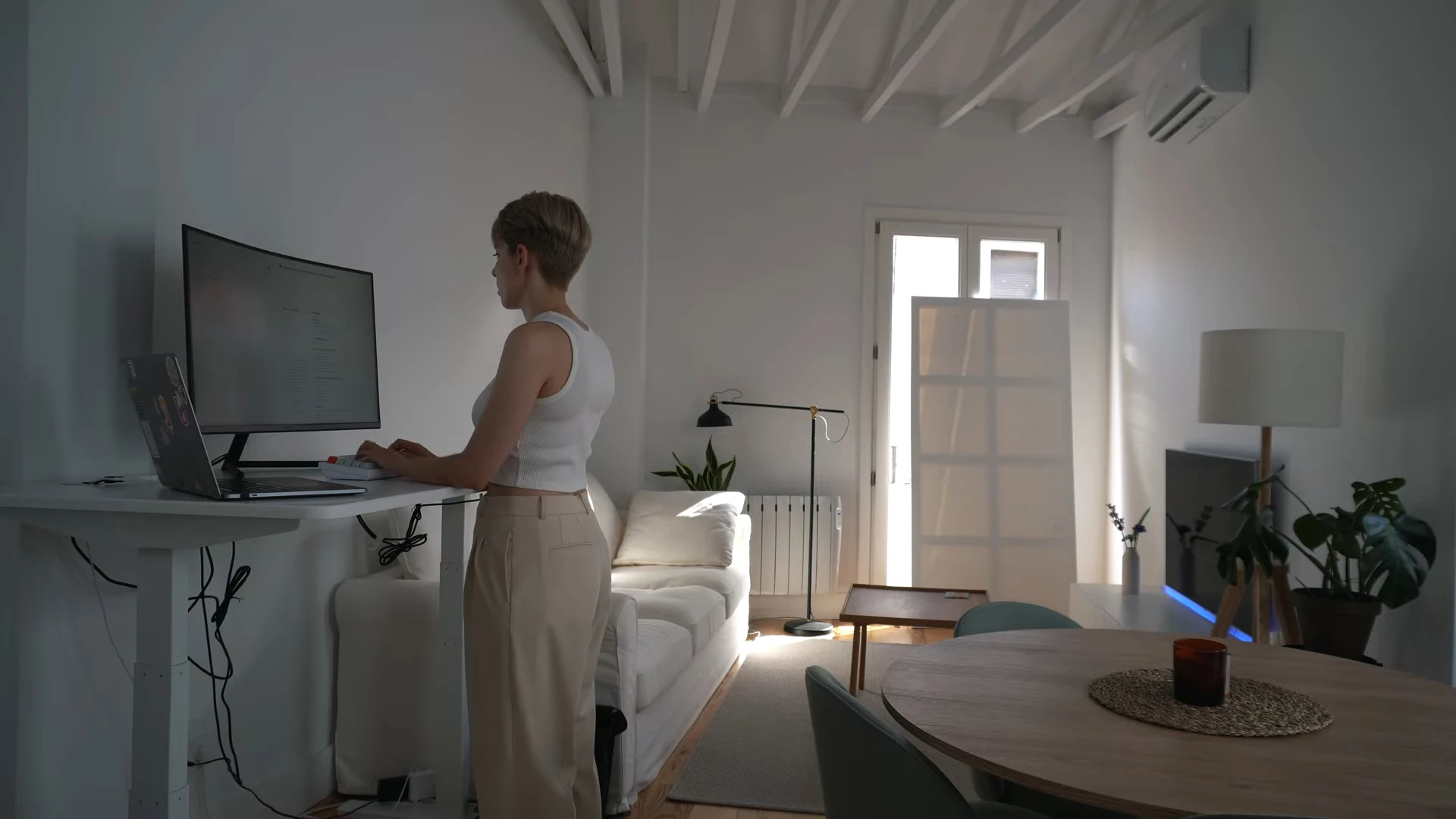

This suits a solo podcaster starting out in a bedroom or home office who wants to sit and stand without paying for a corner desk.

Autonomous Desk Pro: for a steady mic arm at standing height
The Autonomous Desk Pro is the quietest of the three Autonomous desks here and the one with a published stability test, which matters when a mic arm hangs off the edge. TÜV Rheinland measured it at full height: a deliberate 15 lb shove moves the top less than a quarter inch, and a 5 lb nudge, closer to leaning on it, moves it less than a tenth.
The C-shaped frame drops the front crossbar for knee room, the dual motors run under 30 dB at 1.2 inches per second, and the Pro travels from 29.5 to 48.5 inches with a 330 lb rating. The Pro AI version reaches 24.25 to 53.5 inches and 450 lb. The frame has a lifetime warranty and the 1.2-inch HDF top 2 years.
This suits a host who records standing with a long mic arm, or anyone who adjusts height between segments and wants the motor to stay out of the room tone.
PodDesk Max and Forecast CL-L: podcast tables for four hosts
A dedicated podcast table makes sense once four people sit at one surface. Both tables below are fixed height and built for mic arms; neither is sold by Autonomous.
PodDesk Max: Podcast Table Shop's PodDesk Max seats four along a covered front, measures 72 by 36 inches at 28 inches high, and uses a 1.5-inch solid wood top on metal legs. Built-in power gives 6 outlets, 3 USB-A and 4 USB-C ports. It lists at $2,397, with low-profile mic arms at $115 each.
Forecast Consoles CL-L: The Forecast CL-L is a clover-shaped table with four positions, 59.5 by 59.5 inches at a 29-inch counter height. Mic arms mount on a rail, and cables run under the counter and through a cable base. BSW quotes the price on request.
When the desk is fine but the room is not
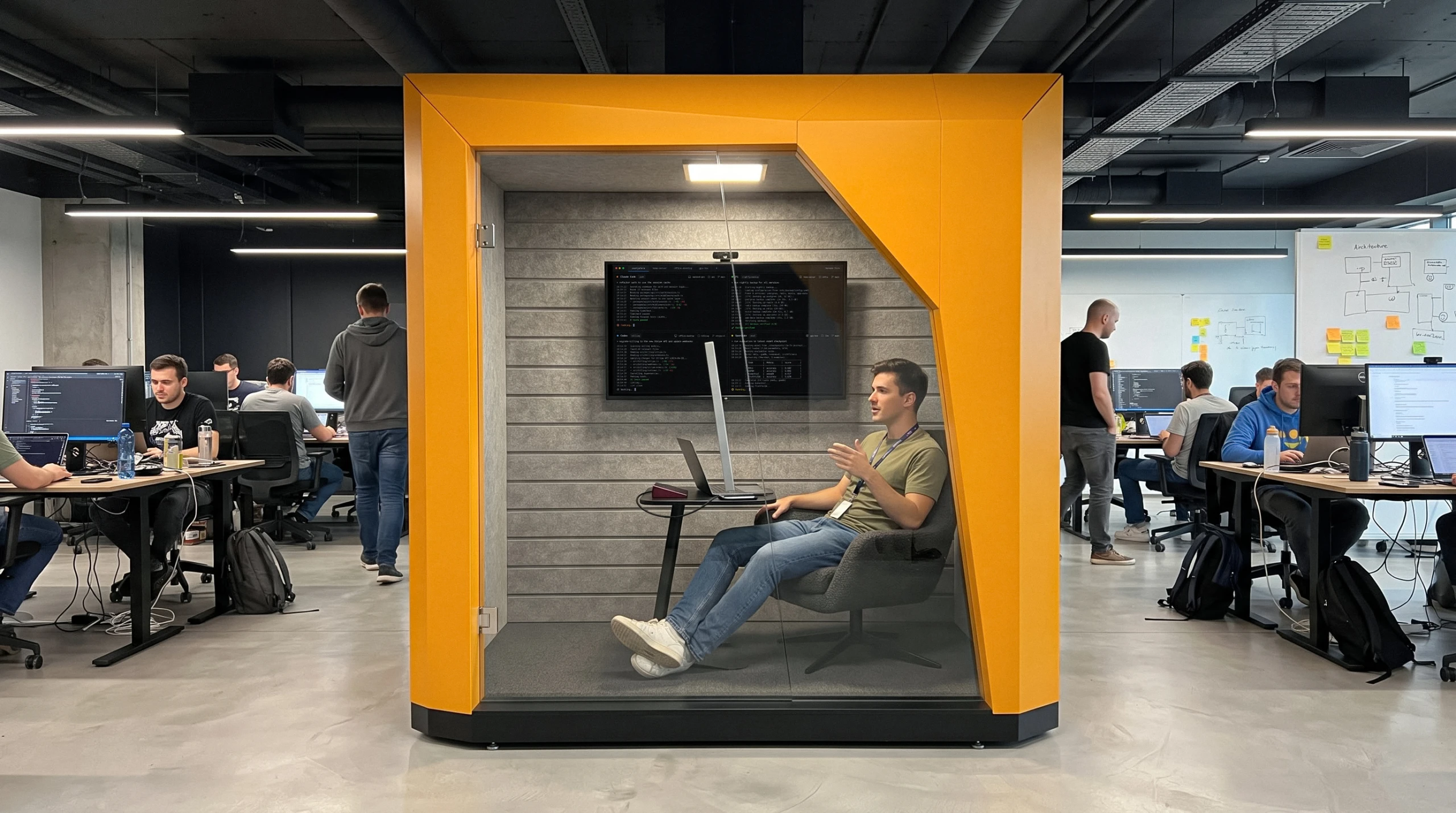
A good desk does not help if the room echoes or the hallway leaks into your mic. Spaceship is Autonomous's one-person indoor pod, a closed room that stands inside a larger one. Autonomous lists 30 dB of speech reduction, marked preliminary, which suits spoken word but not singing at full voice. Its two roof fans always run, at 32 dB(A) at full speed. It is built around a lounge chair and a laptop table (sold separately), not a desk.
How to set up your podcast desk
Set up a podcast desk in this order: desk height, mic arms, screens, cables, then a test recording. Moving the mic arm last means re-drilling or re-clamping less often.
- Place the desk away from windows, doors and HVAC vents, the usual sources of outside noise.
- Set the height so your forearms rest level at about 90 degrees, then save it as a preset on a standing desk.
- Clamp or bolt the mic arm where it reaches your mouth without crossing your keyboard or screen.
- Put the monitor behind the mic at eye level, so you read notes without turning away from the mic.
- Route cables through a tray or grommets, with slack for the full height travel.
- Record a minute of room tone and a short read to check for hum, desk thumps and echo.
Echo comes from the room more than the desk. Soft panels, a rug and curtains do more for sound than any desktop, and a mic in a shock mount on an arm picks up fewer desk taps than one on a desk stand. If you are building a bigger room, our guide to desks for a recording studio covers mixing and music setups.
The chair finishes the setup. An ergonomic chair with adjustable height, lumbar and arms keeps you upright at the mic.
Our list of podcast chairs compares quiet, armless and tall options. If you record at a standing desk set partway up, a drafting chair with a foot ring fits better than an office chair.

Most solo shows record fine from a home office; when the house gets too loud, a backyard studio shed moves the whole desk out of it.
FAQs
Can you use a standing desk for podcasting?
Yes, a standing desk works for podcasting when one host records alone or two co-hosts share one height. Set both presets to elbow height, clamp the mic arm to the desk so it moves with you, leave cable slack for the full travel, and never move the desk while recording.
What makes a good podcast desk?
A good podcast desk has enough depth for a mic in front and a screen behind, an edge your mic arm clamp fits, a frame that stays still when you lean on it, and a way to route cables off the floor. For three or more hosts, shape matters more than size.
What size desk do I need for podcasting?
A solo podcaster with a mic arm, an interface and one monitor fits on a 53 by 29 inch top, the Desk 2's standard size. Two monitors, a mixer or a co-host push you toward a 70-inch top or an L-shape, and four hosts need a dedicated table.
How big is a podcast table for 4?
A podcast table for 4 is usually about 60 by 60 inches in a round or clover shape, or about 72 by 36 inches with a straight front, at 28 to 29 inches high. Leave space behind each seat so chairs can roll back without hitting walls or stands.
Do I need a special desk for podcasting?
No, most solo podcasters record at a normal desk or standing desk. A special podcast table only pays off when three or four people face each other on camera, because it gives each host an equal-distance spot, a mic mount and built-in power for every seat.
How do I organize cables on a podcast desk?
Run cables into an under-desk tray that holds the power strip, bundle them with Velcro straps, and pass mic cables through grommets or along the mic arm. On a standing desk, leave enough slack in every cable that reaches the floor for the desk's full travel.
What materials are best for a podcast desk?
A steel frame with a solid wood, MDF or HDF top is the most practical podcast desk build, because wood takes clamps, screws and grommet holes. Glass tops reflect sound and do not take drilled mounts or grommets.
How do I set up a podcast desk at home?
Set up a podcast desk at home by placing it away from windows and vents, setting the height so your forearms rest level, mounting the mic arm, putting the monitor behind the mic at eye level, routing cables, then recording a short test to catch hum and echo.
Conclusion
For one host, a podcast desk is usually a standing desk or L-shaped desk with a solid edge for the mic arm, a cable tray and heights saved before you record. For three or four hosts facing each other, a fixed round or clover podcast table works better. Either way, check the edge, the depth and the cable slack before you buy.
Once your podcast desk is in place, the next step is building an audience. A podcast agency such as Fame so offers growth strategy and production support for creators.