How to Remove Monitor Stand: Samsung, Dell, LG & Acer


Quick answer: To remove a monitor stand, unplug the display, rest it on a soft, stable surface (follow your maker's support advice for curved screens), then press the quick-release button or undo the screws or thumbscrew at the stand neck and slide the stand off. Check the manual for your exact model first, because the release point differs by brand.
If you're removing the stand for a monitor arm or moving the screen into storage, distinguish the base (the foot on your desk) from the stand neck (the part attached to the display). Removing the base alone may leave the neck in place.
Quick answer: which monitor stand connection do you have?
Most monitor stands use one of four external attachment methods. Check the model label on the back, then compare the connection point with your manufacturer's manual before using a tool.
| Connection type | What to look for | Typical removal |
|---|---|---|
| Quick-release button | Visible button behind stand neck | Press while supporting and sliding the neck off |
| Recessed latch | Small opening near the hinge | Press the designated latch with the tool specified in the manual |
| Screw-fastened | Thumbscrew under foot or screws at hinge | Remove the documented fasteners in sequence |
| Clip-on / friction-fit | No visible screw; shaped connection at rear | Follow the illustrated release direction for that model |
These are connection types, not universal brand rules. Two monitors from the same manufacturer may require different steps.
Before you remove the monitor stand
- Disconnect everything. Turn the monitor off, unplug power, and remove HDMI, DisplayPort, USB and other cables. Free cables routed through the stand.
- Support the panel properly. Use the original packaging insert if possible. For flat screens, the manual may specify a clean cushioned surface. Curved and ultrawide models need shape-appropriate support without pressure on the display.
- Prepare only the tools listed for your model. You might need no tools, a Phillips screwdriver, or a long thin screwdriver to operate a designated latch.
- Keep the fasteners. Put each screw, cover and adapter into a labeled bag if you intend to reinstall the factory stand.
Do not remove the monitor's rear housing or internal electronics to detach a normal external stand. If the attachment is not obvious, stop and locate the manual rather than pry at the casing.
How to remove a monitor stand in 5 steps
- Find the model number. Read the rear label, packaging, or on-screen product information. Search the exact model plus "user manual" and locate the "Removing the stand" or "Wall mounting" pages.
- Position the display as instructed. Rest it on the support specified by the manufacturer. Have a second person stabilize a large or curved monitor.
- Remove the foot if required. Some stands have a captive screw underneath the base; others release the entire assembly as one piece. Do not assume the foot must come off first.
- Release the neck from the display. Operate the documented button, recessed latch, hinge screws or clip, keeping the monitor supported throughout. Slide the stand only in the direction shown in the manual.
- Inspect and store the parts. Check that the mount area is undamaged. Retain the original stand, screws and covers, especially if you plan to resell or move the display.
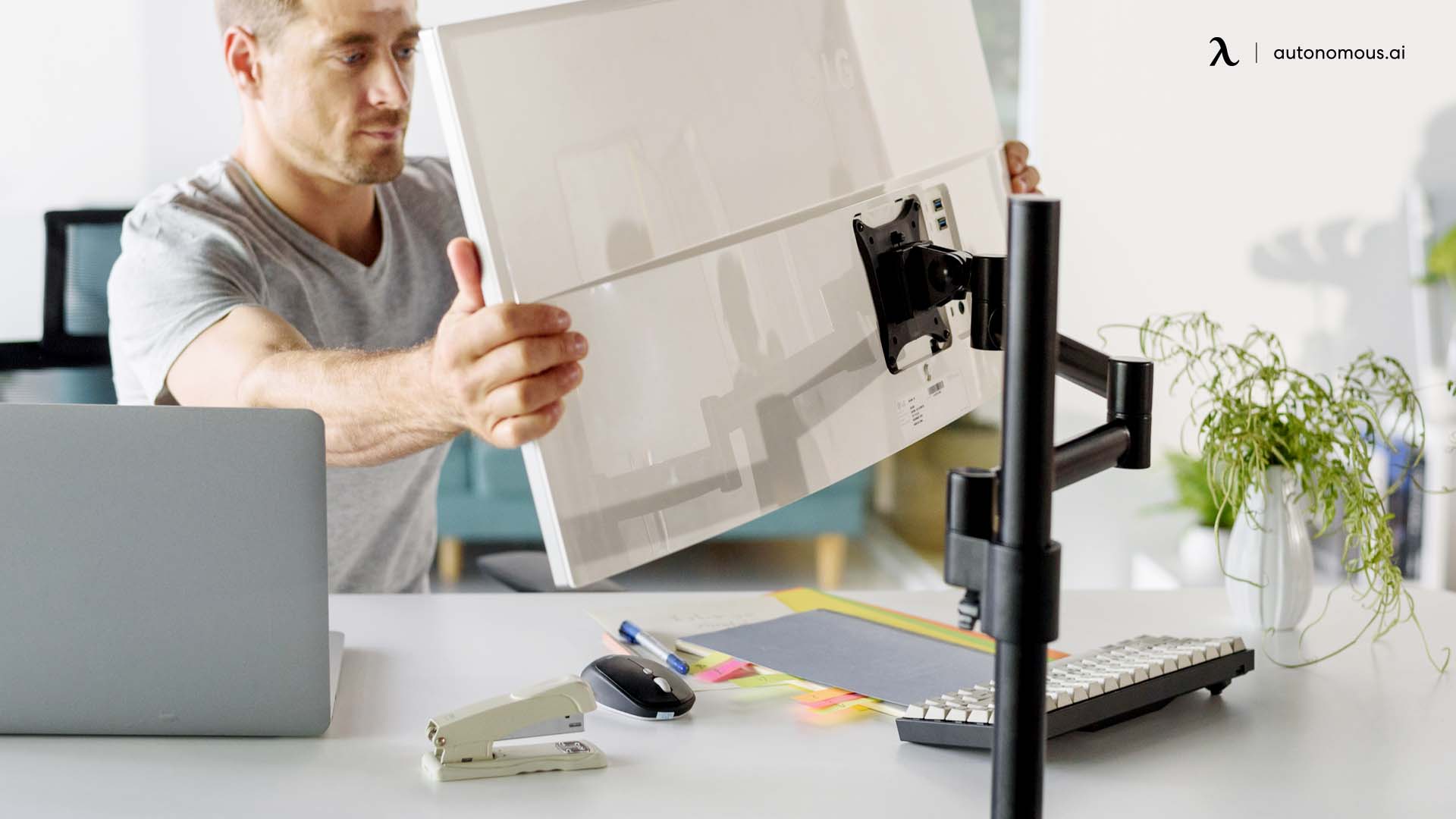
How to remove a Samsung monitor stand
Samsung monitor stand removal depends on the connection design, not just the Samsung name. Curved F390/F396-family models are especially important to handle carefully because pressure on an unsupported curved screen can damage the panel.
Samsung curved monitors: C27F390, C27F396 and related models
Samsung's official service instructions for F390-family curved monitors show the original protective foam supporting the front of the screen. On listed F390 variants, the neck can be detached while the display is supported, followed by loosening the connecting screw beneath the base. Samsung also lists F396-family variants with related assembly diagrams, but you should use the removal illustration for your exact model suffix before pulling the neck.
- Confirm the full code, such as C27F390FHN or C27F396FHN, using the label rather than only "Samsung 27-inch curved."
- Use the molded packaging insert or another support that does not press into the curved panel.
- Refer to the model's removal diagram to release the neck from the rear connection; keep hands on the housing, not the screen.
- Where the diagram shows a base screw, loosen it underneath the foot and separate the foot from the neck.
Samsung warns against pressing down on a curved panel resting face-up or face-down. Some other Samsung models use a hidden ejection hole or different cover, so a "press here" tip for one Odyssey or F-series model should not be copied to another. Samsung's illustrated stand instructions show these differences.
What if a Samsung monitor stand has a lock or no visible button?
A Samsung stand without an obvious button may still use a friction-fit neck, a screw, a hidden eject hole or a model-specific release cover. Check the "Stand installation/removal" pages of the user manual. Do not insert a screwdriver into an unidentified opening or twist the neck just because another Samsung model releases that way.
How to remove a Dell monitor stand
Several Dell models use a recessed release latch, but its location and the preparation steps vary. Check whether you need to expose a VESA cover or lower the stand to reach the latch.
Dell E2422H and E2422HN
For the Dell E2422H/E2422HN factory stand, the user guide specifies a soft, clean surface and removing the VESA cover to reach the release. A long thin screwdriver presses the latch in the designated hole above the stand; the assembly can then slide away. The base has a separate quick-release tab for separating the foot from the riser. Dell E2422H documentation includes the illustrated sequence.
Dell S2721HN, S2421HN and SE2722H
For S2721HN-family monitors, Dell shows the screen supported face-down on a cushion near the table edge. Lower the stand to reach the latch, press that latch with a long screwdriver, and slide the factory stand assembly out while keeping it supported. The SE2722H user guide similarly shows a release button reached after tilting the stand down. Dell S2721HN manuals and the SE2722H user guide show the location for each model.
If the stand does not slide off: make sure you are holding the latch fully open and moving in the illustrated direction. Do not lever against the rear panel or apply oil to the hinge.
How to remove an LG monitor stand, including UltraGear
LG uses different attachment mechanisms across UltraGear, UltraFine and standard monitors. On some models the foot is secured by a thumbscrew while the stand body is fixed with separate screws; others have different locking structures.
For example, LG's 27UD68 documentation shows this sequence: support the screen on a soft surface, undo the screw holding the base, separate the base, remove the screw cover, and undo two screws securing the stand body to the hinge. This is a 27UD68 example, not a universal LG UltraGear procedure. LG's 27UD68 illustrated guide shows the parts.
For an LG UltraGear such as the 27GP850 or 27GN880, open the manual from the LG model support page and check the "Installing on a wall" or "Detaching the stand" section. Identify the correct stand variant first; the UltraGear label alone does not tell you whether it uses a screw, clip or arm mechanism.
How to remove an Acer monitor stand
Some Acer monitor stands have a recessed release operated through the rear cover, while others detach with a screw-fastened base or different connection. An official Acer monitor manual, for example, describes undoing the base screw and pressing a rear-cover latch with a screwdriver while removing the neck. This is evidence of one Acer design, not a rule for every Acer screen.
Find your full Acer model number and check the illustrated procedure before releasing any tab. An Acer stand that appears to have "no button" may simply have a recessed mechanism that is not visible from above. Acer's example manual shows the configuration described here.
How to remove HP, ASUS, AOC and other monitor stands
For lower-volume searches such as HP, OMEN, ASUS ROG/TUF, AOC, BenQ, ViewSonic, Sceptre, Koorui and Onn, the safest shortcut is the exact model's assembly diagram, not a brand-wide instruction.
- HP and OMEN: some HP manuals show a release button; others have rear screws. An HP guide for a curved display specifically warns not to place pressure on the panel while it lies face-down. HP's user guide illustrates one such screw-fastened stand.
- ASUS ROG and TUF: mechanisms depend on model. The ASUS VG278 manual, for example, has a separate base-removal and hinge-screw sequence for wall mounting. ASUS VG278 manual is an example, not instructions for every ROG or TUF screen.
- AOC, BenQ, Sceptre, ViewSonic, Koorui and Onn: inspect the model label and the maker's stand-installation section. Avoid assuming that a lack of exposed screws means the stand should be pulled off by force.
What to do if the monitor stand is stuck
| What happens | What to check |
|---|---|
| The release button moves, but the neck stays in place | Keep the latch fully pressed; check sliding direction and support the weight of the stand. |
| There is no visible button | Look for a cover, foot screw, recessed opening or model-specific clip in the manual. |
| The foot comes off, but the neck remains | Look for a separate stand-to-display release. These are often two stages. |
| A curved monitor flexes when you touch the stand | Stop. Reposition it in a shaped support that does not press on the panel. |
| The stand looks connected inside the casing | Do not remove the rear housing. Check the manufacturer service information or seek qualified repair assistance. |
A stuck stand is not a reason to twist harder, apply lubricant, pry open the bezel, or remove screws that the manufacturer did not identify for stand removal.
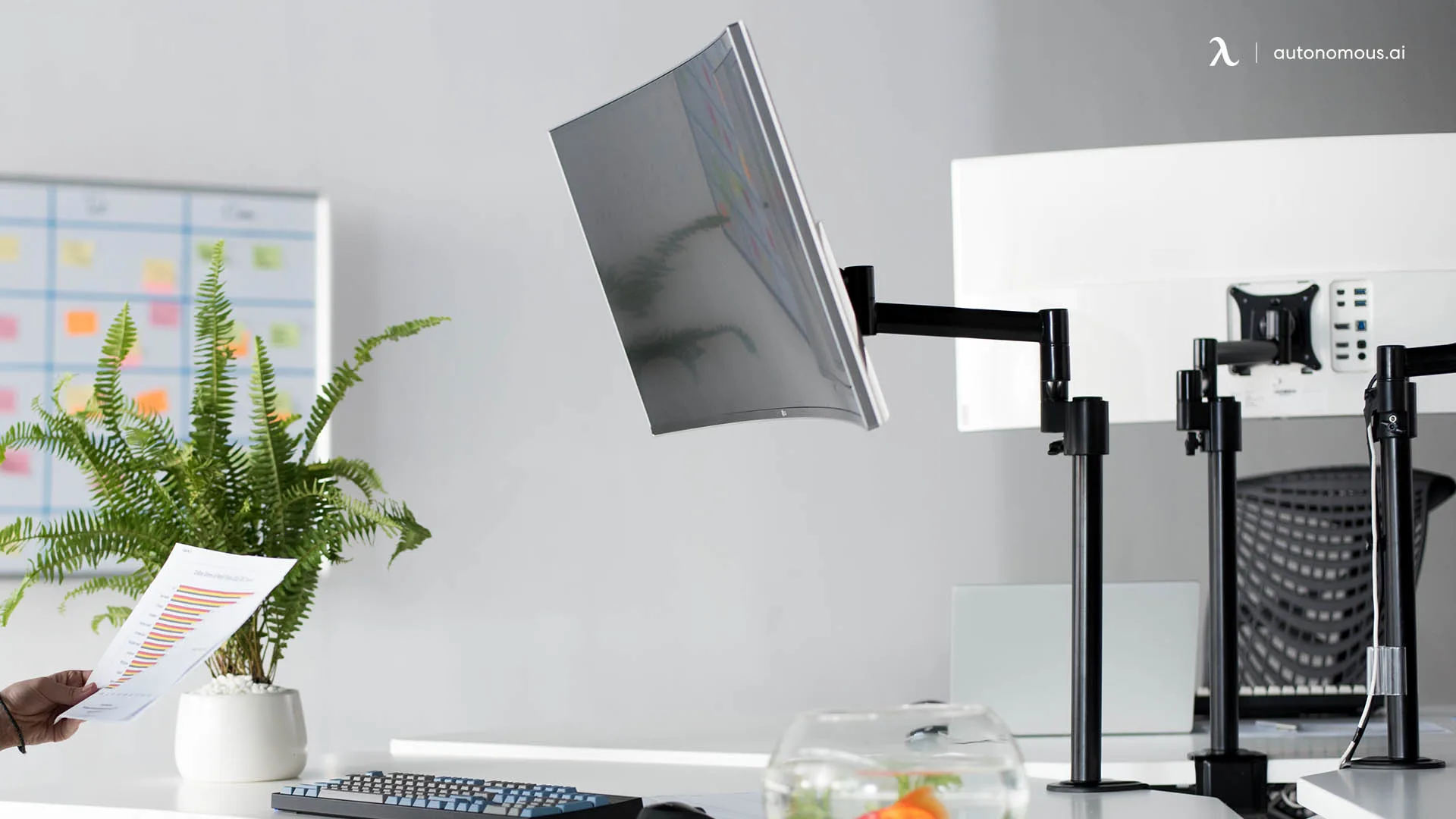
After removing the stand: can you install a monitor arm?
Removing the original foot does not by itself prove the monitor supports a replacement arm. Confirm the monitor's VESA mounting pattern, the arm's weight rating, the correct screw length and any approved adapter or spacer. Common VESA patterns include 75 × 75 mm and 100 × 100 mm, but some displays need a specific mounting bracket.
After the stand is detached, monitor-arm installation still depends on the correct VESA hardware and a suitable desk mount. Check the clamp or grommet's approved thickness and whether the worktop can handle the concentrated load. On a thick worktop, monitor arms for thick desks need enough clamp opening and a secure, flat contact area.
If the desk sits close to a wall, also measure the space needed for the arm to pivot behind the screen. Installing a monitor arm on a desk against a wall can require a low-profile mount or a different clamp position to avoid hitting the wall during adjustment.
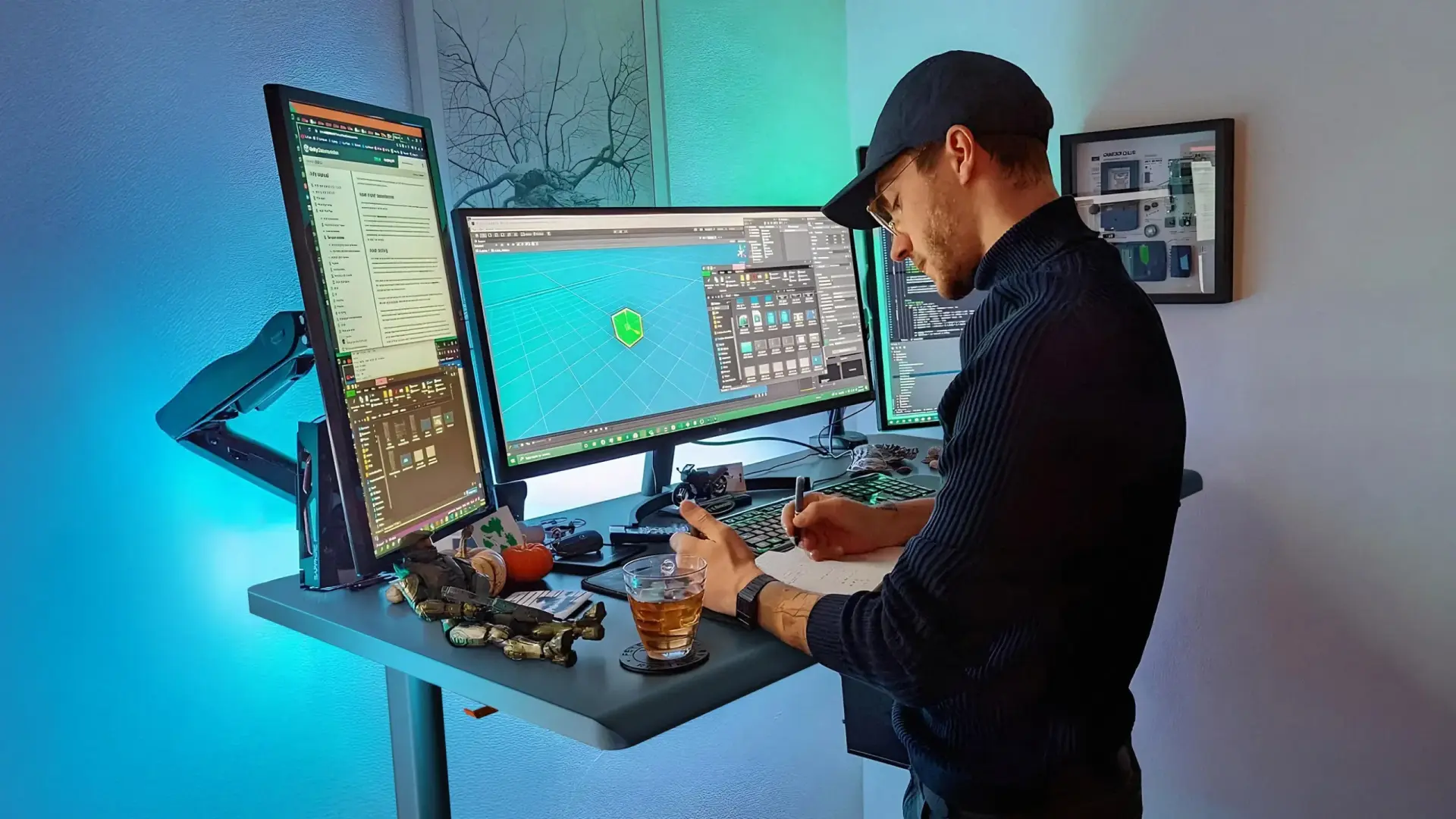
If you are removing two factory stands to make room on a smaller top, the screen positions and reach limits become important in a dual-monitor setup. Keep the main screen aligned with your seat rather than placing both displays only for symmetry.
FAQs
How do I remove a monitor stand without screws?
A screw-free monitor stand may use a quick-release button, recessed latch or clip-on neck. Unplug and support the display, then use the exact model's diagram to locate the release. Do not assume the stand can be pulled straight out without unlocking it.
How do I remove a Samsung curved monitor stand?
Check the full Samsung model code and its removal diagram. Many F390-family models use a supported screen, detachable neck and base screw. Curved panels must not be pressed flat against a table; use the protective foam or model-specified support.
How do I remove the stand from a Samsung C27F396 monitor?
Use the C27F396 suffix on the rear label to find the matching manual. Identify the neck-release direction and base screw from its illustrations. Do not copy steps for a different Samsung curved model if the stand connection looks different.
How do I remove a Dell monitor stand with a release button?
Support the unplugged display and locate the model's release latch. Dell S2721HN and SE2722H guides show a recessed button accessed after angling the stand; press it with the specified tool and slide the assembly out in the documented direction.
How do I remove an LG UltraGear monitor stand?
Open the manual for your exact UltraGear model and follow its stand-detachment diagram. LG models differ: some have a base screw plus separate hinge screws, while others use another connection. Never remove the back cover just because the stand will not move.
How do I remove an Acer monitor stand with no visible release?
Locate the exact Acer model first. Its release may be recessed near the neck or secured by another mechanism. Consult the illustrated user guide before inserting a tool; do not assume the absence of a visible button means the stand is friction-fit.
Can I remove a monitor stand without opening the monitor?
Usually, yes. The factory stand is generally an external assembly with a button, latch or accessible fasteners. Opening the monitor's rear housing is not part of routine stand removal and may expose hazardous components. Seek model-specific support if the external attachment is unclear.
Can I attach a monitor arm after removing the original stand?
Yes, if your display supports the arm's VESA mount or an approved adapter, and its weight is within the arm's rating. Confirm screw specifications and desk-clamp compatibility separately. A removable factory stand does not guarantee universal arm compatibility.
Bottom line
The safest way to remove a monitor stand is to identify the exact model, support the screen correctly, and release only the external fasteners or latch shown by its manufacturer. For Samsung curved screens, protect the panel shape; for many Dell models, locate the recessed button; for LG and Acer, verify the stand design before using a tool.
If the connection resists after the documented release, stop instead of forcing it. An undamaged monitor is worth more than saving a few minutes on the stand.
References
- Samsung Electronics Service. Official monitor stand removal and installation illustrations.
- Dell. E2422H user documentation.
- Dell. S2721HN user documentation.
- Dell. SE2722H user guide.
- LG Electronics. 27UD68 manual with base and hinge disassembly diagrams.
- Acer. Monitor manual with rear stand-release illustration.
- HP. Monitor user guide and curved-display safety warnings.
- ASUS. VG278 user guide and stand-arm detachment procedure.