8 Seated Sciatica Stretches for Fast Pain Relief
Table of Contents
That sharp, burning pain shooting from your lower back down your leg doesn't care about your deadlines. Sciatica affects up to 40% of people at some point in their lives, and sitting for hours only makes it worse — increasing spinal disc pressure significantly.
The good news? You don't need to leave your chair to find relief. These seated sciatica stretches target the exact muscles that compress your sciatic nerve, helping you ease pain in under five minutes without disrupting your workday.
What Causes Sciatica Pain When Sitting?
Your sciatic nerve is the longest and thickest nerve in your body, running from your lower spine through your hips and down each leg. When something compresses or irritates this nerve, you feel that unmistakable radiating pain.
Sitting is one of the most common triggers. When you sit without proper sitting posture, pressure on your spinal discs increases by up to 40% compared to standing. Over time, this sustained pressure can cause a disc to bulge or herniation, pressing directly against the nerve roots that form the sciatic nerve.
But disc compression isn't the only culprit. Prolonged sitting also tightens the piriformis muscle deep in your buttocks. Since the sciatic nerve runs directly beneath (or sometimes through) this muscle, tightness here can squeeze the nerve and trigger pain — a condition called piriformis syndrome.
1. Everyday Sitting Habits That Trigger Sciatica
Many people unknowingly aggravate their sciatic nerve through small, repeated habits. Here are the most common offenders:
- Slouching or rounding your lower back:
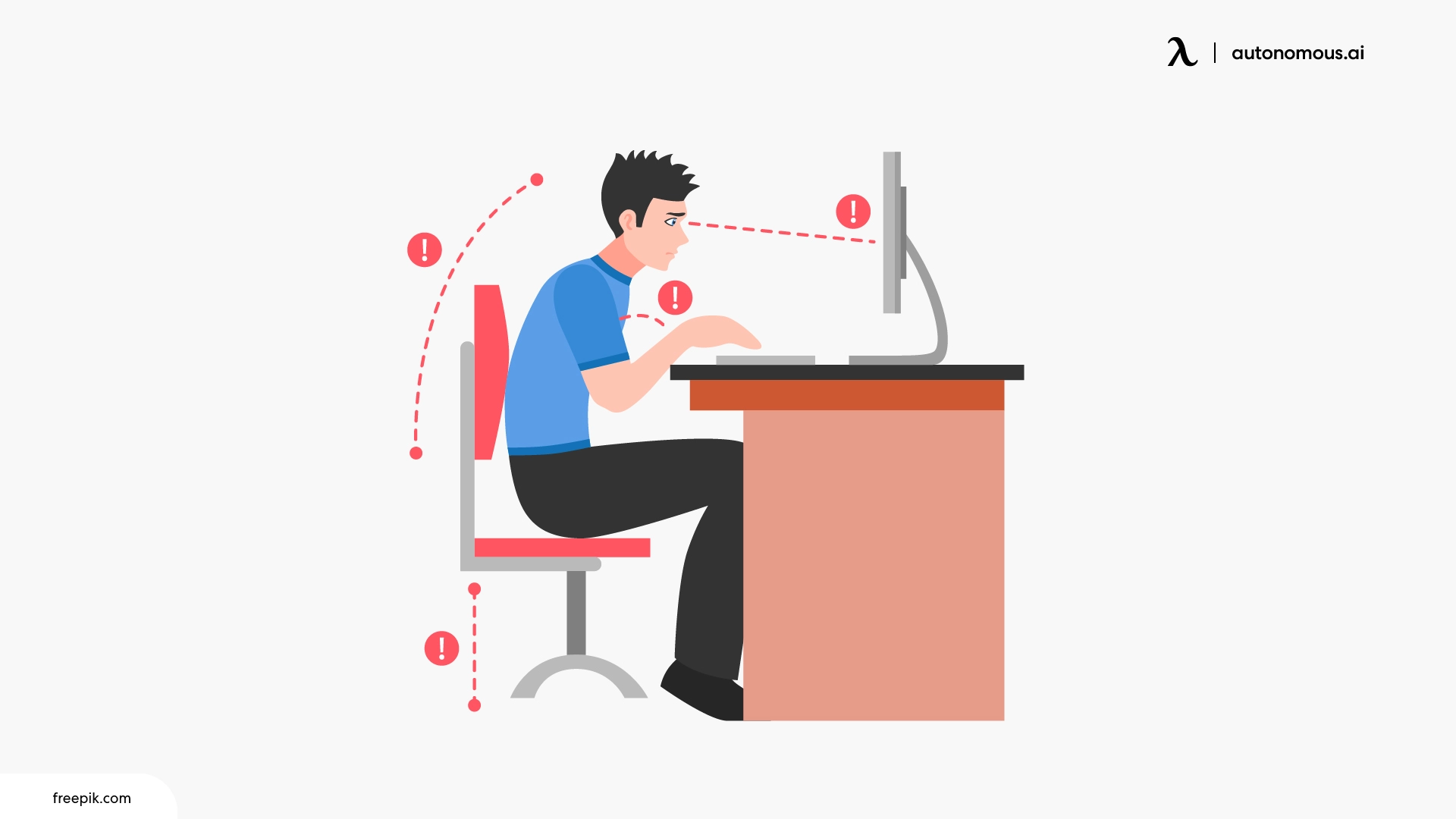
When you slouch, your lumbar spine loses its natural curve. This flattens the discs and pushes them backward — directly toward the nerve roots. Hours of slouching each day gradually weakens your spinal support muscles while increasing disc pressure.
- Sitting with crossed legs:
Crossing your legs rotates your pelvis and puts uneven pressure on your hips. This tightens the piriformis muscle on one side and can compress the sciatic nerve over time. If you always cross the same leg, the imbalance becomes even more pronounced.
- Keeping a wallet or phone in your back pocket:
Sitting on a bulky item — even something as small as a wallet — tilts your pelvis and forces your piriformis muscle to bear extra weight. This direct pressure on the muscle can irritate the sciatic nerve beneath it. Some specialists call this "wallet sciatica" or "back-pocket sciatica."
- Sitting too long without movement:
Staying in one position for hours starves your spinal discs of nutrients. Discs don't have their own blood supply — they rely on movement to absorb fluid and stay healthy. Without regular position changes, discs become dehydrated, less flexible, and more prone to bulging.
- Using a chair without lumbar support:
A flat-backed chair forces your spine into a C-shape, eliminating the natural inward curve of your lower back. This poor alignment increases disc pressure and strains the muscles that protect your spine. Over months and years, this accelerates disc degeneration.
2. Why Sciatica Exercises and Stretches Helps
The good news: these habits are reversible. Gentle sciatica exercises that target your hamstrings, piriformis, hip flexors, and lower back pain can relieve nerve compression and restore mobility. Regular stretching lengthens the muscles that have tightened from prolonged sitting, creates space for the sciatic nerve, and improves blood flow to your spinal discs.
The key is consistency — brief, regular movement throughout your day works better than one long stretching session. Even a few minutes of chair exercises for sciatic nerve pain every hour can make a significant difference.
8 Best Seated Sciatica Exercises and Stretches for Pain Relief
Now that you understand what's triggering your pain, it's time to address it. The following stretches specifically target the muscles most responsible for sciatic nerve compression — your piriformis, hamstrings, hip flexors, and lower back.
Each stretch can be done right in your office chair — whether you're at the office, working from home, or simply spending extended time seated throughout the day. They're gentle sciatica exercises suitable for beginners and effective enough to provide real relief. You don't need any equipment, and most can be done discreetly without drawing attention.
Before you start: move slowly into each stretch, breathe deeply throughout, and never push into sharp pain. Mild tension is normal — that's the stretch working. But if any movement increases your leg pain or numbness, stop immediately and skip to the next exercise.
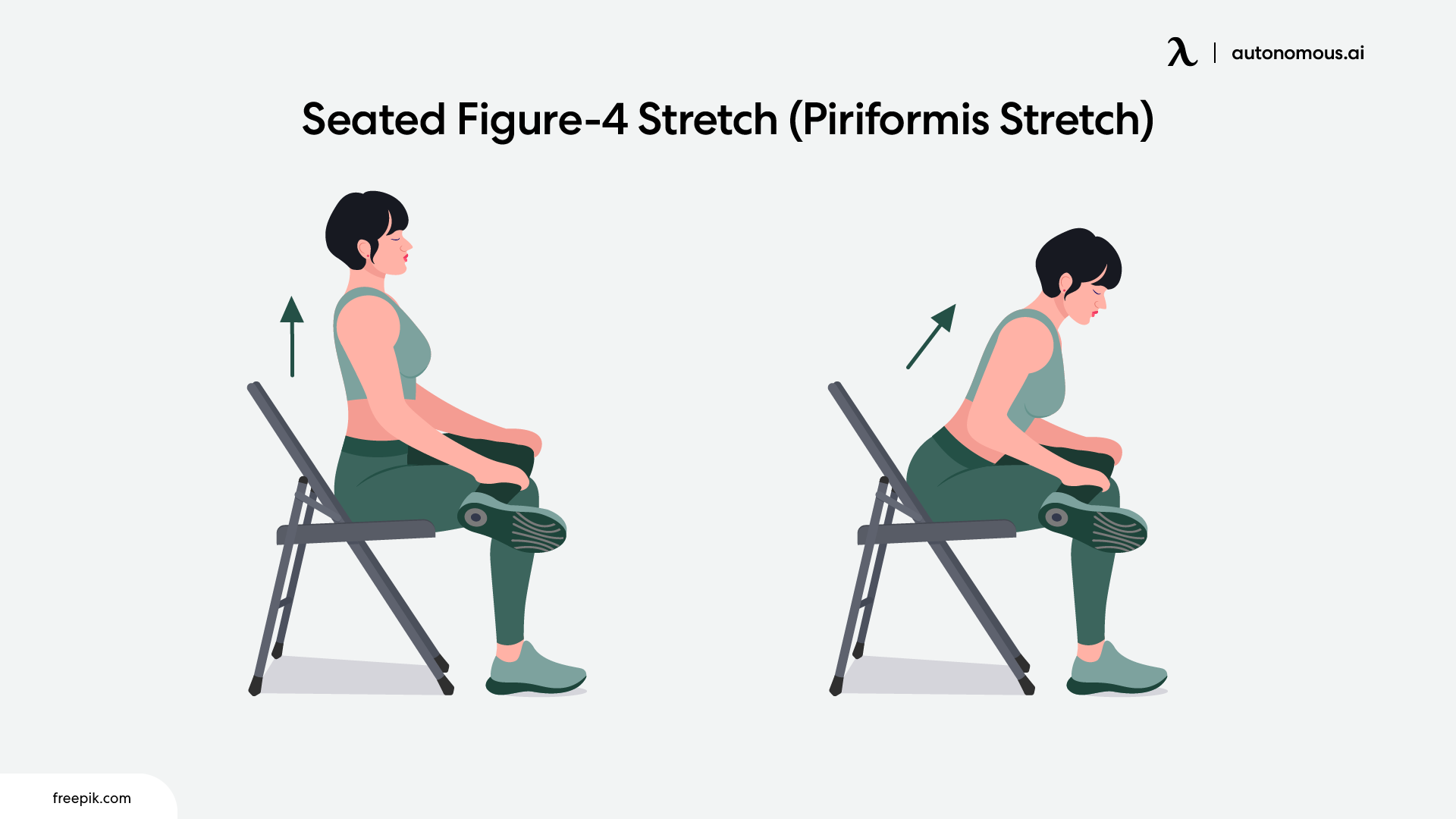
1. Seated Figure-4 Stretch (Piriformis Stretch)
What it targets: Piriformis muscle, glutes, outer hip
This is often the single most effective stretch for sciatica relief. The piriformis muscle sits deep in your buttocks, and when it gets tight — often from prolonged sitting — it presses directly on the sciatic nerve running beneath it. Releasing this muscle can provide almost immediate relief for many people.
Step-by-step:
- Sit upright toward the front edge of your chair with both feet flat on the floor.
- Lift your right ankle and place it on top of your left knee, creating a "figure 4" shape with your legs. Let your right knee fall gently outward.
- Sit tall and lengthen your spine — avoid rounding your back.
- Keeping your back straight, slowly hinge forward from your hips until you feel a deep stretch in your right buttock and outer hip.
- For a deeper stretch, use your right hand to gently press down on your right knee.
- Hold this position for 20–30 seconds while breathing slowly and deeply.
- Return to the starting position and repeat on the other side.
The figure-4 position externally rotates your hip, which lengthens and releases the piriformis muscle. When this muscle relaxes, it stops compressing the sciatic nerve. This stretch also opens up the hip joint and relieves tension in the surrounding glute muscles.
Pro tip: Flex the foot of your raised leg (pull your toes toward your shin). This protects your knee joint and intensifies the stretch in your piriformis. If you can't feel much stretch, try sitting on a firmer surface, soft cushions reduce the effectiveness.
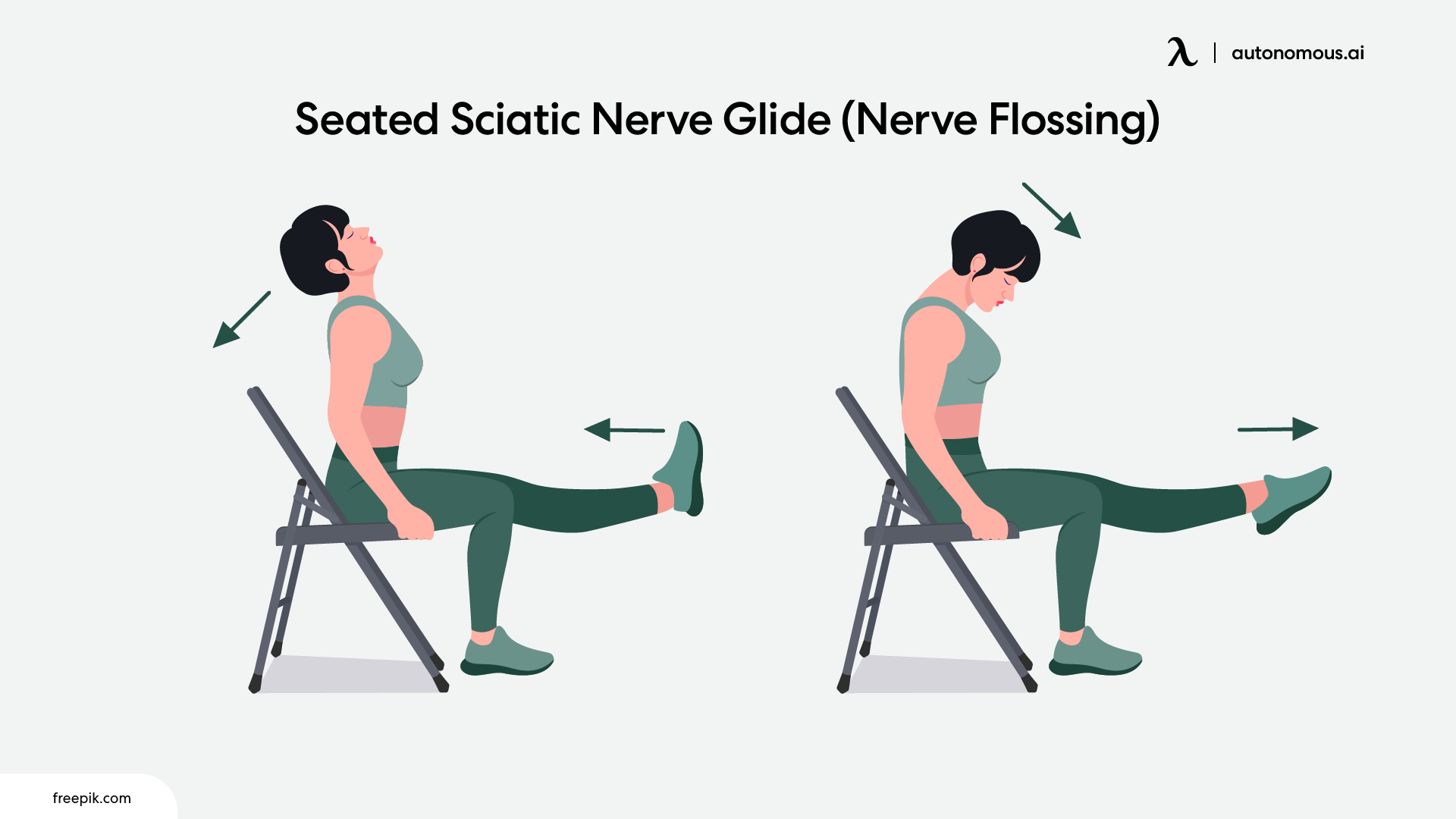
2. Sciatic Nerve Glide Exercise
What it targets: Sciatic nerve mobility, nerve tension along the entire pathway
Unlike traditional stretches that focus on muscles, this office chair exercise works directly on the sciatic nerve itself. When the nerve becomes irritated or compressed, it can get "stuck" in the surrounding tissues. Nerve gliding, sometimes called nerve flossing, gently moves the nerve back and forth through these tissues, reducing adhesions and improving mobility without overstretching.
Step-by-step:
- Sit upright toward the edge of your chair with both feet flat on the floor. Rest your hands on your thighs.
- Slowly straighten your right knee, lifting your foot until your leg is extended in front of you. Keep your thigh on the chair.
- With your leg extended, point your toes away from you (like a ballet point) while simultaneously looking up toward the ceiling and slightly arching your upper back.
- Now reverse the movement: flex your foot (pull your toes back toward your shin) while tucking your chin toward your chest and gently rounding your upper back.
- Continue alternating between these two positions in a slow, controlled rhythm — point toes and look up, then flex foot and look down.
- Perform 10–15 repetitions on your right leg, then switch to your left.
This exercise creates a gentle "flossing" motion that slides the sciatic nerve through the tissues surrounding it. The coordinated movement of your ankle and neck lengthens the nerve at one end while releasing it at the other, mobilizing it without creating excessive tension.
Pro tip: Move slowly and smoothly, this isn't about speed or intensity. If you feel increased pain, tingling, or numbness during the exercise, reduce your range of motion or skip this one for now. Nerve glides work best when they feel like gentle tension, not sharp discomfort.
3. Seated Spinal Twist
What it targets: Lower back, spine mobility, hip rotators
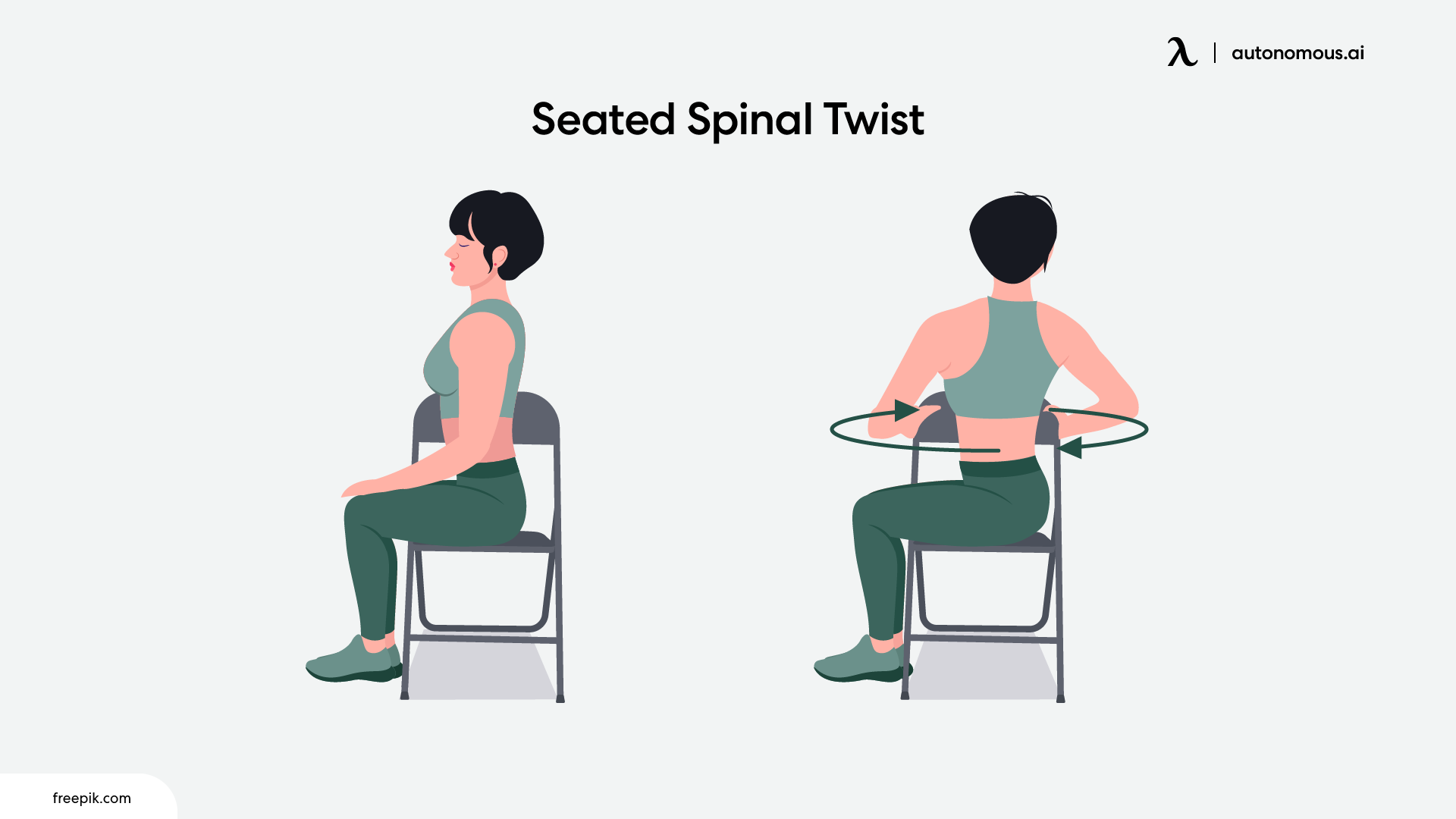
Sitting for long periods compresses your vertebrae and tightens the small muscles along your spine. Over time, this stiffness limits your range of motion and increases pressure on the nerve roots that form the sciatic nerve.
A gentle spinal twist helps reverse this by creating space between the vertebrae and restoring mobility to your lower back. This movement is also especially useful in chair exercises for seniors because it improves spinal flexibility without placing strain on the joints.
Step-by-step:
- Sit tall in your chair with both feet flat on the floor, about hip-width apart. Move slightly away from the backrest so you have room to rotate.
- Place your left hand on the outside of your right knee or thigh.
- Inhale and lengthen your spine, imagining the crown of your head reaching toward the ceiling.
- As you exhale, slowly twist your torso to the right. Use your left hand on your right knee for gentle leverage — don't force the rotation.
- Bring your right hand to the armrest, seat edge, or backrest of your chair for support as you deepen the twist.
- Turn your head to look over your right shoulder, but only as far as feels comfortable for your neck.
- Hold for 15–20 seconds while breathing deeply. With each exhale, see if you can rotate just a little further without straining.
- Slowly return to center and repeat on the opposite side.
Twisting motions gently decompress your spine by creating small gaps between the vertebrae. This relieves pressure on the spinal discs and the nerve roots that exit between them. The rotation also stretches the muscles along your spine and around your hips, areas that commonly contribute to sciatic nerve irritation when tight.
Pro tip: Keep both sit bones firmly planted on the chair throughout the twist. If one side lifts, you've rotated too far. The power of this stretch comes from length and control, not from forcing maximum rotation.
4. Seated Knee-to-Chest Stretch
What it targets: Lower back, glutes, hip flexors
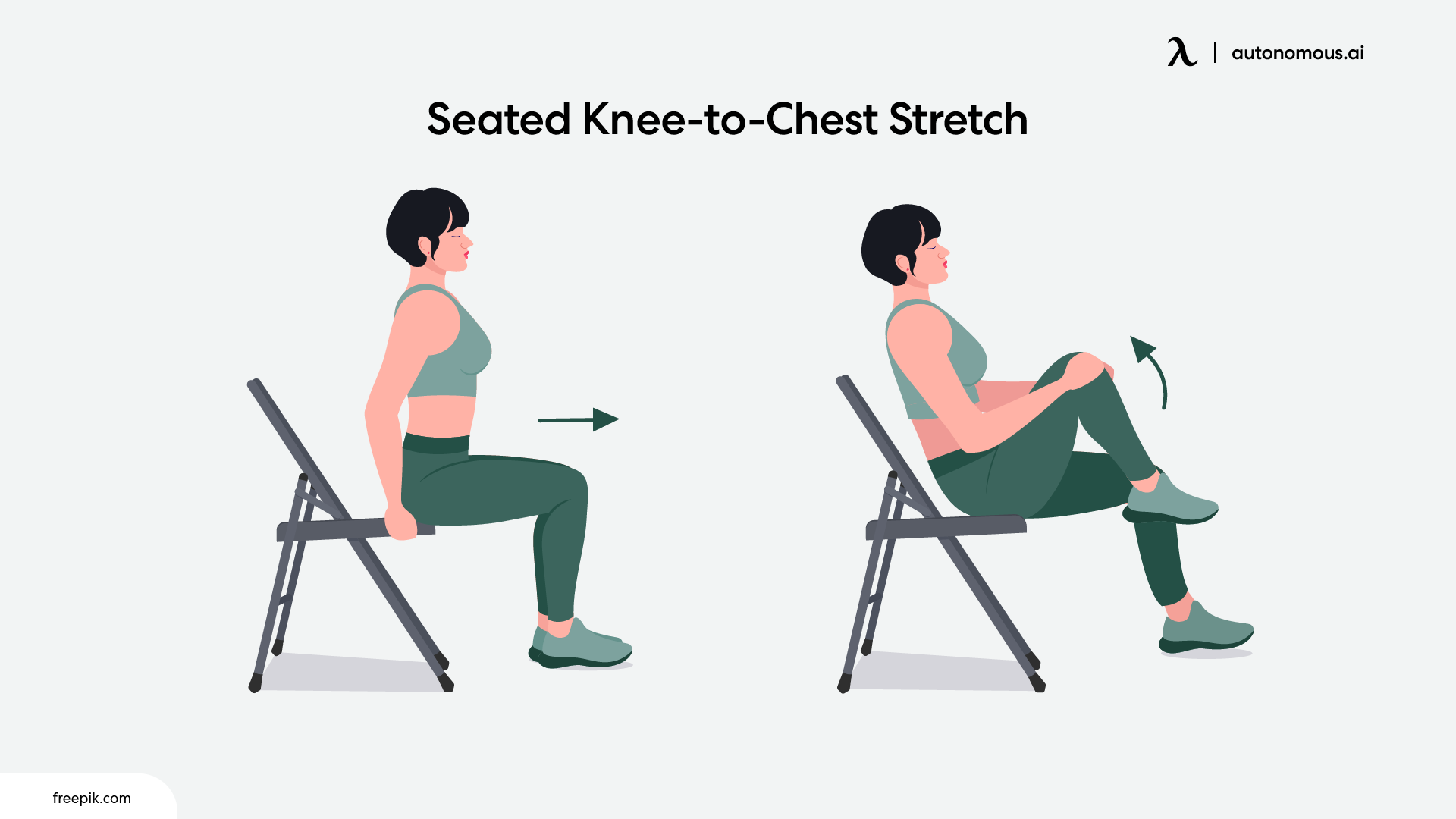
This simple stretch creates space in your lumbar spine by gently flexing the lower back. When you pull your knee toward your chest, you open up the spaces where the sciatic nerve roots exit your spine — reducing compression at the source. It's also one of the most accessible sciatica exercises to relieve pain for people at any fitness level.
Step-by-step:
- Sit upright in your chair with both feet flat on the floor. Scoot forward slightly so you're not leaning against the backrest.
- Keeping your left foot planted, lift your right knee toward your chest.
- Clasp both hands around your right shin, just below the knee. If that's difficult, hold behind your thigh instead.
- Gently pull your knee closer to your chest until you feel a comfortable stretch in your lower back and buttock.
- Keep your back straight and avoid rounding your shoulders forward — the stretch should come from your hip, not from curling your spine.
- Hold for 20–30 seconds while breathing deeply.
- Slowly lower your foot back to the floor and repeat on the other side.
Pulling your knee to your chest gently flexes your lumbar spine, which opens the spaces between your vertebrae called the intervertebral foramina. By creating more room in these openings, you reduce pressure on the irritated nerves and allow better blood flow to the area.
Pro tip: If you feel unstable, hold onto the side of your chair with one hand while pulling your knee with the other. You can also try this stretch with both knees simultaneously if you have enough balance and chair stability — this creates an even deeper lower back release.
5. Seated Cat-Cow Stretch
What it targets: Entire spine, lower back muscles, spinal discs
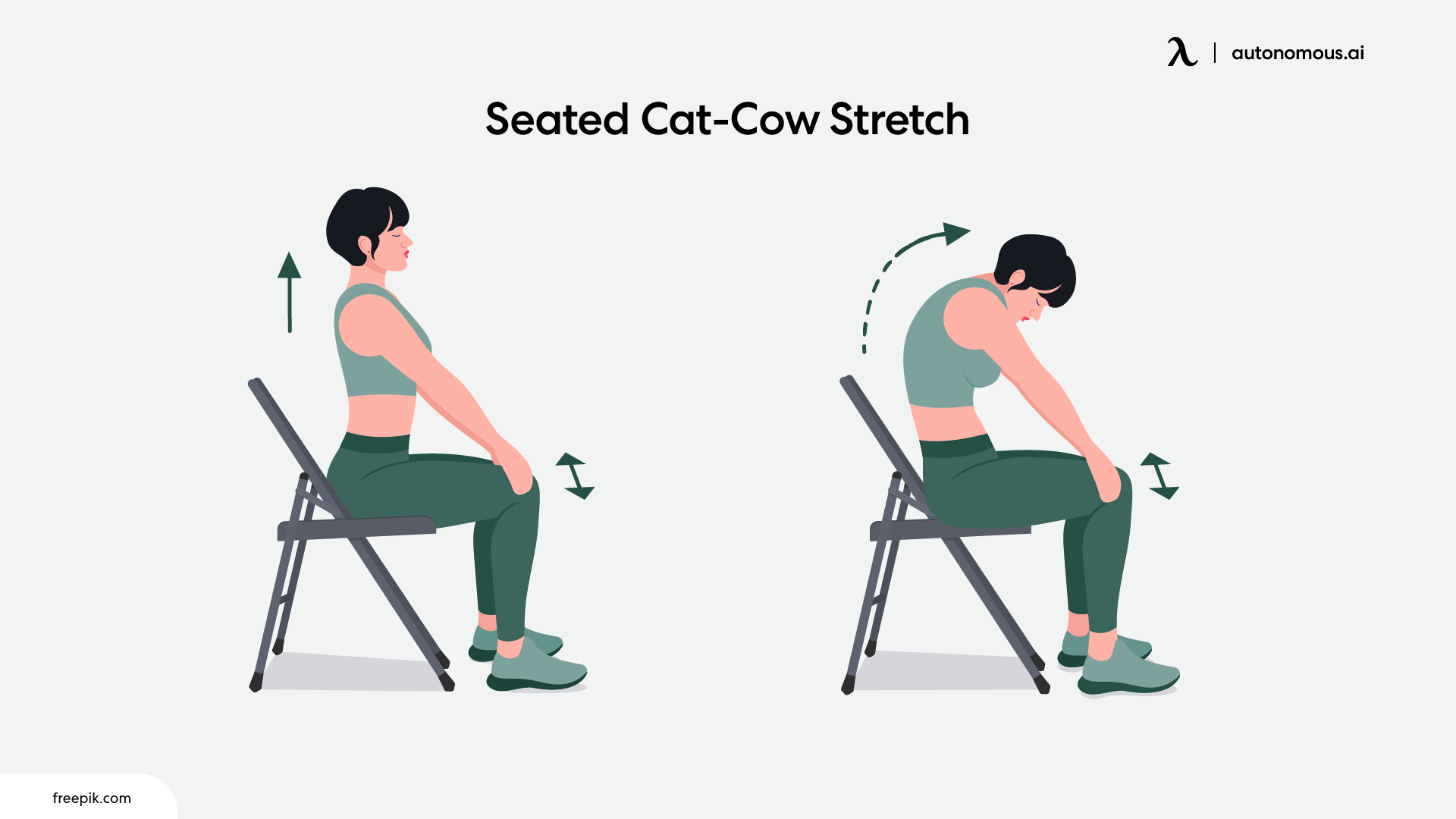
When you sit for extended periods, your spine settles into a fixed position. The small muscles between your vertebrae stiffen, spinal fluid circulation slows, and your discs become compressed under constant pressure. The seated cat-cow gently moves your spine through its full range of flexion and extension — waking up those stiff segments and restoring healthy movement patterns.
Step-by-step:
- Sit toward the front edge of your chair with your feet flat on the floor, about hip-width apart. Rest your hands on your knees or thighs.
- Cow position: Inhale slowly. As you breathe in, arch your lower back, roll your shoulders back, lift your chest, and look slightly upward. Let your belly move forward naturally. Feel your spine extending.
- Cat position: Exhale slowly. As you breathe out, round your entire spine — tuck your tailbone under, pull your belly button toward your spine, drop your chin toward your chest, and let your shoulders roll forward. Imagine you're creating a "C" shape with your back.
- Continue flowing between these two positions, matching each movement to your breath. Inhale into the cow, exhale into the cat.
- Move slowly and deliberately — this isn't about speed. Focus on feeling each segment of your spine move.
- Repeat for 8–10 full cycles (one cycle = cow + cat).
This rhythmic motion gently pumps fluid into your spinal discs, which don't have their own blood supply and rely on movement for nutrition. The alternating flexion and extension also mobilizes each vertebral segment, releasing tension in the small muscles that can contribute to nerve irritation. This is one of the most effective gentle sciatica exercises for relieving stiffness after long periods of sitting.
Pro tip: Close your eyes as you perform this stretch to tune into the sensations in your spine. You may notice certain areas feel "stuck" or restricted — spend extra time gently moving through those segments. If any part of your back feels particularly tight, slow down and take two or three breaths in that position before continuing.
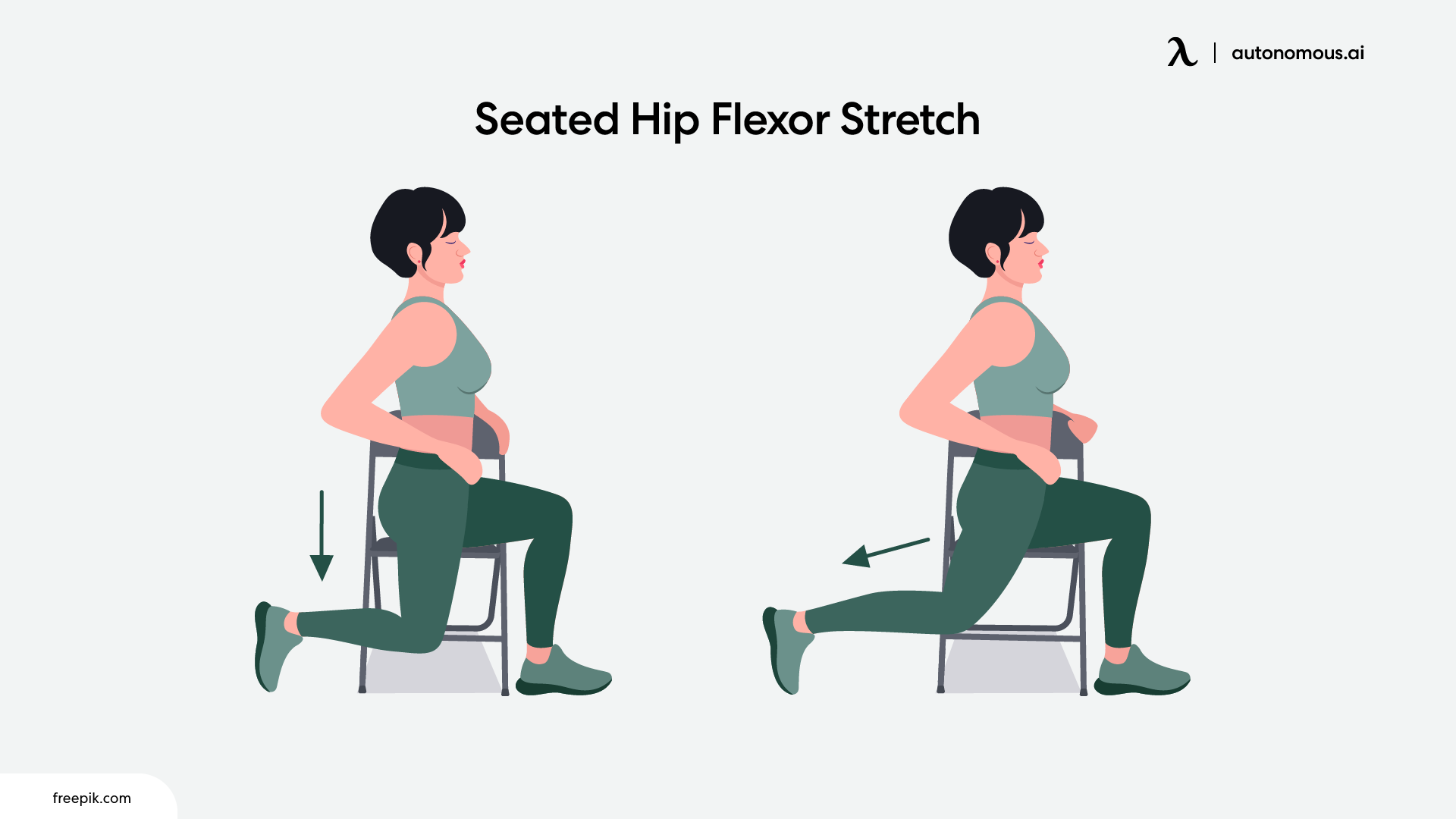
6. Seated Hip Stretch for Sciatica Pain
What it targets: Hip flexor muscles (iliopsoas), front of hip, lower back connection
Your hip flexors are the muscles at the front of your hip that allow you to lift your knees and bend at the waist. When you sit, these muscles stay in a shortened position for hours. Over time, they tighten and pull your pelvis forward into an excessive arch, a postural pattern that compresses your lumbar discs and irritates the sciatic nerve roots. This chair exercise for sciatic nerve pain counteracts that tightness.
The stretch also helps counter that tightness and fits naturally alongside chair leg exercises that keep the hips and thighs mobile throughout the day.
How to do it:
- Turn sideways in your chair so your right hip is near the front edge of the seat. Your right thigh should be fully supported on the chair.
- Let your left leg slide off the back of the chair, placing your left foot on the floor behind you. Your left knee can hover just above the ground or rest lightly on the floor if that's more comfortable.
- Keep your torso upright and your core gently engaged — avoid arching your lower back.
- Tuck your tailbone slightly under (imagine pulling your belt buckle up toward your ribs). You should immediately feel a stretch at the front of your left hip.
- For a deeper stretch, gently shift your weight forward while maintaining the tailbone tuck. Keep your chest lifted.
- Hold for 20–30 seconds while breathing steadily.
- Carefully return to a normal seated position and repeat on the other side.
Tight hip flexors create a chain reaction that ends at your sciatic nerve. When these muscles shorten, they pull your pelvis into an anterior tilt, which increases the curve in your lower back and narrows the spaces where your nerve roots exit the spine. Releasing the hip flexors allows your pelvis to return to a neutral position, reducing compression on the lumbar discs and the nerves they protect.
Pro tip: Squeeze the glute of your back leg as you hold the stretch — this deepens the hip flexor release through a mechanism called reciprocal inhibition, where activating one muscle helps relax its opposing muscle. If sitting sideways feels unstable, place one hand on a desk or wall for support.
7. Seated Glute Stretch for Sciatica Pain
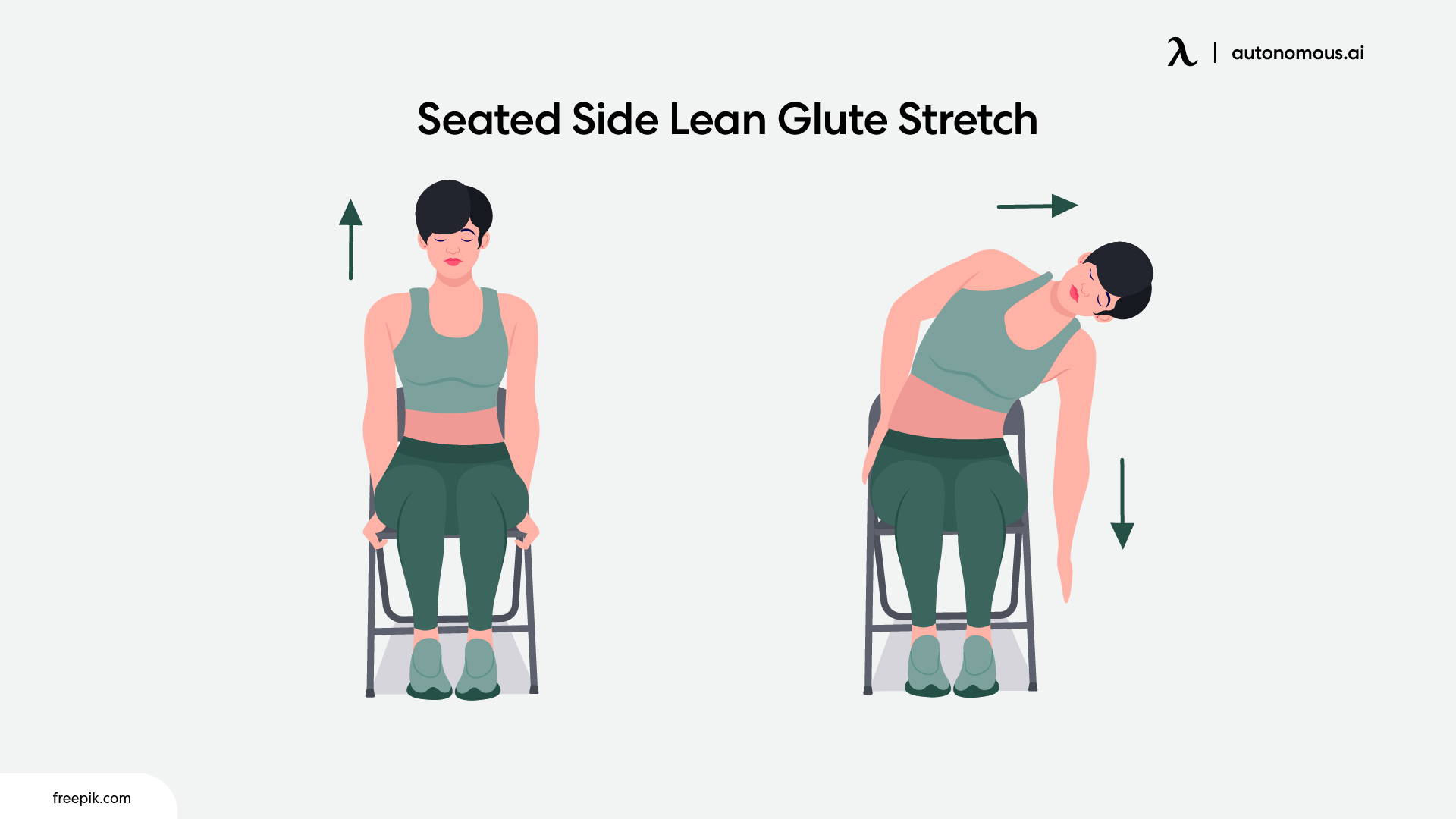
What it targets: Glute medius, deep glutes, outer hip
This lateral stretch targets the outer glute muscles and deep hip stabilizers that often contribute to buttock-driven sciatica pain. When these muscles tighten from prolonged sitting or poor pelvic alignment, they can pull on surrounding tissues and increase tension around the sciatic nerve. It's particularly helpful when sciatica pain runs deep in the buttock and is often recommended as part of sciatica buttock pain exercises to release tension in this area.
How to do it:
- Sit upright in your chair with both feet flat on the floor and your spine tall.
- Shift your weight slightly onto your left hip.
- Extend your right leg a few inches out to the side, keeping your foot flat or lightly resting on the heel.
- Place your right hand on the outside of your right thigh or knee for support.
- Inhale to lengthen your spine.
- As you exhale, gently lean your torso to the right, keeping both sit bones in contact with the chair.
- Slide your left hand down your left thigh or reach it overhead to increase the stretch, only as far as feels comfortable.
- Lean until you feel a stretch along the outer right hip and buttock — avoid collapsing your chest forward.
- Hold for 20–30 seconds while breathing slowly and steadily.
- Return to center with control and repeat on the opposite side.
Leaning laterally opens the space between your pelvis and femur, lengthening the gluteus medius and deep rotator muscles that help stabilize the hip. Releasing tension in these muscles produces lateral pull on the pelvis and can ease compression around the sciatic nerve — particularly in people whose pain worsens when sitting or standing on one leg.
Pro tip: Keep your torso facing forward as you lean to the side. If your chest rotates or one sit bone lifts off the chair, you’ve gone too far — reduce the depth and focus on slow, controlled movement.
8. Seated Pelvic Tilt for Lower Back Pain
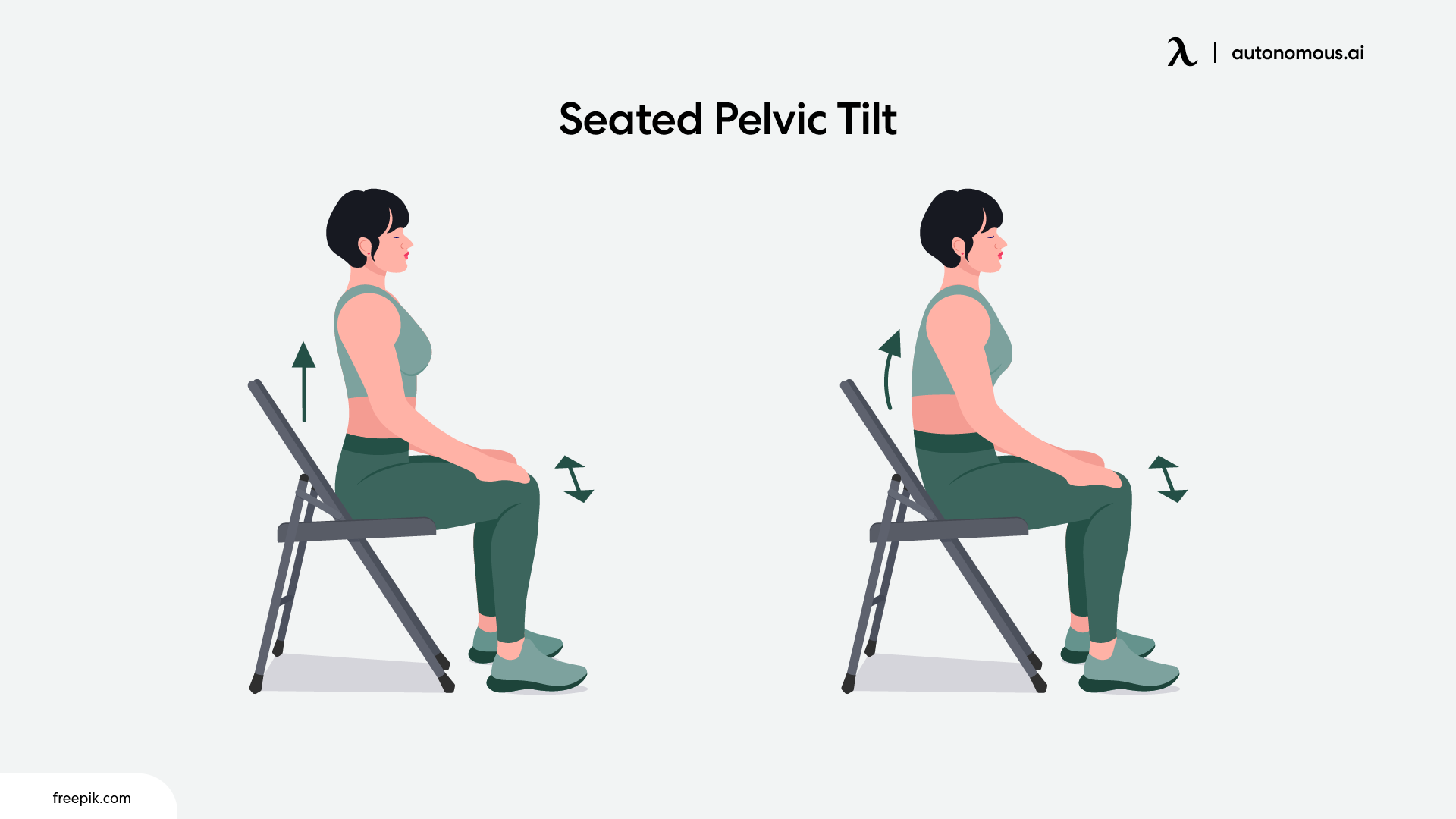
What it targets: Lower back, core muscles, pelvic alignment
This final movement is less of a stretch and more of a gentle mobilization that resets your pelvis and activates the deep core muscles that support your spine. After prolonged sitting, your pelvis often gets stuck in a tilted position — either tipped too far forward or tucked too far under. The pelvic tilt teaches you to control this position, which directly affects how much pressure lands on your lumbar discs and sciatic nerve roots.
When wondering what exercises are good for sciatica, this foundational movement is often overlooked, but it's essential for long-term relief.
How to do it:
- Sit toward the front edge of your chair with your feet flat on the floor, about hip-width apart. Rest your hands on your thighs.
- Start by finding your neutral spine — sit tall with a natural, slight curve in your lower back.
- Posterior tilt: Slowly roll your pelvis backward by tucking your tailbone under and flattening your lower back. Imagine you're gently pressing your belly button toward your spine. Your lower back will round slightly.
- Anterior tilt: Now reverse the movement — roll your pelvis forward, arching your lower back and sticking your tailbone out behind you. Your belly will move forward naturally.
- Move slowly between these two positions, finding the full range of motion in your pelvis without forcing either end.
- After 8–10 repetitions, settle into the middle position — this is your neutral pelvis, where your spine is naturally aligned and pressure is evenly distributed.
- Try to maintain this neutral position as you return to your regular activities.
Many people unknowingly sit with their pelvis stuck in one position, creating constant compression on specific vertebrae and nerve roots. Learning to control pelvic movement restores balance to your lower back and takes uneven pressure off the sciatic nerve.
Pro tip: Place your hands on your hip bones as you perform the tilts — you'll feel them rotate forward and backward with each movement.
Beyond Stretches: Other Ways to Relieve Sciatica at Your Desk
While seated sciatica stretches can ease tension in the moment, lasting relief often comes from improving how your workspace supports your body throughout the day. These simple adjustments target the main drivers of desk-related sciatic pain: posture, pressure, and prolonged stillness.
- Use an ergonomic chair with lumbar support
Good lumbar support helps preserve the natural curve of your lower spine, easing strain on the back and reducing nerve compression. A well-designed office chair for sciatica also discourages slouching, one of the most common triggers of sciatic discomfort during long sitting sessions.
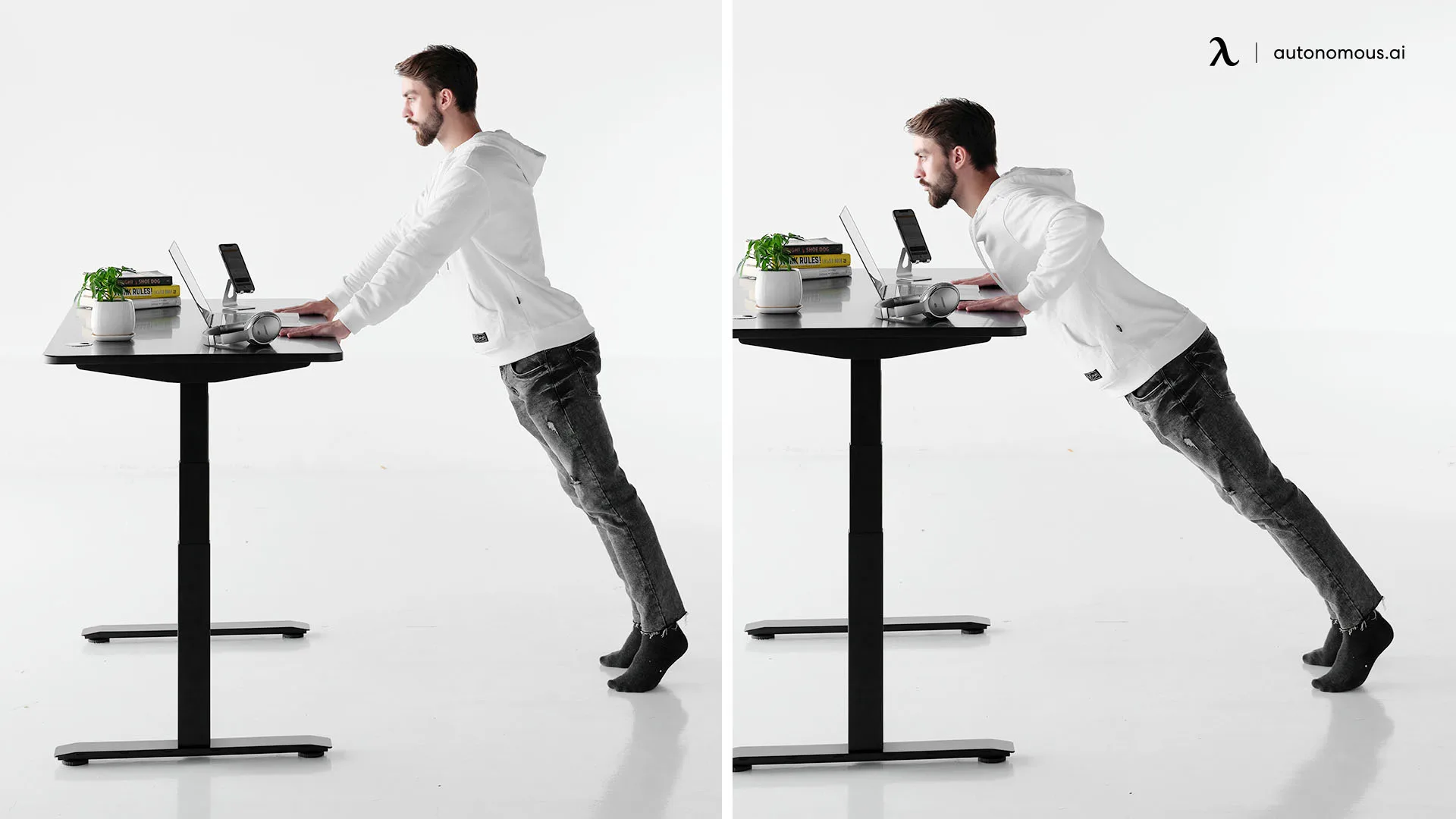
- Alternate between sitting and standing
Remaining in one position for long periods places increasing pressure on the discs in your lower spine. Changing positions — by standing, walking briefly, practicing active sitting, or doing a light stretch — helps release that pressure, improve circulation, and prevent stiffness from building into pain.
In fact, standing periodically can reduce spinal compression by up to 40 percent and give irritated nerves time to recover. With a height-adjustable standing desk, these small movements fit naturally into your workflow instead of interrupting it.
- Apply heat or cold therapy
Heat relaxes tight muscles and improves blood flow, while cold therapy helps calm inflammation after long sitting periods. Used thoughtfully, both can ease flare-ups and keep symptoms more manageable throughout the workday.
FAQs
How do you stretch your sciatic nerve while sitting?
The safest way is with seated nerve gliding exercises, such as slowly extending one leg while flexing and pointing the foot. This gently mobilizes the sciatic nerve, reducing tension without overstretching or irritating it further.
What is the miracle stretch for sciatica?
There is no single miracle stretch, but the seated figure-4 stretch is often the most effective for fast relief. It releases the piriformis muscle, one of the most common sources of sciatic nerve compression when sitting.
What are the best seated sciatica stretches for quick pain relief?
The most effective sciatica exercises and stretches include the seated figure-4, sciatic nerve glide, knee-to-chest stretch, and seated spinal twist. These target the piriformis, hamstrings, lower back, and nerve pathway where compression usually occurs.
How long should you hold seated sciatica stretches?
Most stretches should be held for 20 to 30 seconds while breathing slowly and staying relaxed. Avoid bouncing or forcing the movement, which can irritate the nerve.
How often should you do seated sciatica stretches?
For best results, perform seated sciatica stretches every 60 to 90 minutes if you sit for long periods. Frequent short sessions prevent stiffness from building into pain.
Is it safe to do seated sciatica stretches every day?
Yes, daily gentle stretching is generally safe and recommended for managing sciatica. Stop if any stretch increases sharp pain, numbness, or tingling, and consult a professional if symptoms persist.
Conclusion
Sciatica pain can turn even a short workday into a long, uncomfortable experience — but relief doesn’t always require leaving your desk or changing your entire routine. With the right seated sciatica exercises and stretches, you can reduce nerve compression, release tight muscles, and restore healthy movement in just a few minutes at a time.
The key is consistency. Brief, regular stretching throughout the day works far better than waiting until pain becomes severe. Alongside seated sciatica stretches, complementary movements such as neck posture exercises, seated back stretches, and chair exercises for upper body can help keep your entire spine mobile and balanced during long hours of sitting.
If your sciatica pain persists, worsens, or includes weakness or numbness that doesn’t improve, it’s important to consult a healthcare professional. But for many people, these seated stretches provide a practical, effective way to manage sciatica — right where it starts, at your desk.