.svg)


MDF vs. Particle Board: Are They the Same?

The Fast Answer — MDF vs. Particle Board by Use Case
If you need a quick ruling before reading the full breakdown, here it is. The table below covers the most common applications:
Application | Better Choice | Why | Caveat |
Kitchen cabinet doors | MDF | Smooth surface, holds paint without grain bleed-through | Avoid in under-sink or dishwasher-adjacent zones |
Kitchen cabinet boxes | Particle board (melamine-coated) | Industry standard, adequate in dry zones, lighter | Not suitable near moisture sources |
Bathroom vanity | Moisture-resistant MDF | Handles humidity better than standard particle board | Must have fully sealed edges and moisture-resistant finish |
Office desk surface | MDF | Flat, dense, ideal base for laminate or paint | Heavier — relevant for large motorized frames |
Shelving / bookcases | Either — depends on span and load | Particle board works in short, lightly loaded spans; MDF handles longer spans and heavier loads better | Sagging risk increases with span length regardless of material |
Flooring underlay | Particle board | Performs well under consistent, distributed weight in dry conditions | Not suitable where subfloor moisture is a risk |
Laminate flooring core | MDF / HDF | Density provides dent resistance and joint integrity | HDF preferred over standard MDF for high-traffic floors |
When neither condition fits — high moisture, heavy structural load, or furniture that will be frequently modified — neither material is the right answer
Table of Contents
- The Fast Answer — MDF vs. Particle Board by Use Case
- What MDF and Particle Board Are Actually Made Of
- Head-to-Head — 6 Properties That Separate MDF and Particle Board
- Health and Off-Gassing — What the Spec Sheet Won't Tell You
- Room by Room — Which Material Belongs Where
- MDF vs. Particle Board vs. Plywood — Where the Third Option Changes the Calculus
- What to Look For on the Spec Sheet Before You Buy
- FAQs
- Conclusion
Most furniture listings won't tell you much beyond "engineered wood." Whether you're buying a new home office desk, replacing kitchen cabinets, or sourcing sheet material for a build, you'll eventually run into the MDF vs. particle board decision — and the difference matters more than the price tag suggests.
This guide breaks down how each material performs across the applications that actually come up: moisture exposure, surface finish, load-bearing, and long-term durability. By the end, you'll have a clear answer for your specific situation.
What MDF and Particle Board Are Actually Made Of
Understanding how each material is manufactured explains most of the performance differences — without needing to memorize a spec sheet.
1. What is MDF Board?
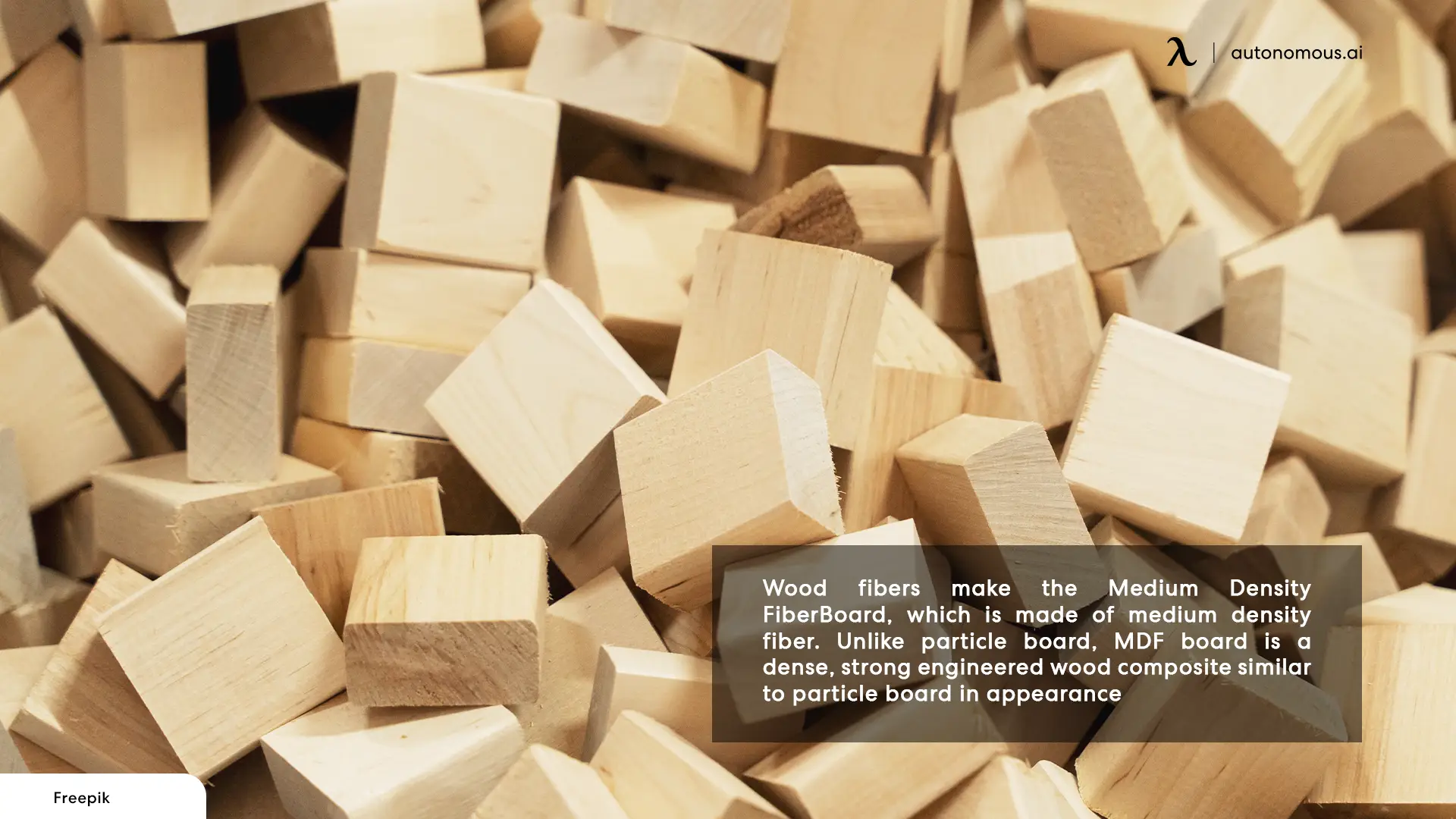
MDF is an engineered wood composite similar to particle board but much more dense and strong. MDF has no wood grains because it is composed of small wood fibers. Those fibers are combined with wax and resin and compressed under high heat and pressure — a process that produces a smooth, void-free panel with consistent density from face to edge.
The result is a dense, void-free board with a uniform internal structure and a smooth surface on both faces. Because the fibers are consistent in size and tightly compressed, MDF has no wood grain, no knots, and no weak points from uneven particle distribution. Standard MDF density ranges from 700 to 800 kg/m³.
That uniformity is what makes MDF easy to cut cleanly, rout into shapes, and finish with paint or veneer without surface texture telegraphing through. It also makes MDF heavier than particle board at equivalent thicknesses — a tradeoff that matters in large wall-mounted installations.
Most MDF uses urea-formaldehyde resin as the binding agent. Products certified to CARB Phase 2 (California Air Resources Board) or European E1/E0 standards meet regulated limits on formaldehyde emissions.
2. What is Particle Board?
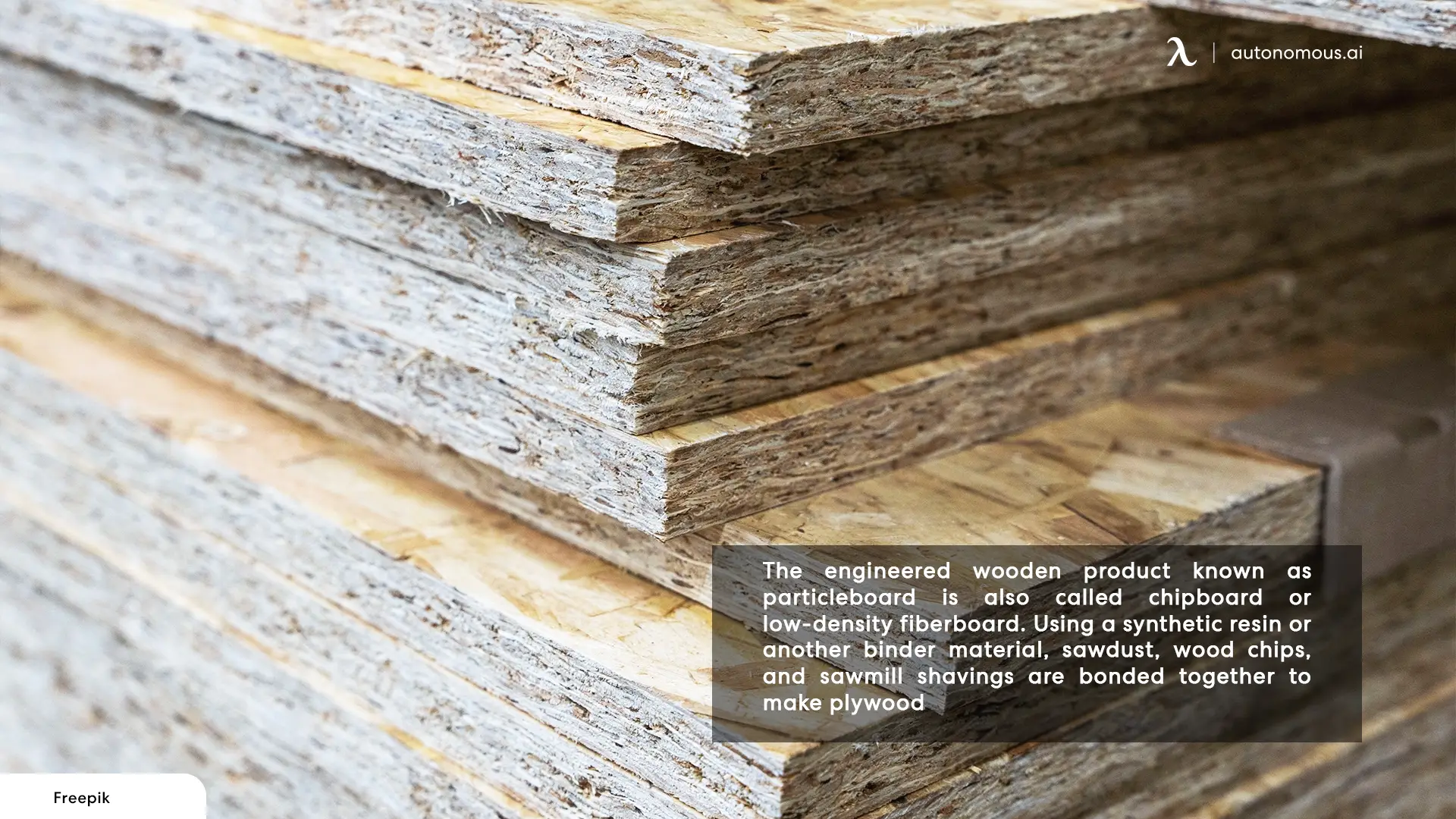
Particle board — also called chipboard or pressboard — is made from wood chips, sawdust, and sawmill shavings bonded with resin and pressed into sheets.
Unlike MDF, the raw inputs are not broken down into uniform fibers. The particles vary in size, which creates a coarser internal structure with more air gaps. Standard particle board density runs from 600 to 680 kg/m³ — lower than MDF, which makes it lighter but also less rigid and more prone to weak points where large chips cluster.
Raw particle board has a rougher surface that does not hold paint well. Most of what consumers encounter in ready-to-assemble furniture is melamine-coated particle board — a layer of melamine resin paper bonded to both faces during manufacturing. That coating is what gives the material its smooth, cleanable surface and basic moisture resistance at the face. The edges remain the vulnerability.
Particle board is not a single fixed product. Higher-grade versions use finer particles near the surface for better screw retention and finish quality. The grade distinction rarely appears on consumer furniture listings, which is part of why the material has a reputation that does not always match its actual performance range. Higher-grade versions use finer particles near the surface for better screw retention and finish quality — a distinction that rarely appears on consumer furniture listings.
Head-to-Head — 6 Properties That Separate MDF and Particle Board
The MDF vs. particle board comparison comes down to six properties. Each one affects a specific real-world outcome — how long the piece lasts, how it looks after finishing, and whether it survives the environment it's placed in.
1. Strength and Density
MDF is stronger than particle board because its uniform fiber structure distributes stress evenly across the panel.
Particle board's chip-based composition creates inconsistency — areas where larger chips cluster have lower tensile strength than surrounding zones. Under sustained load, those weak points are where sagging and cracking begin. MDF's density (700–800 kg/m³) versus particle board's (600–680 kg/m³) reflects this directly: more material per cubic meter means more resistance to bending and impact.
MDF is the better choice for load-bearing applications. Particle board is suitable only in flat, lightly loaded uses where span length is short.
2. Moisture and Water Resistance
Neither standard MDF nor standard particle board is water-resistant — but they fail differently, and that difference affects which one belongs in which room.Standard MDF absorbs water rapidly through its fine fiber structure. Once wet, it swells throughout the panel, not just at the surface, and the damage is typically irreversible. Particle board fails at the edges first — the face coating resists surface moisture until breached, but raw or cut edges absorb water quickly and cause the board to crumble from the inside out.
What most comparisons skip: moisture-resistant MDF is a distinct product category. It uses phenolic resin instead of standard urea-formaldehyde, which significantly slows water absorption. Products designed to this spec perform better than standard particle board in humid conditions — though they are not a substitute for plywood or PVC-based materials in genuinely wet environments.
Melamine coating resists surface spills — it does not make the core waterproof.
In humid rooms, moisture-resistant MDF outperforms standard particle board. In wet rooms, neither material is appropriate without additional sealing and surface protection.
3. Surface Finish and Paintability
MDF produces a cleaner painted or veneered finish than particle board because its surface is void-free and consistent across the full face.
Paint applied directly to MDF absorbs evenly with minimal variation. Routed edges stay sharp. Veneer bonds reliably without surface texture reading through. Particle board's coarser face requires laminate or pre-applied melamine to present well — painting directly onto uncoated particle board produces an uneven result, and the texture of the chips shows through the paint layer over time.
MDF is the correct choice for any painted or veneered finish. Particle board performs acceptably only with laminate or melamine pre-applied at the factory.
4. Screw and Fastener Retention
MDF holds screws securely in the face but is vulnerable to splitting at the edges without a pilot hole first.
The dense fiber structure grips face-driven screws well under static load. Edge fastening is the weakness — driving a screw into the edge of an MDF panel without pre-drilling causes the fibers to separate. Particle board holds face screws adequately but degrades faster under repeated tightening and loosening. Screws strip out of particle board more quickly than MDF, which is why furniture requiring ongoing adjustment — hinges, drawer slides, removable shelving pins — tends to fail at fastener points first in particle board construction. For either material, screws designed for engineered wood panels outperform standard wood screws noticeably.
MDF is the better choice for fixed assemblies requiring long-term fastener integrity. Neither material is well-suited to furniture that will be disassembled and rebuilt multiple times.
5. Weight and Handling
Particle board is lighter than MDF at equivalent thickness, and in large installations that difference has direct structural implications.
A standard 4×8 sheet of 3/4" MDF weighs approximately 96–100 lbs. The equivalent particle board sheet runs 85–90 lbs. Upper wall cabinets built from MDF place meaningfully more load on wall anchors than the same cabinets in particle board — which affects anchor type and spacing, not just ease of lifting during installation.
For floor-standing furniture, MDF's weight works in its favor. The added density reduces flex across wider spans and contributes to stability in a finished piece. The weight is a liability only when the piece goes on a wall.
Particle board has a practical installation advantage in large wall-mounted applications. In floor-standing furniture, MDF's weight is an asset, not a drawback.
6. Cost
Particle board costs less than MDF at every thickness and grade — but the price difference is smaller than most buyers expect, and lifespan changes the math.
Current retail pricing for a 4×8 sheet: particle board runs approximately $20–$35 depending on thickness and coating. MDF runs approximately $30–$55 for equivalent dimensions.
The upfront price difference in the mdf vs particle board decision narrows significantly when lifespan is factored in. In any application with regular moisture exposure, moderate load, or repeated fastener stress, particle board degrades faster — and replacement cost closes the gap quickly.
Particle board costs less upfront. MDF costs less per year of use in any moderate-to-heavy application.
Health and Off-Gassing — What the Spec Sheet Won't Tell You
Both MDF and particle board contain formaldehyde-based resins, and both can release low levels of formaldehyde gas into the air — particularly when new.
This is not a reason to avoid either material. It is a reason to know what you are buying.
1. Where the Risk Actually Comes From
Formaldehyde off-gassing occurs when the resin binders inside engineered wood panels slowly release volatile organic compounds (VOCs) into the surrounding air.
In well-ventilated spaces, the levels dissipate quickly and pose no meaningful risk for most people. In small, poorly ventilated rooms — a home office, a child's bedroom, a fitted wardrobe — new furniture from multiple pieces can temporarily raise indoor VOC concentrations above comfortable levels.
MDF typically off-gasses more than particle board because it contains a higher density of resin per unit volume. The finer fiber structure requires more binding agent to hold together, which means more resin content overall.
2. What Certification Actually Means
CARB Phase 2 and E1/E0 are the two most widely referenced standards for formaldehyde emissions in engineered wood products. Both set maximum allowable emission levels — they are regulatory and classification benchmarks, not brand endorsements.
CARB Phase 2 (California Air Resources Board) establishes emission limits for composite wood products sold in the United States. It sets a limit of 0.11 ppm for MDF and 0.09 ppm for particle board. Under TSCA Title VI, these limits apply federally to products manufactured or imported for sale in the US market. Products certified to this standard will typically state CARB Phase 2 or TSCA Title VI compliance on the spec sheet or product documentation.
E1 and E0 are European classification levels under EN 717-1 testing standards. E1 allows up to 0.1 ppm; E0 is the stricter classification at 0.05 ppm or below. These are not equivalent to CARB Phase 2 — they use different testing methods — so direct ppm comparisons between the two systems should be treated as approximate rather than definitive.
Standard | Region | Max Formaldehyde (MDF) | Max Formaldehyde (Particle Board) |
CARB Phase 2 / TSCA Title VI | United States | 0.11 ppm | 0.09 ppm |
E1 | Europe | 0.10 ppm | 0.10 ppm |
E0 | Europe / Premium | 0.05 ppm | 0.05 ppm |
These standards regulate emission levels at the point of manufacture and sale. They do not account for variables in installation, ventilation, or how a product is finished in the field. Certification is a meaningful baseline for comparison — not a guarantee of conditions in any specific space.
3. Practical Steps That Actually Reduce Exposure
Certification matters, but how the product is finished and installed matters just as much.
- Check certification before buying: Look for CARB Phase 2 or TSCA Title VI on the spec sheet or product listing. If that information is absent and the seller cannot confirm compliance, do not assume the product meets the standard — in most cases, compliant products state it explicitly because it is a selling point.
- Confirm edges are finished at purchase: Raw or cut edges — where the core material is directly exposed — are the primary off-gassing point on both MDF and particle board. Edge banding, paint, or laminate applied to all exposed edges reduces VOC release significantly. Furniture with unfinished edges off-gasses faster and for longer. This is a detail worth checking on a product listing before ordering, not after delivery.
- Ventilate after installation: Leaving windows open for several days after new furniture arrives allows VOCs to disperse before the room returns to normal use. This applies to both materials but matters more with MDF-heavy pieces in smaller rooms.
E0-rated products carry a retail price premium of approximately 15–25% over standard CARB Phase 2 equivalents and are worth considering for smaller rooms with limited airflow.
Room by Room — Which Material Belongs Where
The right choice between MDF and particle board often comes down to where the furniture is going, not just what it is. The same material that performs well in a dry living room can fail within a year in a bathroom or kitchen.
1. Kitchen Cabinets
For kitchen cabinets, the answer depends on which part of the cabinet you are specifying.
Cabinet doors and visible panels are where MDF earns its place — its smooth, stable surface holds a painted finish without grain interference and handles moderate kitchen humidity better than particle board over time. Cabinet boxes in dry zones such as upper cabinets and pantry units are routinely built from melamine-coated particle board in mid-range kitchens, and this is an accepted industry-standard choice.
The exception is anywhere near a moisture source. Under-sink cabinets, dishwasher-adjacent panels, and toe kicks in contact with floor moisture require moisture-resistant MDF with fully sealed edges at minimum. Plywood is the more reliable choice in these zones.
For kitchen cabinets: MDF for doors and painted surfaces; melamine particle board for dry cabinet boxes; MR-MDF or plywood near any moisture source.
2. Bathroom Vanities and Storage
Standard particle board is not appropriate for bathroom installations. Standard MDF is only marginally better without additional treatment.
Moisture-resistant MDF with fully sealed edges and a moisture-resistant finish can work in a bathroom vanity, but every edge and joint must be consistently sealed — a single unsealed cut edge is enough to start the degradation cycle. Plywood or PVC-based board is the more reliable long-term specification for wet rooms.
Both MDF and particle board can be used without issue in bathroom-adjacent storage — a linen closet or hallway cabinet outside the wet zone.
In bathrooms: neither standard MDF nor particle board is recommended. MR-MDF with fully sealed edges is viable for vanities; plywood or PVC-board is the more reliable long-term choice.
3. Home Office Desk Surfaces
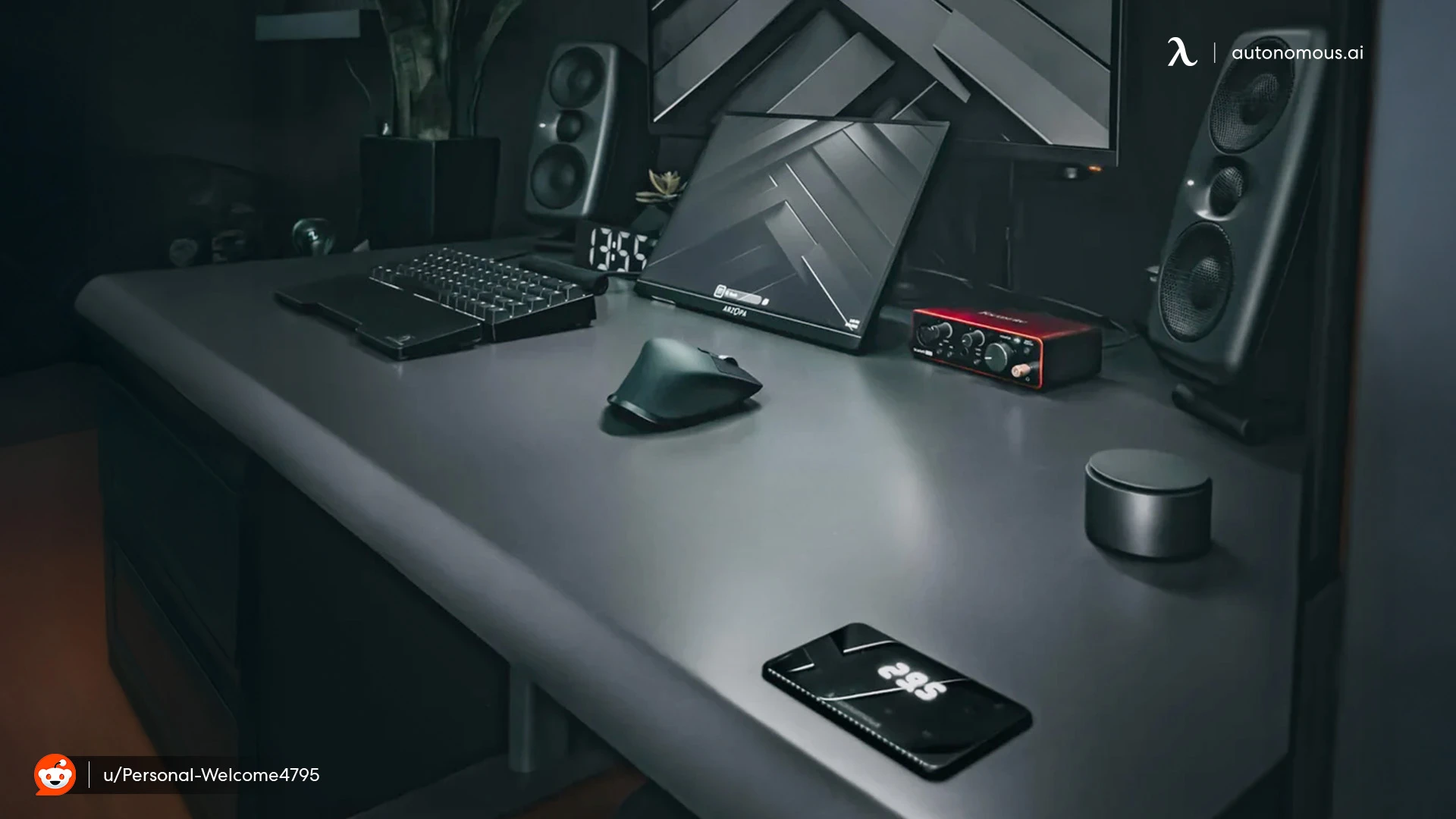
For desk surfaces, MDF is the stronger performing material across finish quality, dimensional stability, and surface flatness.
MDF's void-free, uniform face provides an ideal substrate for laminate, veneer, or direct paint application. It does not flex across wider spans the way particle board can under the weight of monitors, equipment, and daily use. Particle board desk tops are a workable option in light-use, static setups where cost is the primary constraint — budget MDF computer desks often use particle board for this reason, though surface finish and long-term rigidity will be noticeably lower.
For motorized standing desks specifically, span rigidity matters more than it does in a fixed desk. A wider, denser surface distributes load more evenly across the frame and reduces the flex that can stress the lifting mechanism over time. The Autonomous Desk Pro uses an HDF-core surface — a step above standard MDF in density and rigidity — which provides consistent flatness at the face and reliable frame attachment across the full span.

For desk surfaces: MDF is the better specification across finish, rigidity, and long-term performance. Particle board is acceptable only in light-use, static setups where cost is the overriding factor.
4. Shelving and Bookcases
Both materials are used in shelving, and both can perform adequately within defined limits — where they differ is how span length and load interact with each material's internal structure.
A particle board shelf at 600mm span under light load will perform comparably to MDF. The same shelf at 900mm under sustained book weight will sag noticeably faster than an MDF equivalent of the same thickness. For particle board shelving, 16mm thickness is the minimum for spans under 700mm with light loads. At spans beyond 800mm or with heavy contents, 18mm MDF is the more appropriate specification. Center supports reduce the effective span and improve performance in either material.
For shelving: particle board is adequate in short spans with light loads. MDF is the better choice for longer spans, heavier loads, or shelving that will stay loaded long-term.
5. Flooring Substrate and Laminate Cores
Particle board is a common flooring underlay in residential construction, and in this application it performs well — because the installation conditions suit its properties.
As an underlay, particle board sits flat, carries evenly distributed load, and is protected from surface moisture by the floor covering above it. It is a cost-effective and appropriate choice for this specific use when the subfloor is dry and the installation is correct.
For laminate flooring plank cores, the industry standard is HDF rather than standard MDF. HDF sits at densities above 800 kg/m³, which provides the dent resistance and click-joint integrity that laminate flooring requires under foot traffic. Particle board is not used as a laminate core in quality flooring products because its lower density cannot maintain the precision tolerances that click-lock joints require over time.
For flooring underlay: particle board is appropriate in dry, correctly installed conditions. For laminate flooring cores: HDF is the industry standard. Particle board is not suitable for this application.
MDF vs. Particle Board vs. Plywood — Where the Third Option Changes the Calculus
Plywood is not always the better choice — but in three specific situations, neither MDF nor particle board is the right answer, and plywood is.
Situation | Why MDF and Particle Board Fall Short | Why Plywood Works Better |
High-moisture areas (bathrooms, laundry rooms, under sinks) | Both absorb moisture through edges and swell from the inside, even when sealed on the surface | Plywood (especially exterior or marine-grade) resists moisture through the full panel, not just the surface |
Heavy load or structural use (cabinet boxes, shelving, workbenches) | Fasteners loosen over time, and the material can sag or break under sustained weight | Cross-layered construction gives plywood consistent strength and better screw-holding over time |
Furniture that may be repaired or modified | Screws strip easily, and edges chip when recut or adjusted | Holds screws through multiple uses and can be cut or refinished with less edge damage |
Plywood costs more upfront — a 4×8 sheet of 3/4" birch plywood typically ranges from $55–$90, depending on grade. For desk surfaces specifically, solid wood desktops represent the tier above plywood where longevity and finish quality are the primary criteria. But in moisture-prone or high-use environments, that cost is often offset by longer lifespan and fewer replacements.
For dry, everyday use, the MDF vs. particle board decision is usually enough. When conditions go beyond that — moisture, weight, or long-term durability — plywood is the more dependable choice.
What to Look For on the Spec Sheet Before You Buy
Most furniture listings tell you less than they should about the materials inside. Knowing what to look for — and what missing information signals — saves you from making a decision based on incomplete data.
1. Material Named Specifically
The spec sheet should identify the core material by name: MDF, particle board, HDF, or plywood. "Engineered wood," "wood composite," or "manufactured wood" without further specification almost always means particle board. Manufacturers who use MDF or HDF typically say so, because it is a stronger specification worth stating.
2. Emission Certification Listed
Look for CARB Phase 2, TSCA Title VI, E1, or E0 on the product listing or in the documentation. If none of these appear and the seller cannot confirm compliance on request, do not assume the product meets current emission standards.
3. Edge Treatment Confirmed
Check whether exposed edges are banded or sealed. Raw edges — on shelves, cabinet sides, or cut-to-size panels — are where both MDF and particle board degrade first under moisture and daily contact. Edge banding or a continuous laminate wrap is the detail that separates furniture built to last from furniture built to a price.
4. Thickness Specified
Thickness determines structural performance more than most buyers account for. For shelving, 16mm is the practical minimum for spans under 700mm with light loads. For spans beyond 800mm or sustained heavy loads, 18mm in MDF or HDF is the appropriate specification. If a listing does not state thickness, ask — it is a basic product detail that should be available.
5. Surface Treatment Identified
The surface treatment on any particle board or MDF wood desk top — or any flat furniture surface — changes how the piece performs and how long it holds up. Melamine, laminate, veneer, and paint-ready MDF are meaningfully different finishes with different durability ceilings. A listing that says "smooth finish" without identifying the treatment is not giving you enough information to assess the product accurately.
FAQs
Is MDF the same as particle board?
No, MDF and particle boards are not the same material. Both are engineered wood products made from wood waste and resin, but MDF uses finer, more uniform wood fibers while particle board uses coarser, mixed-size wood chips. This makes MDF denser, heavier, and smoother — which is why they perform differently in finish quality, moisture resistance, and load-bearing.
Is MDF stronger than particle board?
Yes, MDF is generally stronger than particle boards in most applications. Its uniform fiber structure distributes stress more evenly, while particle board’s chip-based composition creates weak points under load. For shelving, cabinet doors, and desk surfaces, MDF holds up better over time at the same thickness.
Does MDF last longer than particle board?
Yes, MDF typically lasts longer than particle board in moderate-to-heavy use. Particle boards break down faster under repeated stress, moisture exposure, and sustained weight — especially at edges. In dry, light-use conditions, the lifespan difference becomes less noticeable.
Can you paint a particle board?
No, you should not paint directly onto an uncoated particle board. Its coarse surface absorbs paint unevenly and the chip texture shows through over time. It performs better when pre-sealed or when a laminate or melamine layer is already applied. For a smooth painted finish, MDF is the better choice.
Which is better for furniture — MDF or particle board?
MDF is better for most furniture applications. It offers a smoother surface for finishes, stronger structure for daily use, and better long-term durability. Particle board is suitable for low-cost, light-use furniture where budget is the main priority.
Which is better for cabinets — MDF or particle board?
MDF is generally better for cabinet doors and painted surfaces, while particle board is often used for cabinet boxes in low-cost builds. For long-term durability, MDF performs better under repeated use and load.
Is particle board waterproof?
No, a particle board is not waterproof. It absorbs moisture through edges and unsealed surfaces, causing swelling and crumbling that is usually irreversible. Even melamine-coated boards only resist surface spills — the core remains vulnerable.
What are the disadvantages of MDF?
MDF has four main disadvantages. It is heavier than particle board, absorbs water quickly and swells when wet, can split at edges without pilot holes, and may release low levels of VOCs from formaldehyde-based resins. Certified boards (CARB Phase 2, E1/E0) meet regulated emission limits.
Which is cheaper — MDF or particle board?
Particle boards are cheaper than MDF. A standard 4×8 sheet typically costs around $20–$35, while MDF ranges from $30–$55. The price gap becomes less significant over time, as MDF usually lasts longer in moderate-to-heavy use.
Why is MDF so cheap compared to solid wood?
MDF is cheaper than solid wood because it is made from compressed wood fibers and manufacturing byproducts rather than solid timber. This lowers raw material costs and allows for consistent, large-scale production with minimal waste.
How do you tell the particle board from MDF?
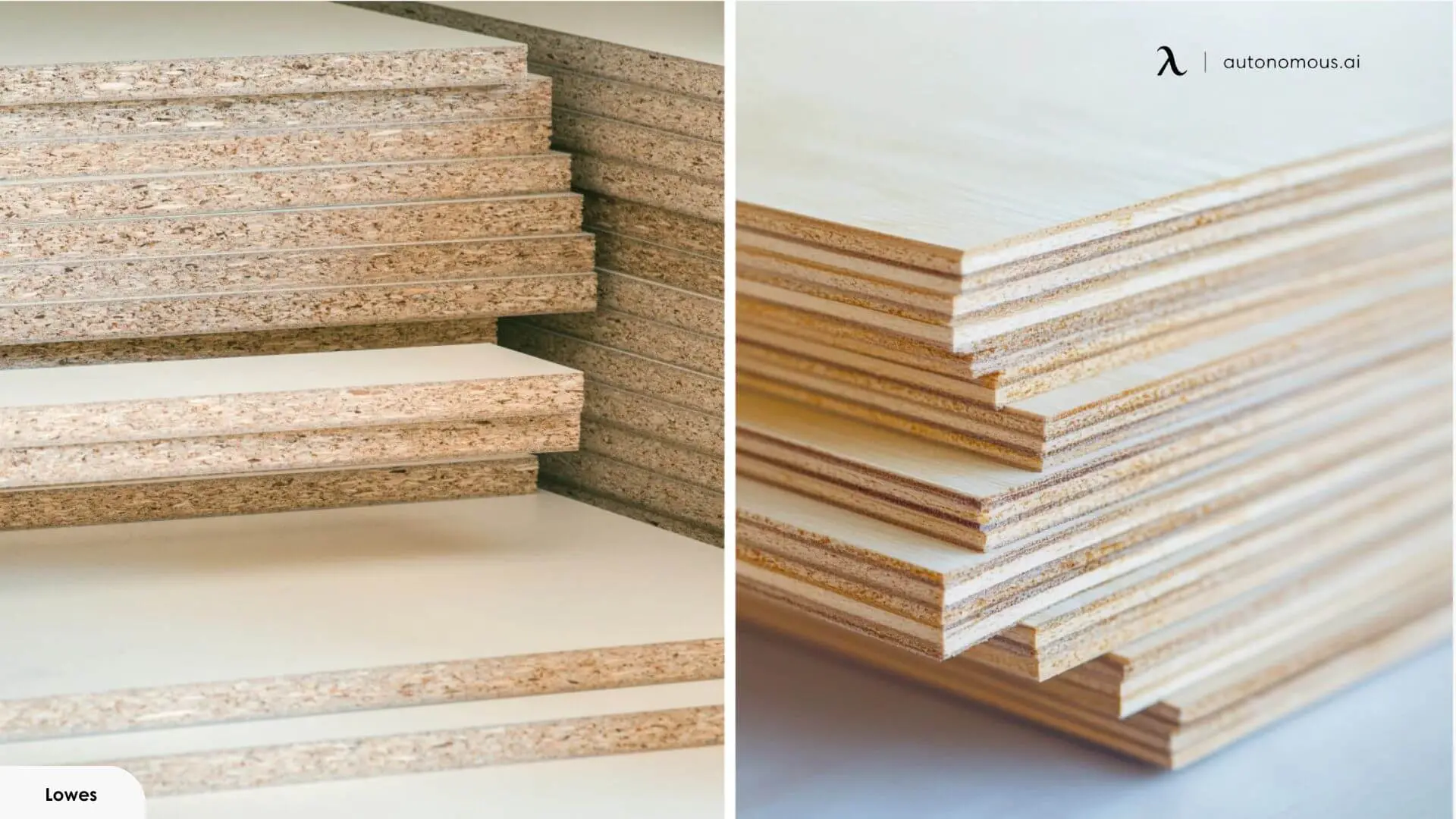
The easiest way is to check a cut edge. MDF looks smooth and uniform, while particle board shows visible wood chips and a rough texture. MDF is also noticeably heavier at the same thickness.
Conclusion
MDF is the better material when finish quality, dimensional stability, and longevity under moderate-to-heavy use are the priority. It holds paint cleanly, resists bending across wider spans, and outlasts particle board in any application that puts it under regular stress. If the piece is visible, painted, and expected to last — MDF is the correct specification.
Particle board is the right call when the application is dry, the load is light, and cost is the overriding constraint. Melamine-coated particle board in a low-humidity environment, used within its span and load limits, performs adequately for its price point. The material is not inherently poor — it is frequently used outside the conditions it is suited for, which is where the reputation for failure comes from.
When neither works — high moisture, heavy structural load, or furniture that will be modified and reassembled over time — the mdf vs particle board decision is the wrong frame entirely. Step up to plywood. The additional cost is real; so is the performance difference.