DeerRun Treadmill Reviews 2026: Which One Fits Your Goals?

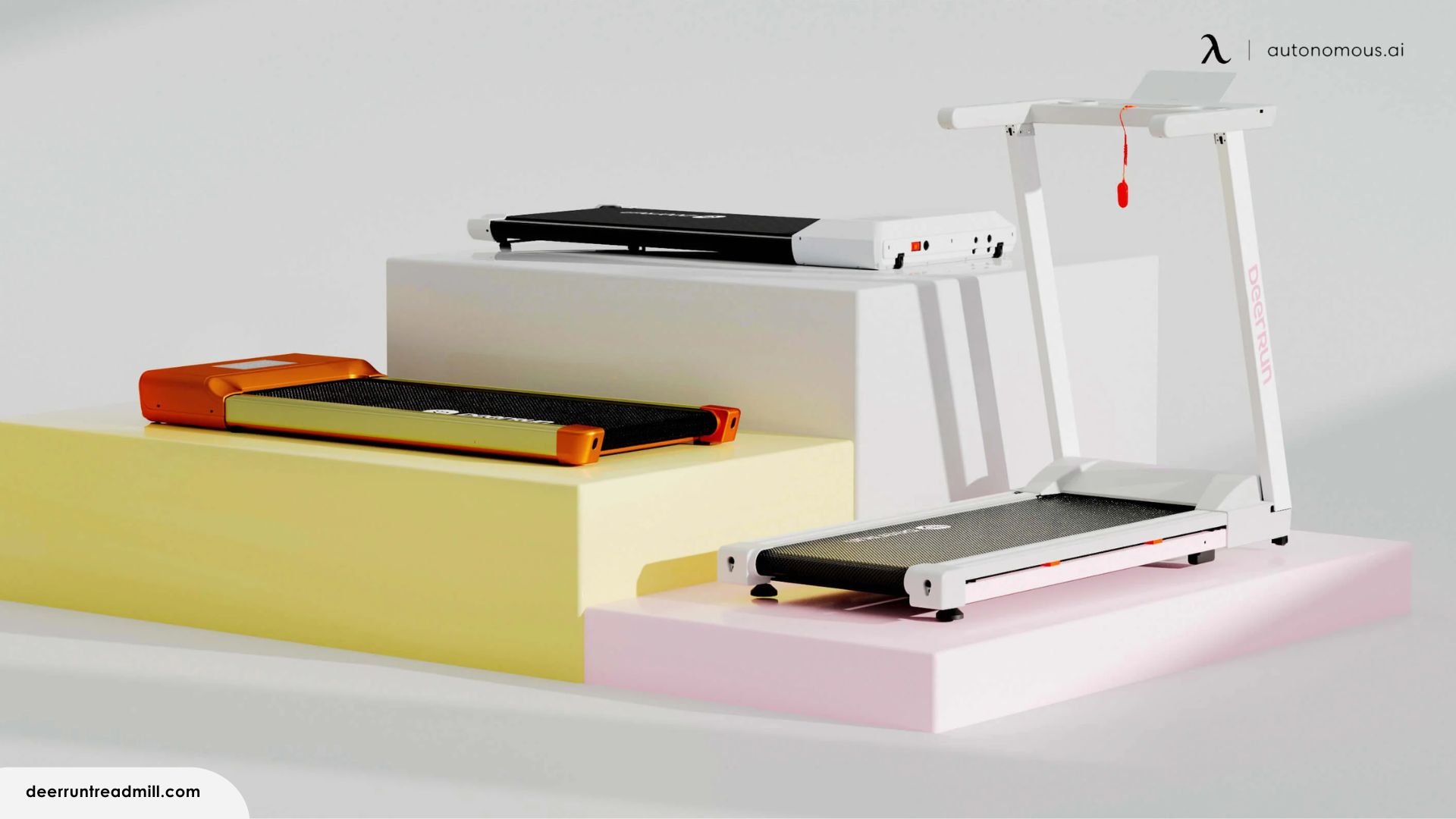
Table of Contents
Consistent movement matters for long-term health, and for many people the appeal of a treadmill is less about peak performance than the benefits of walking on a treadmill as part of a sustainable daily routine. By removing barriers like weather, time, and location, treadmills remain one of the most accessible ways to build cardiovascular fitness at home, especially for those with busy schedules or limited outdoor options.
DeerRun has positioned itself as a practical choice in the home fitness market, offering models across different price points and space requirements. This article provides DeerRun treadmill reviews for three of their current models, the X20, A1 Pro, and A5 Pro, examining build quality, functionality, and real-world usability to help you determine which, if any, fits your wellness goals.
How We Evaluated
Most DeerRun reviews focus heavily on specs without explaining what those numbers mean in practice. A 3.5 HP motor sounds impressive, but does it run quietly at 6 mph while you're on a work call? A 400-lb weight capacity suggests durability, but how does the frame actually feel underfoot during a 30-minute session, especially when following structured routines like a treadmill workout rather than short test bursts?
To keep these DeerRun treadmill reviews practical and honest, each DeerRun treadmill was tested using criteria that reflect real home use. not lab conditions or marketing claims. The goal was to understand how each model performs when it becomes part of a daily routine.
- Build Quality:
We evaluated frame construction, belt thickness, and rated weight capacity to assess overall stability. A well-built DeerRun treadmill should feel planted underfoot, with minimal vibration during walking or running, which often signals better long-term durability.
- Motor Performance:
Motor output affects more than top speed. We focused on how consistently each treadmill handled sustained walking, jogging, and incline changes, while paying close attention to noise levels during typical home use.
- Space Efficiency:
Home gym equipment competes for floor space. We measured footprint dimensions, tested folding mechanisms, and assessed how easily each model stores in apartments or multipurpose rooms.
- Ease of Use:
From unboxing to the first workout, we tracked setup time, control responsiveness, and display readability. A treadmill that’s simple to operate is far more likely to be used consistently.
- App Integration:
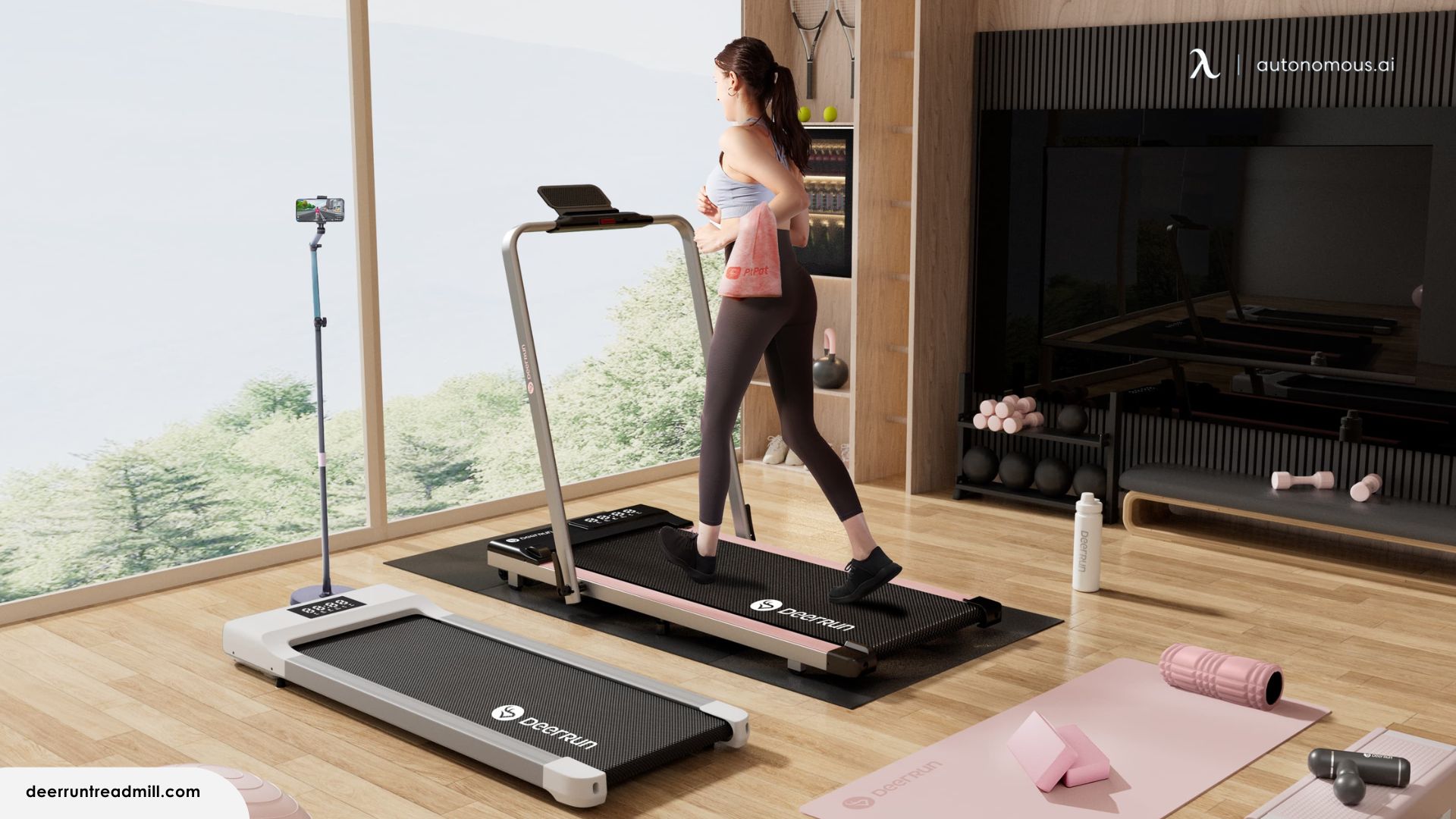
DeerRun treadmills connect to the PitPat app, so we tested pairing reliability, feature usefulness, and whether the app genuinely enhances the experience, or simply adds friction. App performance was evaluated as a supplement, not a requirement.
A Side-by-Side Look
Before diving into individual DeerRun treadmill reviews, here's a side-by-side look at the core specifications. Each model occupies a different segment of DeerRun's lineup. The X20 sits at the performance end, the A1 Pro targets consistent home runners, and the A5 Pro leans toward flexibility and space efficiency. The individual reviews below unpack whether each delivers on that positioning.
Specification | DeerRun X20 | DeerRun A1 Pro | DeerRun A5 Pro |
Max Speed | 11.3 mph | 10 mph | 7.5 mph |
Incline | 15% auto | 6% manual | None |
Weight Capacity | 400 lbs | 350 lbs | 300 lbs |
Running Surface | Full deck (wide) | 44.5" × 16.5" | 43.3" × 16.5" |
Folding | Yes | Yes | Yes (2-in-1 with collapsible handrail) |
Handrail | Fixed | Fixed | Collapsible |
DeerRun Treadmill Reviews Across Three Popular Picks
Not every treadmill suits every lifestyle. A model built for serious runners may overwhelm someone who just wants to walk during work calls, while a compact walking pad won't satisfy those training for a 10K. The three DeerRun treadmills below span that range, from high-performance running to space-conscious flexibility. Each review covers what the machine does well, where it falls short, and who would genuinely benefit from owning it.
1. DeerRun X20 Treadmill
The X20 is DeerRun's flagship model, and it shows. This is the only treadmill in their lineup with a full-length running deck and 15% automatic incline, features typically reserved for commercial-grade equipment.
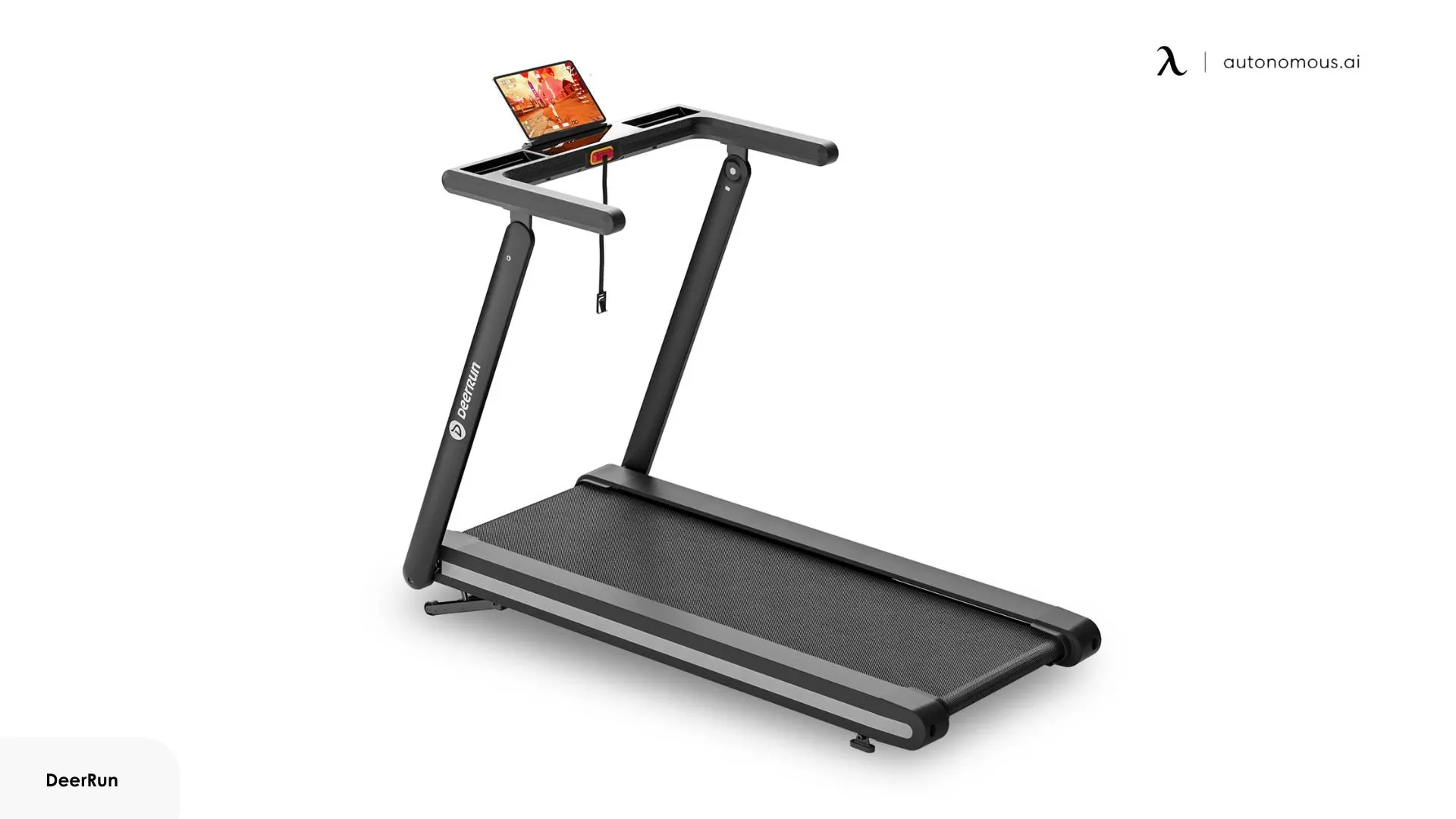
Specs at a glance:
- Max speed: 11.3 mph
- Incline: 15% auto-adjustable
- Weight capacity: 400 lbs
- Unit weight: 87.83 lbs
- Dimensions (expanded): 53.94" × 30.43" × 42.83"
What separates the X20 from DeerRun's other models isn't just the specs, it's the stability at speed. Running above 8 mph on budget treadmills often produces frame wobble or belt slippage. The X20 held steady through tempo runs without that unsettling vibration that makes you grip the handrails.
The auto-incline proved more practical than expected. The auto-incline proved more practical than expected. Rather than stopping to manually adjust, I could program hill intervals directly into a session, which also makes it effective for users focused on walking on a treadmill to lose weight. The transition between incline levels isn't seamless, there's a brief mechanical pause, but it doesn't interrupt rhythm enough to matter during training.
One feature worth noting: the inverse walking mode. DeerRun markets this for glute activation and reduced knee impact. In practice, it feels awkward initially, but after a few sessions, it became a useful cool-down option. Whether it delivers the claimed calorie boost is hard to verify, but the reduced joint pressure felt noticeable.
The folding mechanism, while functional, doesn't make this a true space-saver, at over 53 inches long when folded, you still need dedicated floor space. And at nearly 88 pounds, portability is limited. And while the PitPat app integration works, the app itself leans heavily on gamification that may not appeal to users who prefer straightforward workout tracking.
This is a serious home treadmill for people who run seriously. If your goal is consistent mileage, interval work, or training through bad weather, the X20 justifies its price. If you're walking during Zoom calls or fitting in occasional cardio, it's overbuilt for your needs.
2. DeerRun A1 Pro Treadmill
The A1 Pro sits in the middle of DeerRun's lineup—more capable than a walking pad, less imposing than the X20. For many users, that middle ground is exactly what home fitness requires.
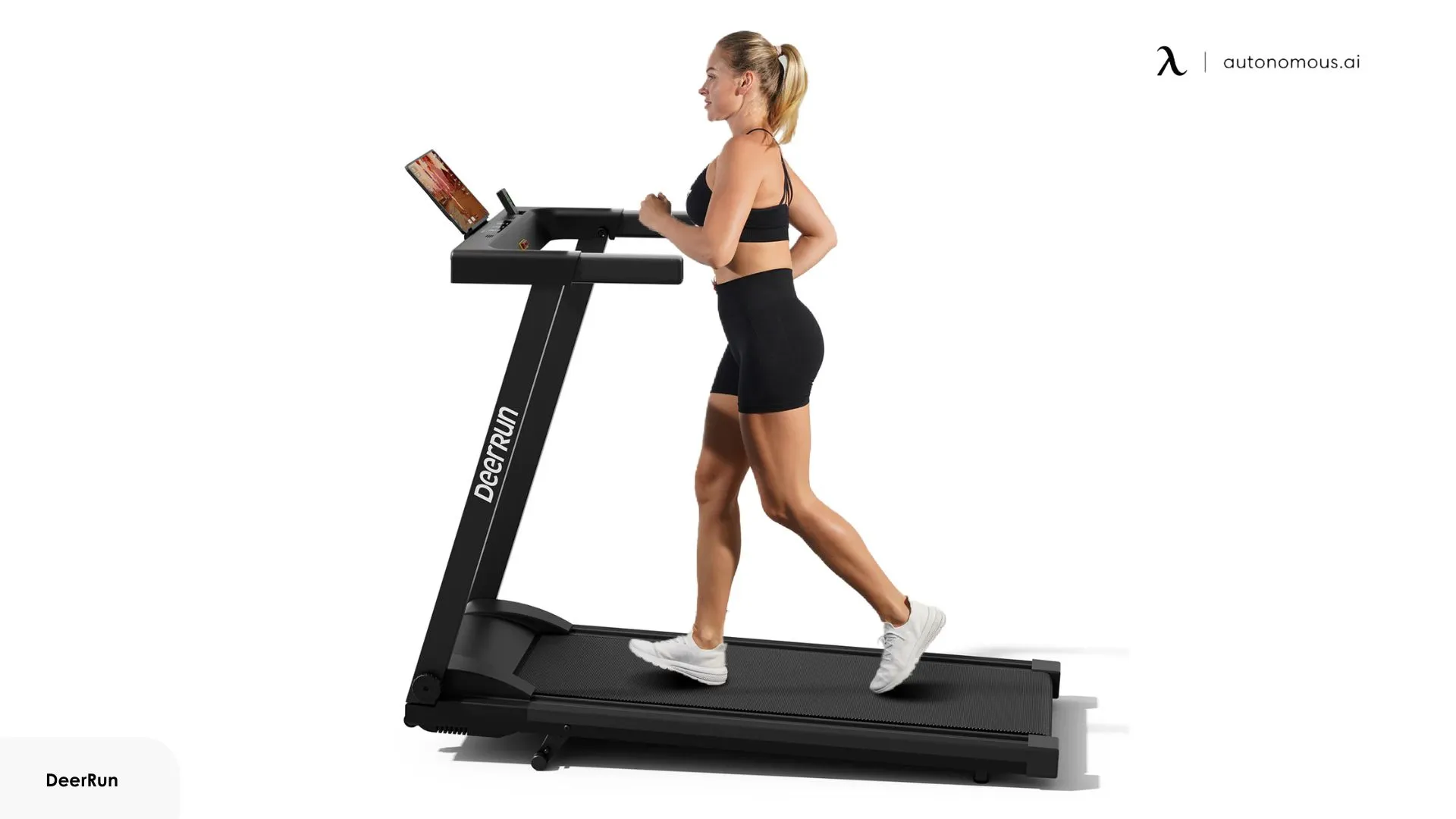
Specs at a glance:
- Max speed: 10 mph
- Incline: 6% manual
- Weight capacity: 350 lbs
- Running surface: 44.5" × 16.5"
- Dimensions (expanded): 53.35" × 24.06" × 44.57"
- Unit weight: 79.59 pounds
The A1 Pro handles consistent daily use without complaint. During weeks of testing at moderate speeds (5–7 mph), the motor ran smoothly and the frame stayed planted, making it well suited for routines built around an indoor walking workout for beginners. That said, pushing toward the 10 mph ceiling felt less secure—the shorter deck leaves little margin for stride variation at higher speeds, particularly for taller users.
The 6% incline adds training variety, but the manual adjustment requires stepping off the belt to change levels. For steady-state walks or jogs at a fixed incline, this is fine. For interval-based hill work, it's a workflow interruption that disrupts momentum.
One detail that surprised me: the folding mechanism. Unlike other mini treadmills, the A1 Pro requires an Allen wrench to adjust bolts on each side. If you're folding and unfolding daily, this becomes tedious. For occasional storage, it's manageable.
The LED display is straightforward—time, speed, distance, calories. No touchscreen, no flashy graphics. Some users may find this limiting; others will appreciate not navigating menus mid-workout.
The running surface is compact. Users over 6 feet or those with longer strides may feel constrained during faster efforts. And while the 2026 model includes NFC pairing for the PitPat app, the remote's display remains difficult to read in dim lighting.
DeerRun A1 Pro treadmill reviews often position this as an entry-level machine, and that framing fits. It's well-suited for building a walking habit, light jogging, or bad-weather backup runs.
3. DeerRun A6 Plus Treadmill
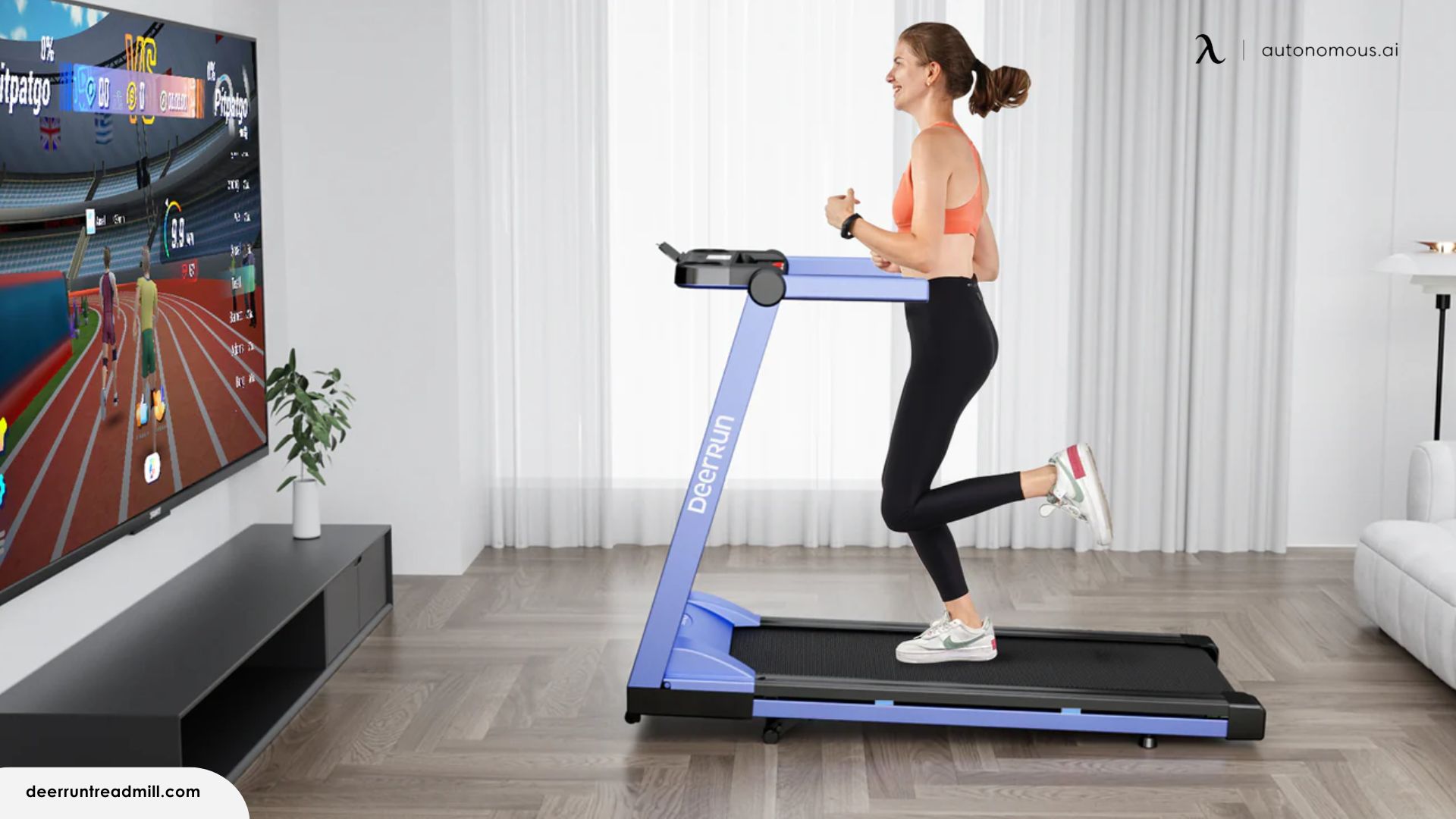
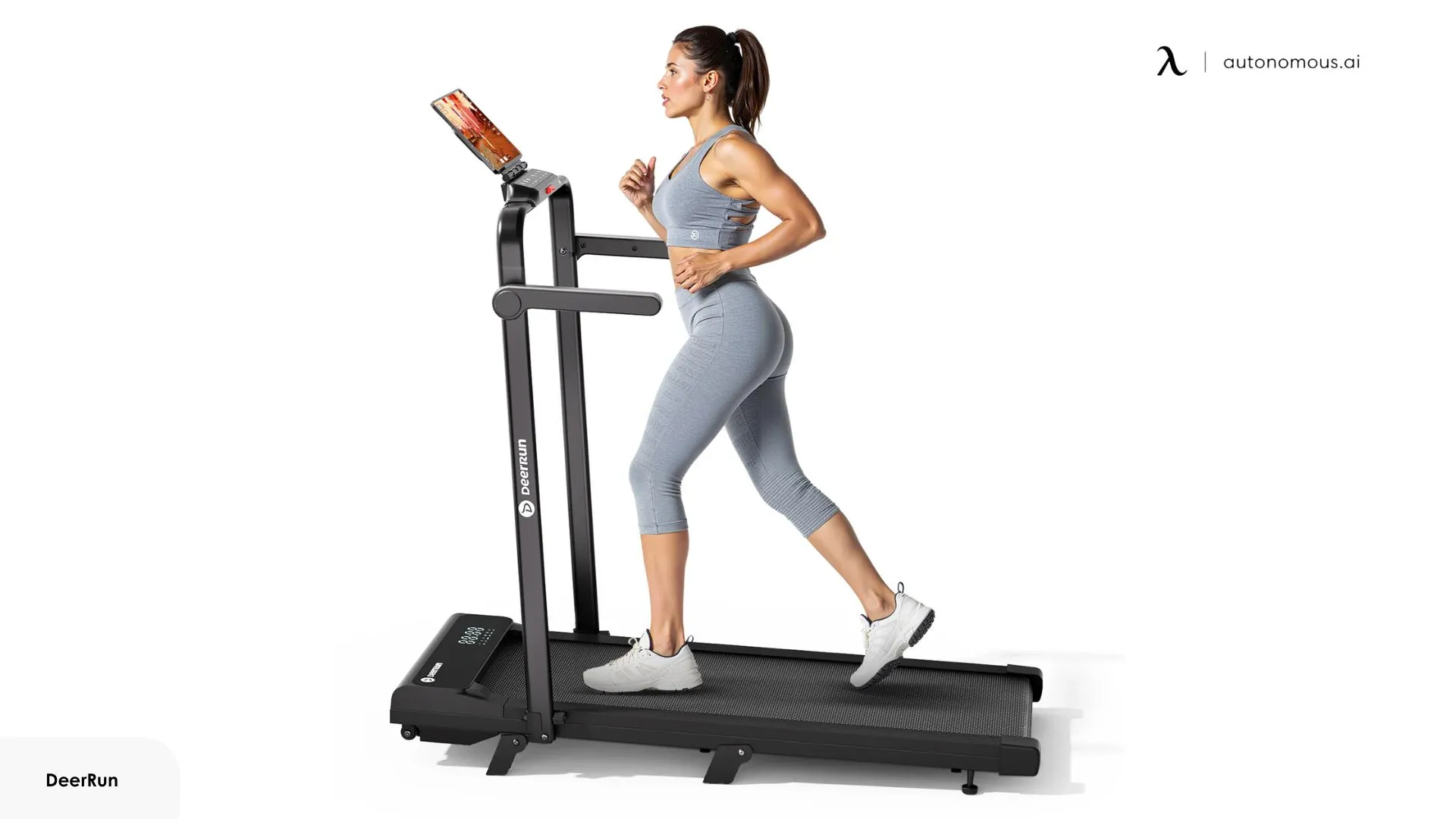
The A6 Plus is DeerRun's 2026 entry in their 2-in-1 category, positioned between basic walking pads and their mid-tier A1 Pro. The key differentiator from older models is the 5% manual incline, a feature that was absent in the previous A5 Pro generation. It’s designed for users choosing between a walking pad vs. a treadmill, balancing portability and space efficiency with enough stability for light jogging.
Specs at a glance:
- Max speed: 7.5 mph
- Incline: 5% manual
- Weight capacity: 300 lbs
- Running surface: 43" × 16"
- Weight: 54.54 lbs
- Display: Full-screen LED with NFC
The dual-mode design takes some getting used to. With the handrail folded down, the speed locks at 3.8 mph, fine for desk walking, but the transition to jogging mode isn't seamless. You stop, raise the handrail, lock it in place, then restart. It's a deliberate changeover, not a quick flip. After a few days, the routine becomes automatic, but anyone expecting to slide between modes mid-session will find the workflow slower than anticipated.
The 5% manual incline is a welcome addition over flat-only walking pads, though the adjustment method requires patience. Changing the grade means stopping the belt, moving to the back of the unit, and repositioning the rear legs. For fixed-incline sessions, this is a one-time setup. For anyone hoping to vary intensity throughout a workout, the interruption breaks rhythm.
At just under 55 lbs, the A6 Plus is noticeably easier to reposition than heavier models in the lineup. Moving it from a home office corner to the living room is realistic without asking for help. That lighter build does show up elsewhere, the handrail has some lateral give at faster speeds, particularly above 5 mph. In desk-walking mode, the A6 Plus fits naturally into a walking desk setup where movement is integrated into the workday rather than treated as a separate workout.
The A6 Plus fits users building toward more activity rather than maintaining an existing routine. It bridges the gap between basic walking pads and dedicated treadmills, offering incline variety and jogging capability without the footprint or weight of larger machines. For apartment dwellers, home office setups, or anyone testing whether daily walking actually sticks, the lower commitment makes sense.
PitPat App: Does It Matter for Your Use Case?
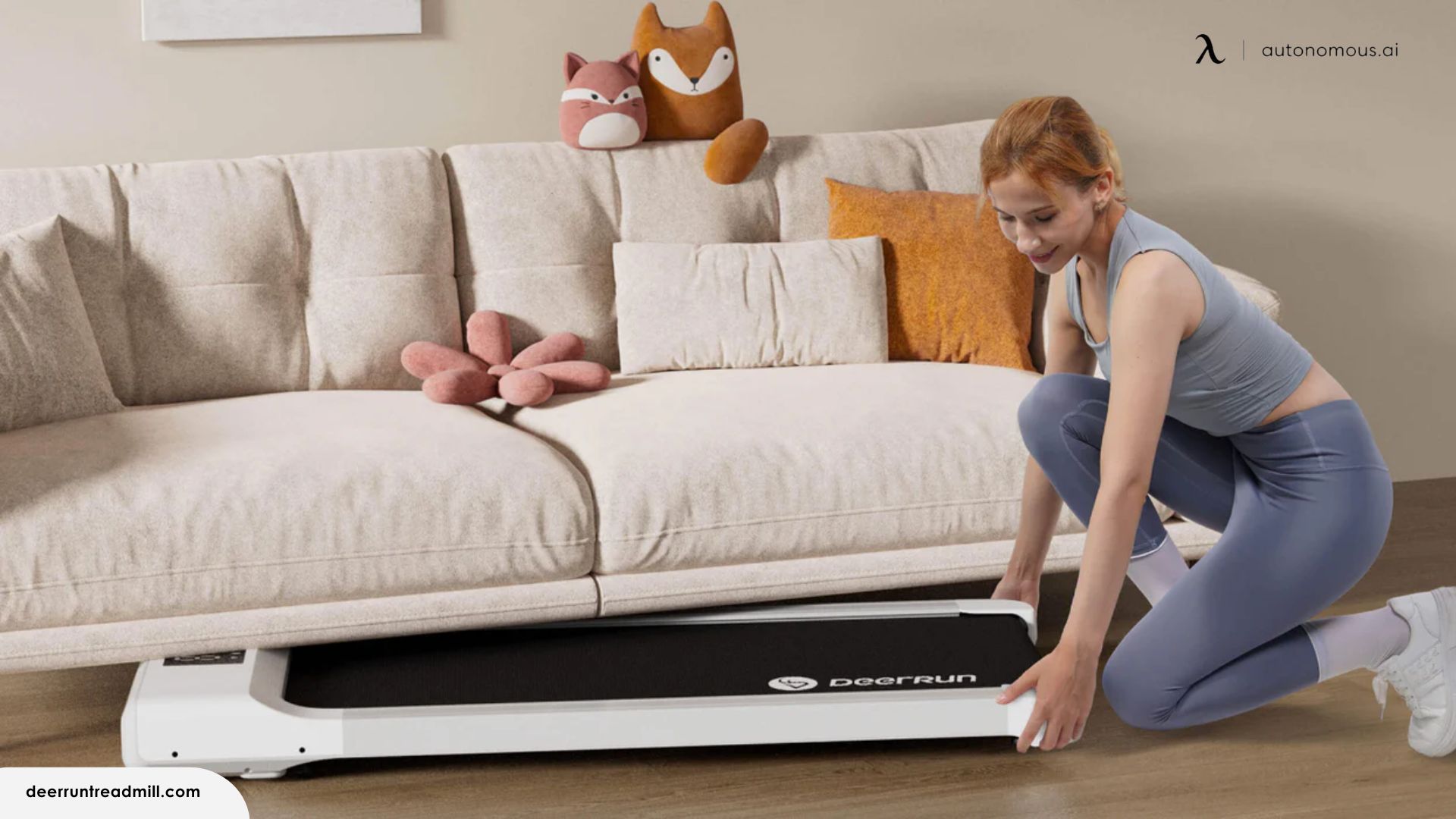
All three treadmills in this review—X20, A1 Pro, and A6 Plus—connect to DeerRun's PitPat app. But whether the app adds value depends entirely on how you plan to use the treadmill.
- For X20 users (serious training):
The app's workout tracking and virtual race features align with users already committed to structured routines. Syncing session data over time helps monitor mileage, pace trends, and progression, which matters for runners paying attention to metrics like calories burned running rather than just time spent on the belt. The competitive events may appeal to runners who miss outdoor race culture during off-seasons or bad weather. That said, the X20's built-in touchscreen already displays comprehensive metrics, the app duplicates rather than expands core functionality.
- For A1 Pro users (building consistency):
PitPat's gamification, avatars, points, leaderboards, targets exactly this user profile. For someone establishing a walking or jogging habit, external motivation often matters more than raw data. The app's challenges and community features can make the difference between a treadmill that gets used and one that collects dust. The 2026 A1 Pro Move+ includes NFC pairing, which reduces setup friction and makes casual use more seamless.
- For A6 Plus users (casual movement):
The app is least essential here. Users buying the A6 Plus for under-desk walking or occasional light cardio typically want simplicity—start walking, stop walking, done. The remote and display handle that without opening an app. PitPat becomes relevant only if the user later decides to increase intensity and wants tracking or motivation tools.
PitPat is optional on every DeerRun treadmill. The hardware works fully without it. For users who respond to gamified motivation or want long-term data tracking, it's worth trying the free tier. For users who just want to walk or run without extra steps, the remote handles everything necessary.
FAQs
Is the DeerRun treadmill any good?
DeerRun treadmills offer solid value for home use, particularly for walkers and light joggers. Build quality is reasonable for the price range, and the machines perform reliably for daily use at moderate speeds. They're not gym-grade replacements, but for users prioritizing space efficiency, portability, and budget, DeerRun delivers on its positioning.
Which DeerRun treadmill is the best?
The best DeerRun treadmill depends on your intended use. The X20 is best for serious runners who need a full-size deck. The A1 Pro suits users building a consistent walking or jogging habit. The A6 Plus works best for casual users who want flexible under-desk walking and occasional light jogging at a lower price point.
Does the DeerRun a treadmill incline?
Yes, most DeerRun treadmills include incline functionality. The X20 offers 15% automatic incline control via touchscreen or app. The A1 Pro and A6 Plus both feature manual incline (6% and 5% respectively), which requires stopping the belt and adjusting the rear legs to change the gradient.
How does DeerRun compare to WalkingPad treadmills?
Both brands target the compact treadmill market, but they differ in emphasis. WalkingPad leads in folding technology and app integration (KS Fit), while DeerRun offers more models with incline options and generally lower price points.
Is the DeerRun treadmill good for running?
The DeerRun X20 is suitable for running with its 11.3 mph top speed, 400 lb capacity, and full-length running deck. The A1 Pro supports light running up to 10 mph but has a shorter belt that may feel restrictive for taller runners or faster paces. The A6 Plus maxes out at 7.5 mph, making it better suited for walking and light jogging rather than sustained running.
Which DeerRun treadmill is best for weight loss?
For weight loss, the X20 or A1 Pro offer the most effective options due to their incline features, incline walking burns significantly more calories than flat walking at the same speed. The X20's 15% auto incline provides the highest calorie-burn potential without increasing joint impact.
Can you use a DeerRun treadmill in an apartment?
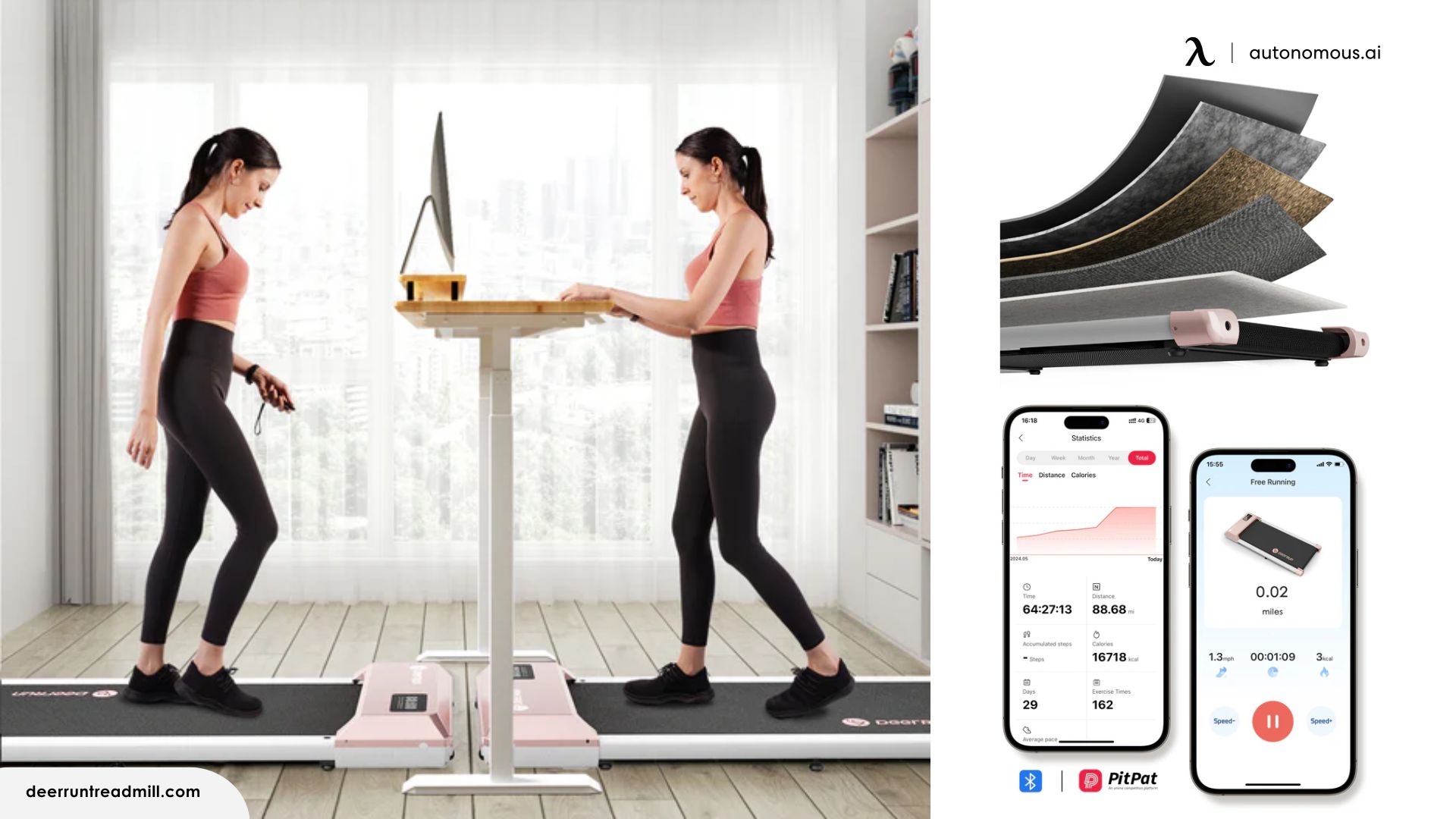
Yes, DeerRun treadmills suit apartment living due to quiet motors (under 45 dB at walking speeds), compact footprints, and foldable designs. Noise increases at jogging speeds but remains manageable for most shared-wall situations.
Does the DeerRun treadmill sync with the Apple Watch?
DeerRun treadmills connect to the PitPat app, which advertises Apple Health integration. However, syncing reliability has been inconsistent based on user feedback—some users report successful data transfer while others experience connection drops. For dependable Apple Watch tracking, using the watch's native workout app independently may be more reliable.
Which DeerRun Treadmill Should You Buy?
After testing all three models, the answer depends less on which treadmill is "best" and more on what you're actually trying to accomplish.
Choose the X20 if: You already have an established fitness routine and need equipment that keeps up. The full-length deck, 15% auto incline, and 11.3 mph ceiling make it the only DeerRun treadmill I'd recommend for consistent running. For users comparing higher-intensity indoor cardio options, the differences outlined in a StairMaster vs. treadmill comparison help clarify whether running-based training or step-focused workouts better suit their routine.
Choose the A1 Pro if: You're building toward something. The A1 Pro sits in that middle ground, capable enough to grow with you from walking to jogging, but not so overbuilt that you're paying for features you'll never use. The 6% manual incline adds training variety without the complexity of motorized systems. It's the model I'd point most first-time treadmill buyers toward, particularly those who suspect they'll use it but aren't certain yet.
Choose the A6 Plus if: Movement is the goal, not performance. The A6 Plus works for users who want flexibility between casual walking at a desk—similar to how an under desk treadmill is typically used—and occasional light jogging, while prioritizing portability over capability. At 54 lbs with a 2-in-1 design, it's the easiest to reposition and store. But be realistic: this is an entry point, not a long-term training tool. If your goals evolve beyond casual cardio, you'll outgrow it.
DeerRun treadmills do what they claim to do at prices that undercut most competitors. They're not gym replacements. They're tools for making daily movement more accessible, whether that's walking while working, jogging when weather won't cooperate, or building fitness habits without a major financial commitment.
The models reviewed here represent three distinct points on that spectrum. Match the treadmill to your actual behavior, not your aspirational goals, and you'll likely be satisfied with what you get. For buyers in apartments or shared living spaces, noise can be just as important as performance, which makes quiet treadmills for apartments a relevant consideration alongside speed and incline.