Autonomous Desk Pro AI: An Intelligent Desk for Awareness

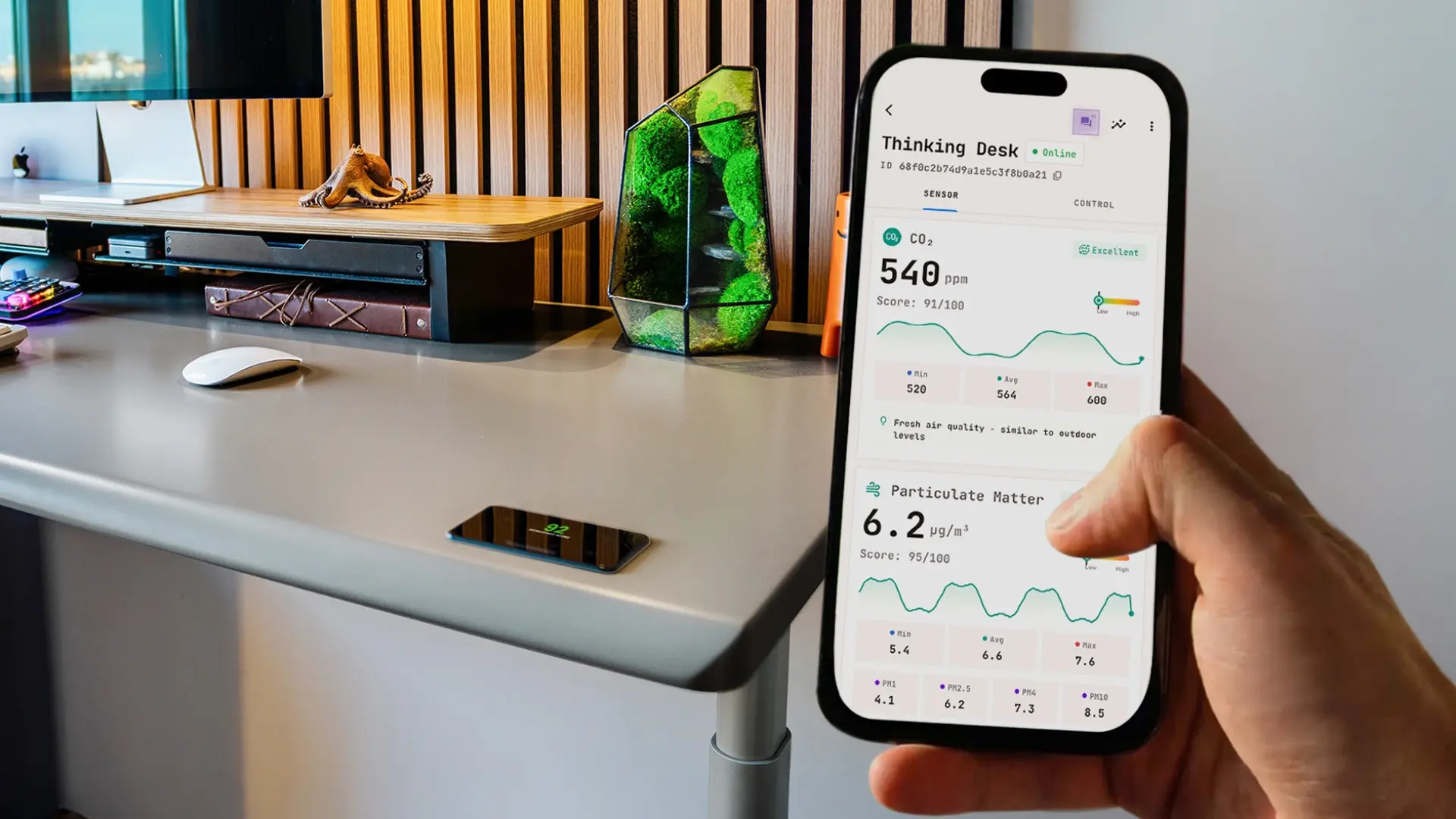
Work today stretches across long, uninterrupted hours in the same spot, yet most desks stay passive furniture. They do not respond when posture slips, when the air turns stale, or when fatigue quietly builds over the afternoon. That gap is what the intelligent desk closes: a sensor-based desk that reads how the workspace affects your body and focus, then helps you build healthier habits through the day. Autonomous builds this into the Pro AI model of its standing desk, which this guide uses as a working example.
Why desks have not kept up with how we work
An intelligent desk pairs built-in sensors with software that watches workspace conditions and behavior in real time. A traditional standing desk only responds when you press a button, while a desk with AI notices patterns on its own and surfaces feedback you would otherwise miss.
At a basic level, a sensor-based desk tracks the environmental conditions around the workstation, the time you spend sitting or standing, and long stretches of static posture. The better systems turn that data into insight rather than raw numbers, so you can see why you feel foggy or restless as the day goes on, not just that you do.
.webp)
What makes a standing desk intelligent
A standing desk is intelligent not because of any single sensor, but because multiple inputs combine into a clear picture of the workspace. Instead of showing isolated readings, many intelligent desks roll the signals into one figure, often called a Workspace Score, that answers a simple question: is your setup supporting how you feel right now, or quietly working against you? Most rely on three sensor groups to get there.
Reading the environment
Environmental sensors track conditions that shape focus and comfort over long periods, such as temperature, humidity, air quality, and ambient noise. Individually these are easy to ignore, but together they explain why focus fades or discomfort arrives earlier than expected. The score reflects whether the room supports sustained work or adds gradual strain.
Understanding movement
Movement sensors detect sitting, standing, and long stretches without a change of position. Rather than grading posture, they focus on duration and variation. Long, unbroken periods in one position pull the score down, while balanced sit-stand patterns hold it up. The emphasis is consistency, not perfection.
Time, habits, and recovery
Time-based tracking watches how long sessions run without a break and how often recovery happens. The score reflects not just what you are doing but when. Prolonged work without a pause lowers it, and timely breaks stabilize it, which over time makes the link between your daily routine and end-of-day fatigue easy to see.
How the Autonomous Desk Pro AI reads your workspace
Autonomous builds this awareness into the Pro AI model of the Autonomous Desk Pro, which adds a six-sensor hub and software to the standard Pro frame. Because the desk powers the board, the sensors run continuously, so unlike a battery gadget that samples every few minutes, the Pro AI reads eight signals and a presence radar without ever needing a charge.
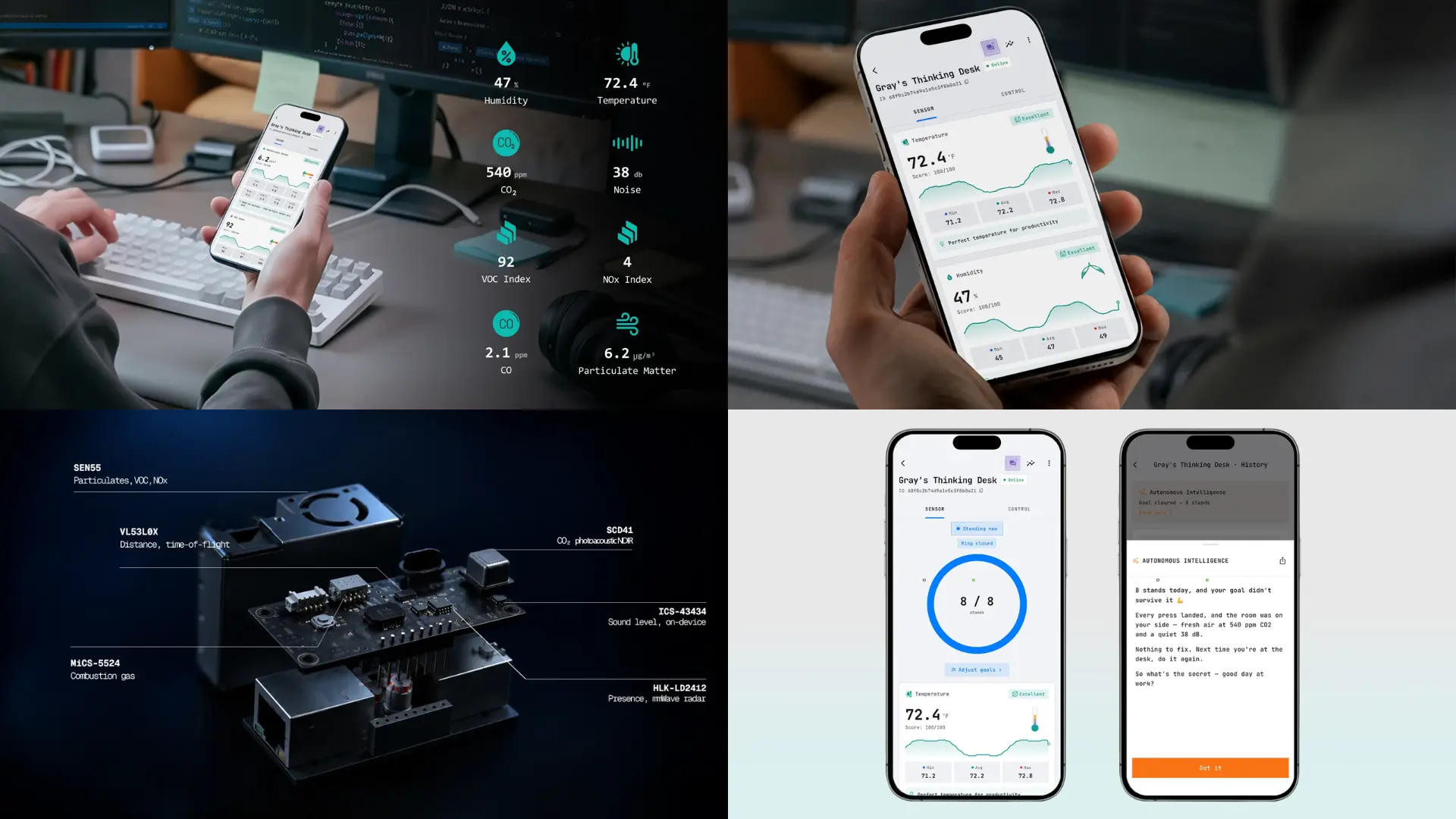
The hub combines six sensors, each chosen for a specific signal:
- A Sensirion SCD41 for CO2, the gas behind mid-afternoon brain fog
- A Sensirion SEN55 for fine particulates, VOCs, and NOx
- A MiCS-5524 for combustion gases such as carbon monoxide
- An ICS-43434 microphone for the room's noise floor
- An HLK-LD2412 mmWave radar for presence
- A VL53L0X time-of-flight sensor for distance
Those feed eight readings, each scored out of 100 and translated into plain words: CO2, PM2.5, VOC, noise, humidity, carbon monoxide, temperature, and your sit-stand pattern. The radar and time-of-flight sensors tell sitting at the desk from walking past, even when you sit perfectly still, so the numbers reflect your real session and stand time tracks itself.
Because every reading is stored, you can ask about your air in plain language and Autonomous Intelligence reads that history to answer. Underneath, it is the standard Pro build: a C-frame that lifts 330 pounds at under 30 decibels, a 1.2-inch HDF top, and a lifetime frame warranty.
Beyond height adjustment alone
It is easy to assume an intelligent desk is just a standing desk with extra features, but the difference is more basic than that. A standing desk is reactive: it waits for input, so you decide when to sit or stand, often after discomfort has already set in.
An intelligent desk is adaptive. It observes patterns on its own, flags issues before they escalate, and nudges toward balance rather than extremes. That is a shift from static ergonomics, set once and forgotten, to adaptive ergonomics that respond to how you actually work.
Who benefits most from an intelligent desk
An intelligent desk is not necessary for everyone, and its value shows most for people who spend long, focused hours at a workstation. Remote workers lack the ergonomic cues of a traditional office, so a sensor-based desk adds quiet structure to a home office setup without supervision.
Writers, developers, designers, and traders depend on sustained focus, where a small environmental shift can break concentration, so a programmer desk setup or a trading desk setup benefits from a desk that flags when something is off. Anyone working on posture and movement gains from habits made visible before stiffness sets in.
Why awareness beats willpower
One reason intelligent desks are catching on is that awareness changes behavior more reliably than rules do. When you can see how the environment and your habits shift through the day, small adjustments happen on their own: standing sooner, moving more often, taking a break before fatigue peaks. Rather than enforcing discipline, the desk supports self-regulation, which tends to last longer than a rule you have to remember.
The future of intelligent desks
The intelligent desk is part of a broader move toward responsive workspaces. As sensors, software, and ergonomics converge, standing desks are becoming less like furniture and more like quiet collaborators. Expect deeper personalization, better integration with other workspace tools, and more focus on long-term trends over moment-to-moment alerts. In that sense, a desk with AI is not about working harder, but about understanding how your workspace shapes how you feel, and adjusting before problems compound.
.webp)
FAQs
What is an intelligent desk?
An intelligent desk is a standing desk with built-in sensors and software that track workspace conditions and movement, then translate them into feedback. Instead of only adjusting height, it notices air quality, noise, and sit-stand patterns automatically and summarizes them, often as a single score, so you can see how your setup affects your focus.
How does the Autonomous Desk Pro AI work?
The Pro AI model adds a six-sensor hub to the Desk Pro that reads CO2, particulates, VOCs, combustion gases, noise, and presence. It scores eight signals out of 100 each session, uses radar to tell when you are actually at the desk, and stores the data so you can ask about it in plain language.
What is a Workspace Score?
A Workspace Score rolls several sensor readings into one figure that shows whether your environment and habits are supporting your work or wearing on you. Poor air, high noise, or long unbroken sitting pull it down, while fresh air and balanced sit-stand movement hold it up, making abstract conditions easy to read at a glance.
Is an intelligent desk worth it?
It depends on how you work. For people at a desk for long, focused hours, remote workers, developers, writers, and traders, the awareness pays off by catching stale air or too much static sitting before they cost you focus. For light or occasional use, a standard height-adjustable desk is usually enough.
Can I ask the desk about my data?
Yes. Because the Pro AI stores every reading it takes, you can ask a question about your air or habits in plain language, and Autonomous Intelligence reads the stored history to answer. That turns a stream of numbers into something you can actually query, rather than a dashboard you have to interpret yourself.
Conclusion
An intelligent desk matters because awareness, not another rule, is what changes how we work. By reading the air, your movement, and your habits, a sensor-based desk shows the quiet factors that shape focus and comfort, then helps you adjust before fatigue compounds. The Autonomous Desk Pro AI puts that into a desk you already rely on, scoring eight signals and answering questions about them, so the surface you work at understands the room as well as you do.
References
- United States Environmental Protection Agency (EPA). Indoor Air Quality (IAQ). https://www.epa.gov/indoor-air-quality-iaq
- Occupational Safety and Health Administration (OSHA). Computer Workstations eTool: Good Working Positions. https://www.osha.gov/etools/computer-workstations/positions