ADU in California: Rules, Costs, and Rental Income (2026)
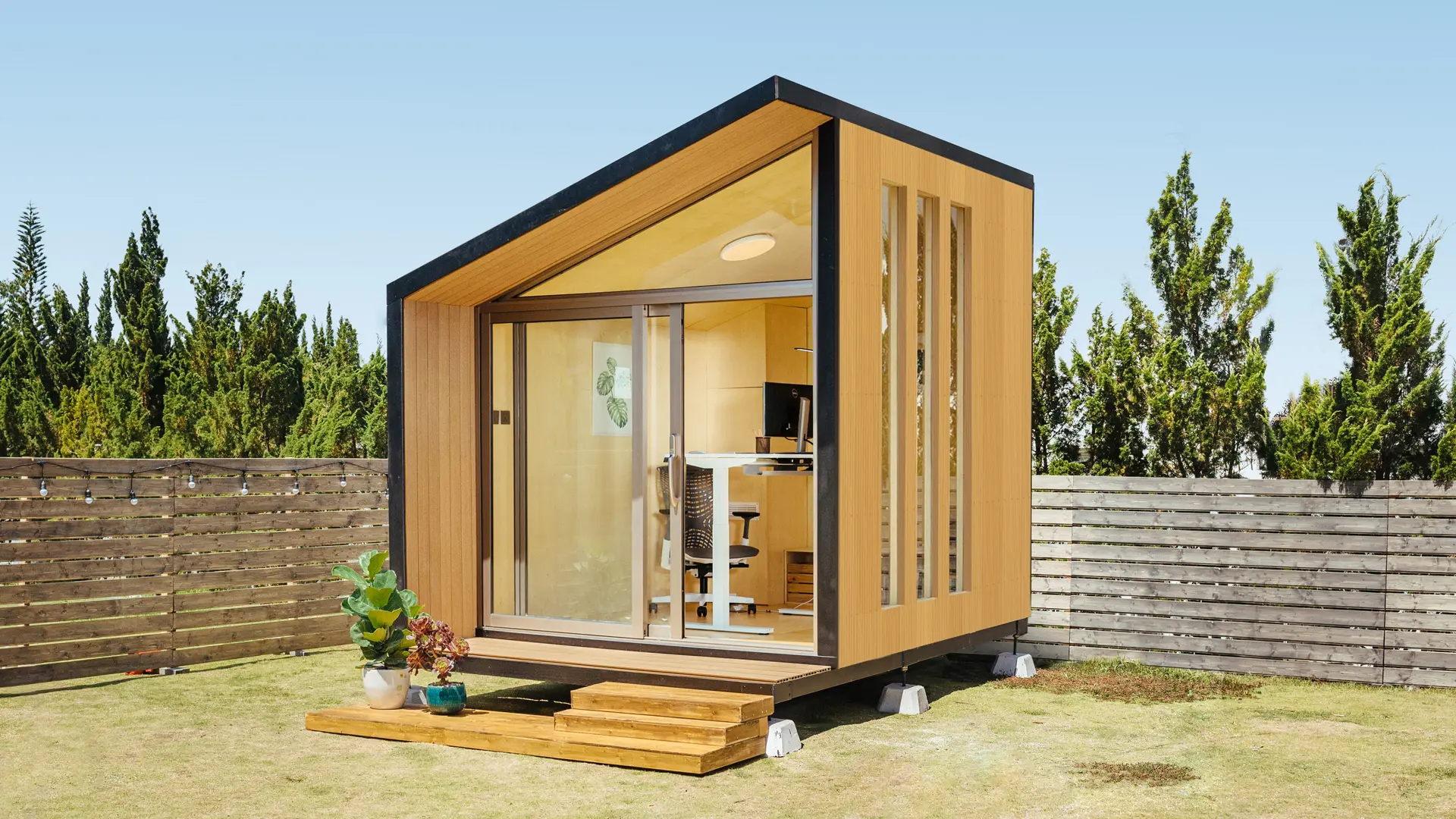
California's ADU laws have changed significantly since 2019 - streamlined approvals, reduced fees, and fewer local restrictions have made building a backyard accessory dwelling unit more accessible for homeowners across the state. An ADU in California is a self-contained residential unit on the same lot as your primary home, with its own entrance, kitchen, and bathroom.
This guide covers what you need to know before you start: types, permits, costs, regulations, and whether the investment makes financial sense for your property.
Types of ADUs You Can Build in California
California allows five main ADU types. The right choice depends on your lot, budget, and how you plan to use the space.
- Detached ADU
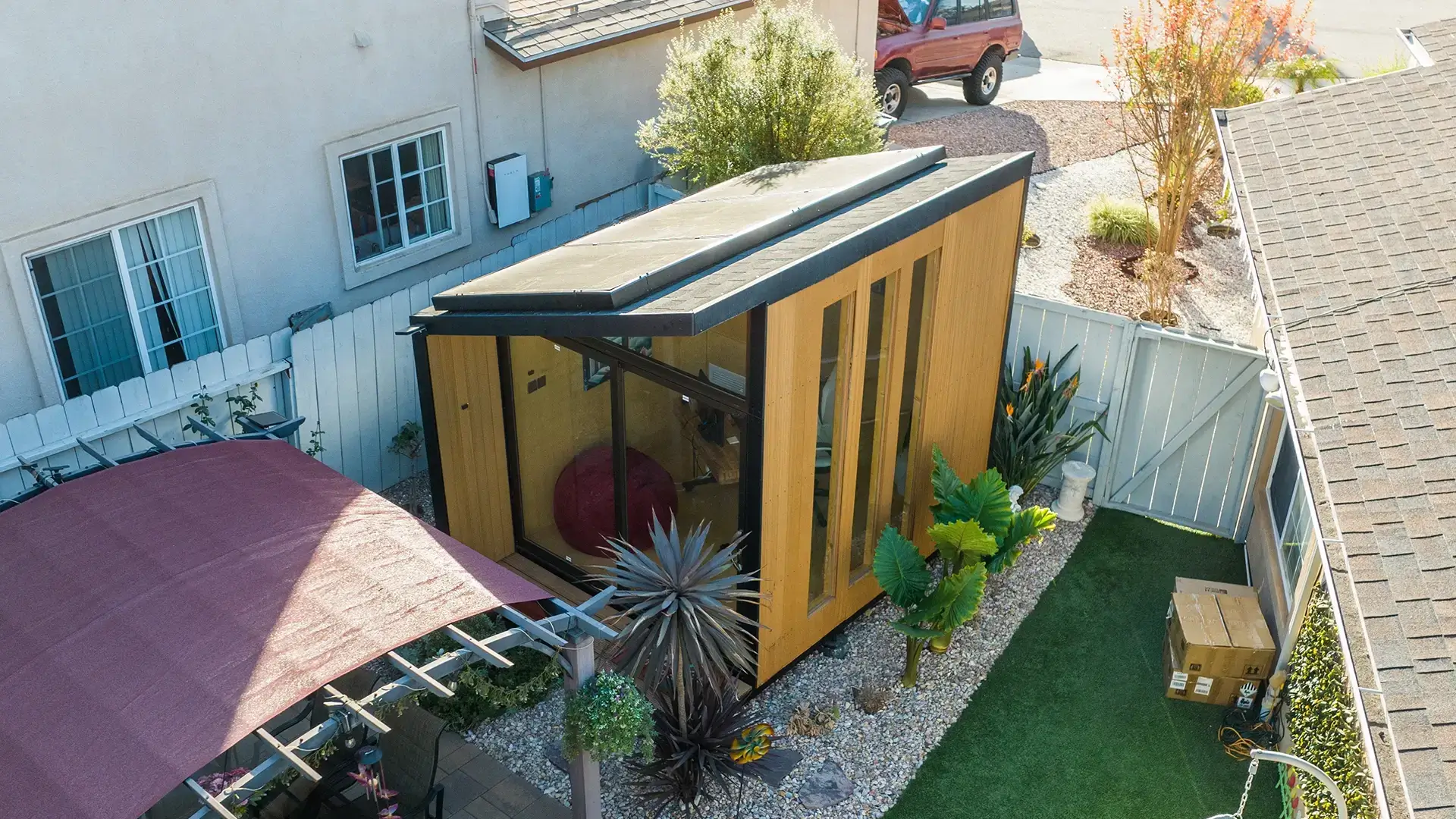
A freestanding, detached ADU built separately from the main house, with no shared walls. It offers the highest level of privacy and design flexibility - commonly used for long-term rentals or housing family members independently.
Maximum size is 1,200 sq. ft. for most detached builds, though what's actually permitted on your lot depends on local rules - ADUs size limits in California vary by jurisdiction and can sit below the state ceiling.
- Attached ADU
An addition to the primary residence that shares at least one wall with the main structure. Attached ADU tends to cost less than a detached build since it connects to existing plumbing and electrical systems. Size is capped at 50% of the primary home's living area, up to 1,200 sq. ft.
- Garage Conversion ADU
An existing attached or detached garage converted into a habitable residential unit. It's one of the more cost-effective paths since the structure is already in place - but the space will need insulation, proper ventilation, egress compliance, and electrical upgrades to meet California's habitability standards.
- Basement ADU
A conversion of an existing below-grade space into a separate living unit. Waterproofing, egress windows, and adequate ventilation are required. This option is more practical in Northern California, where homes with basements are more common.
- Junior ADU (JADU)
A smaller unit - up to 500 sq. ft. - created entirely within the existing footprint of the primary home. It must include an efficient kitchen but may share a bathroom with the main residence. Junior accessory dwelling units are the most affordable and straightforward to permit, making them a practical option for homeowners who want to add a unit without major construction.
California also permits certain mobile and wheel-mounted units under specific conditions. ADUs on wheels follow a different regulatory path from standard ADUs and are subject to their own eligibility requirements.
California ADU Laws and Regulations: What You Need to Know
Between 2019 and 2023, California passed a series of bills that fundamentally changed who can build an ADU and how quickly it can happen. The laws reduced setbacks, capped local fees, shortened approval timelines, and - critically - stripped local governments of much of the discretionary authority they previously used to block applications.
In practice, this means most single-family and multifamily properties in California can now add an ADU as a matter of right, without needing a variance, public hearing, or neighbor approval.
1. Who Can Build An ADU
Any owner of a single-family or multifamily residential lot can apply. Renters cannot. HOAs retain limited design review authority but cannot outright prohibit ADU construction under state law.
Owner-occupancy requirements were suspended through 2025. As of 2026, that suspension has lapsed - unless your city has adopted a local ordinance extending the exemption, owner-occupancy is now required, meaning at least one unit on the property must be owner-occupied. Verify the current rule with your local jurisdiction before applying.
2. Statewide Rules That Apply Everywhere
Regardless of city or county, these rules apply to all ADU applications:
- Applications must be approved or denied within 60 days. If the local agency misses the deadline, the application is considered approved by default - a significant change from the pre-2020 environment where delays were routine. AB 2533, SB 1211, and coastal zone provisions introduced in the most recent new ADU laws in California cycle have further expanded these protections for homeowners.
- ADUs cannot be rented for stays under 30 days. Short-term rental platforms (Airbnb, VRBO) are not a legal use case for an ADU.
- Parking replacement is not required when converting an existing structure such as a garage or basement, or when the property sits within half a mile of public transit.
- ADU impact fees in California are waived for ones that are under 750 sq ft and proportionally limited for larger units - a meaningful reduction in soft costs.
3. A Note On JADUs
California also allows Junior ADUs (JADUs) - units up to 500 sq ft created within the existing walls of a primary residence. JADUs have a lower permitting bar, are exempt from impact fees, and don't require new utility connections. If your project involves converting interior space rather than new construction, a JADU may be the faster and cheaper path.
4. Where Local Rules Still Apply
State law sets the floor, not the ceiling. Cities and counties can still regulate maximum height, exterior design standards, and fire safety requirements. What's permissible in Los Angeles may differ from Sacramento or San Diego. Before finalizing plans, confirm your local jurisdiction's specific requirements. ADU zoning rules at the local level - particularly height limits and lot coverage - are where the most meaningful variation between jurisdictions occurs. Before finalizing plans, confirm your local jurisdiction's specific requirements.
The ADU Permit Process in California: Step by Step
California has streamlined ADU permitting significantly - but the process still requires preparation. Most delays happen before submission, not during review. Understanding each step upfront prevents the most common setbacks.
- Step 1: Confirm your property's eligibility
Before engaging an architect or designer, verify that your lot qualifies under both state law and local zoning. Check your city's planning department website or call directly.
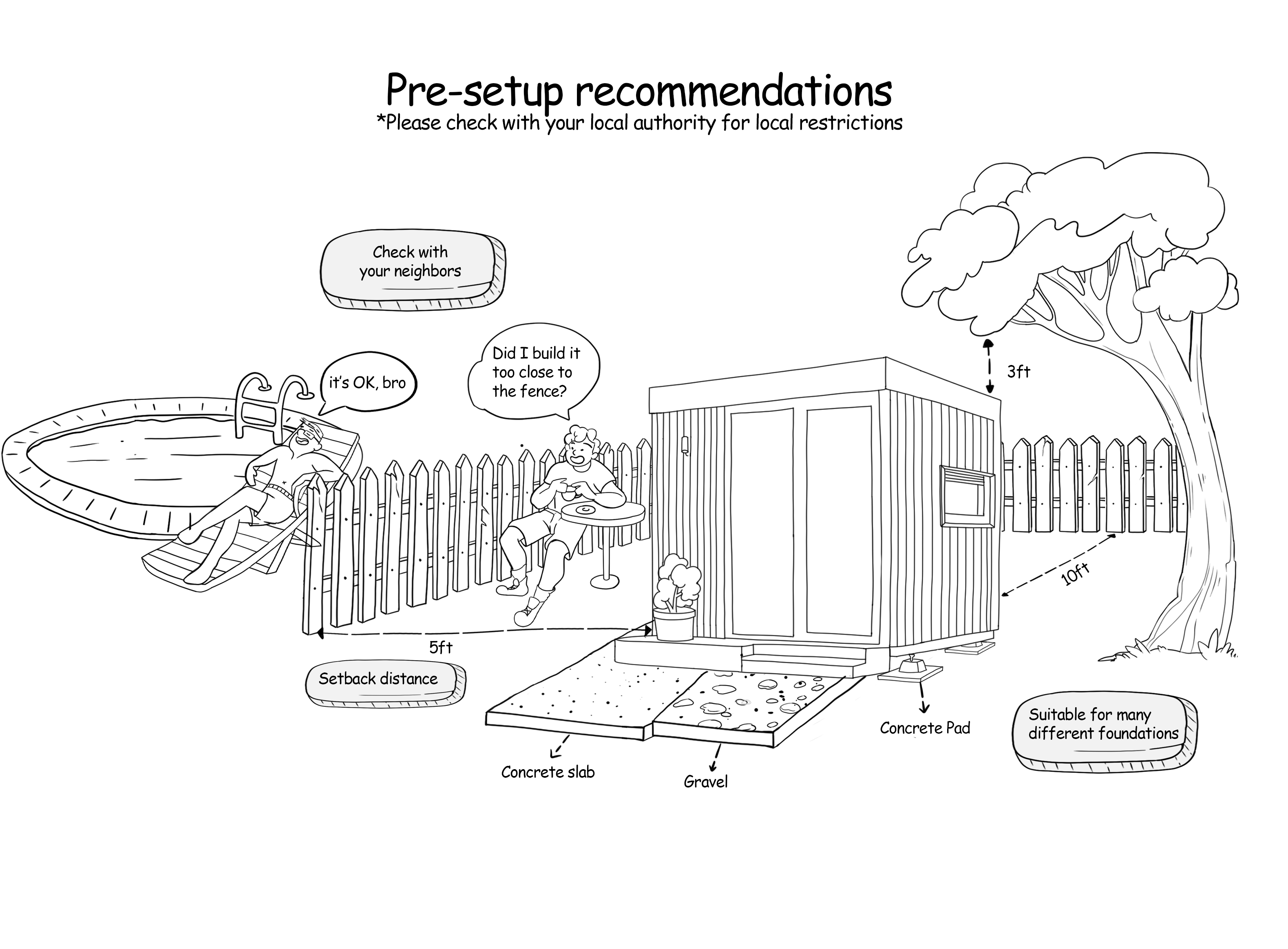
Key things to confirm: allowable ADU type and height, ADUs setback limits, and whether your jurisdiction has adopted any local ordinances that differ from the state baseline.
- Step 2: Prepare your plans
ADU permit applications in California require detailed architectural drawings - site plan, floor plan, elevations, and structural details. Most homeowners work with a licensed architect or ADU design firm at this stage.
If you're considering a prefab ADU or pre-approved ADU design, some California cities maintain pre-approved plan libraries that can significantly cut design time and review costs.
- Step 3: Submit your application
Submit your plans, permit application, and associated fees to your local building or planning department. California law caps application fees for ADUs under 750 sq. ft. - confirm the exact amounts with your jurisdiction before budgeting.
- Step 4: Review and approval
Local agencies have 60 days to approve or deny the application. If they miss the deadline, approval is automatic under state law. Most straightforward applications are approved within this window. If corrections are requested, a revised submission restarts the clock.
- Step 5: Construction and inspections
Once permits are issued, construction can begin. Inspections are required at key milestones - foundation, framing, electrical, plumbing, and final occupancy. The timeline from permit approval to occupancy varies: garage conversions typically take 3–6 months; new detached ADUs average 6–12 months depending on contractor availability and site complexity.
ADU Costs in California: Budgeting Before You Build
ADU costs in California are typically the deciding factor for homeowners considering an ADU in California. The range is wide - a Junior ADU conversion can come in under $50,000 while a custom detached build in the Bay Area can exceed $350,000. What matters most at the pre-decision stage is understanding which cost category your project falls into and what financial support is available.
- Estimated costs by ADU type
These estimates reflect California construction costs in 2025–2026. Projects in the Bay Area and Los Angeles typically land at the higher end of each range; Central Valley and Inland Empire builds tend to run lower.
ADU type | Estimated cost range |
Junior ADU (JADU) | $20,000–$50,000 |
Garage conversion | $60,000–$120,000 |
Basement ADU | $80,000–$150,000 |
Attached ADU | $100,000–$220,000 |
Detached ADU | $150,000–$350,000+ |
These figures cover construction only. Budget an additional $15,000–$40,000 for soft costs - permit fees, architectural and engineering plans, and utility connection work - which apply regardless of ADU type.
- The CalHFA ADU Grant
California's ADU Grant Program, administered by the California Housing Finance Agency (CalHFA), provides up to $40,000 to income-eligible homeowners to cover pre-construction costs - design fees, permits, and site preparation. This is a grant, not a loan, and does not need to be repaid.
Eligibility is generally limited to homeowners at or below 80% of the area median income (AMI); check current program availability at CalHFA's website, as funding rounds open and close periodically.
- Financing options
Most homeowners fund ADU construction through one of four paths:
- Home equity loan or HELOC - draws on existing equity; typically the lowest-interest option for homeowners with significant equity built up.
- Cash-out refinance - refinances the primary mortgage at a higher principal and pulls out the difference; works best when current rates are favorable.
- Construction-to-permanent loan - covers the build and converts to a standard mortgage on completion; more complex to qualify for but structured for exactly this use case.
- ADU-specific lenders - a growing category of lenders (RenoFi, Mosaic, and others) offering products specifically underwritten against post-ADU property value.
- Property tax implications
Building an ADU in California triggers a supplemental assessment on the new unit only - your existing home's assessed value under Proposition 13 is not affected. For most ADU types, the annual property tax increase is proportionally modest relative to the rental income the unit can generate.
.webp)
ADU Rental Income and ROI in California
For many California homeowners, rental income is the primary motivation for building an ADU. With housing demand remaining high across most of the state, a well-located ADU can generate consistent monthly income - but the financial case depends on your specific market, construction cost, and financing structure.
- What to expect from rental income
Rental rates for ADUs vary significantly by region. In high-demand markets like the Bay Area, Los Angeles, and San Diego, a one-bedroom detached ADU can command $1,800–$3,500 per month. In mid-tier markets like Sacramento, Fresno, or the Inland Empire, the range is typically $1,200–$2,000. JADUs and studio conversions generally rent at the lower end of the local market rate.
These are estimates based on current market conditions. Research comparable rentals in your specific neighborhood before projecting income - rates vary significantly within cities based on walkability, transit access, and unit quality.
One planning note: California law prohibits renting ADUs for stays under 30 days. Short-term rental platforms are not a legal income strategy for ADUs.
- A simple ROI framework
Nominal payback period - construction cost divided by monthly rent - gives a rough sense of scale but overstates returns for financed projects. Most ADU builders carry debt, which creates a monthly cost that reduces net income significantly in the early years.
A more useful number is net monthly cash flow: Monthly rent − debt service − operating costs = net cash flow
For example, a garage conversion costing $90,000, financed via HELOC at 8% over 10 years, generates roughly $750/month in debt service. At $1,500/month rent with $200/month in maintenance and insurance, net monthly cash flow is approximately $550 - or $6,600/year. At that rate, the project returns the equity investment in roughly 14 years, not 5. For cash buyers, the 5-year nominal payback in that same example is accurate.
Properties also benefit from ADU-driven appreciation. California appraisal data generally shows ADUs add roughly 20–30% of their construction cost to the property's market value - a secondary return for homeowners who plan to sell rather than hold long-term.
Understanding this gap is the difference between a well-underwritten project and a cash flow problem. For most California markets, a 14-year financed return still compares favorably to other property investments given the additional rental income and long-term appreciation upside.
- What affects the actual return
Financing cost - a construction loan or HELOC adds monthly interest that reduces net income until the loan is paid down
Vacancy - budget for 1–2 months of vacancy per year in your projections
Operating costs - maintenance, insurance, and property management (if applicable) typically run 10–15% of gross rent annually
Tax treatment - rental income is taxable at ordinary income rates. ADU owners can depreciate the structure over 27.5 years under federal rules, which reduces taxable rental income meaningfully over time. Discuss depreciation, deductible expenses, and how ADU income interacts with your overall tax position with a CPA before the first rent check arrives.
ADU Rules by City: How Local Regulations Differ
State law sets the baseline for building an ADU in California, but cities and counties layer their own requirements on top. Height limits, setback distances, design standards, and permit processing times all vary - sometimes significantly - between jurisdictions.
Here's a snapshot of how the five largest California cities approach ADU development.
- Los Angeles
LA has one of the most active ADU markets in the state, driven by high rental demand and relatively streamlined local permitting. The city offers a pre-approved ADU plan program that reduces design costs and approval timelines.
Detached ADUs can be up to 1,200 sq. ft.; height limits generally follow state minimums at 16 feet for detached units. Garage conversions are common and typically faster to permit than new construction. Building a prefab ADU in Los Angeles is also a common path for homeowners looking to reduce construction timelines and manage costs more predictably.
- San Francisco
SF's permitting process is more involved than most California cities, with additional review requirements for properties in certain neighborhoods and historic districts. The city allows both attached and detached ADUs but applies stricter design compatibility standards.
ADUs in San Francisco also carry higher baseline construction costs, which means projects here tend to sit at the top end of statewide cost ranges.
- San Diego
San Diego has actively encouraged ADU development as part of its housing policy. The city accepts state-approved standard plan programs and has reduced some local fees. Coastal zone properties - which make up a significant portion of the city - require additional Coastal Development Permit review under SB 1077, which is currently being implemented through 2026.
Prefab ADUs in San Diego are a practical option given the city's acceptance of state-approved standard plan programs.
- Sacramento
Sacramento is one of the more accessible cities in California for first-time ADU builders, thanks to lower construction costs, simpler permitting, and fewer design restrictions than many coastal markets. The city has adopted ADU-friendly local ordinances that align closely with state law, creating a relatively straightforward approval process. For homeowners working with an ADU construction company for the first time, Sacramento offers a practical and lower-friction starting point.
- San Jose
San Jose permits both standard ADUs and JADUs on single-family and multifamily lots. The city has published detailed ADU guidelines and maintains a relatively predictable permit review process. Prefab ADUs in San Jose are well-supported by the city's published ADU guidelines and streamlined review process. Impact fees apply for larger units, though JADUs and ADUs under 750 sq. ft. are exempt per state law.
FAQs
What are the rules for ADUs in California?
Under California ADU laws, most single-family and multifamily properties can add an ADU by right if the project meets state standards. Key rules include a maximum size of up to 1,200 sq. ft., approval within 60 days, and a minimum 4-foot setback for detached units. ADUs also cannot be rented for stays under 30 days, meaning short-term rentals like Airbnb are generally not allowed.
How much does it cost to build an ADU in California?
Building an ADU in California typically costs between $60,000 and $350,000+, depending on the type of unit, size, and location.. Garage conversions and junior ADUs are usually the least expensive, while detached ADUs cost the most. Additional soft costs such as permits, design, and engineering can add $15,000–$40,000 to the total project budget.
How big can an ADU be in California?
Most ADUs in California can be built up to 1,200 square feet, though local jurisdictions may set slightly lower limits. Attached ADUs are typically capped at 50% of the primary home’s living area, while detached ADUs can reach the 1,200 sq ft maximum. Junior ADUs (JADUs) are limited to 500 square feet.
How long does it take to build an ADU in California?
Most ADU projects in California take 6 to 12 months from permit approval to final inspection. Garage conversions may take 3 to 6 months, while new detached ADUs typically take longer due to foundation work and utility connections. Permit approval itself is required to happen within 60 days under California ADU law.
What is the $40,000 grant in California for ADUs?
The California ADU Grant Program offers up to $40,000 to help eligible homeowners cover pre-construction costs for building an ADU in California. The grant can pay for architectural plans, permits, soil tests, and site preparation. It is administered by the California Housing Finance Agency (CalHFA) and generally applies to homeowners earning 80% or less of area median income.
Can you build more than one ADU on a property in California?
Yes. Under California ADU law, many properties can build more than one ADU. Multifamily properties may add multiple ADUs, and single-family homes can often build one ADU plus one Junior ADU (JADU) on the same lot.
Can an ADU in California be rented out?
Yes, an ADU in California can be rented as a long-term residential unit. State law requires rentals to be 30 days or longer, which means short-term rental platforms like Airbnb are generally not allowed. Many homeowners use ADUs as a source of consistent monthly rental income.
Do ADUs increase property taxes in California?
Building an ADU in California triggers a property tax reassessment only for the new unit, not the existing home under Proposition 13. This means the original home's assessed value stays the same. The tax increase typically reflects only the added value of the ADU.
Do ADUs add value to a home in California?
Yes, adding an ADU in California often increases a property's value because it creates additional living space and rental potential. Appraisal data commonly shows ADUs adding 20–30% of their construction cost to a home’s market value. In high-demand housing markets, the added value can sometimes be higher.
What are the disadvantages of ADUs in California?
The main disadvantages of building an ADU in California include high upfront construction costs and navigating local permitting requirements. Financing can reduce short-term rental profits if loans are used. Homeowners also take on responsibilities such as maintenance, tenant management, and compliance with local housing regulations.
Conclusion
Building an ADU in California is more accessible today than at any point in the state's history - streamlined approvals, reduced fees, and a wider range of eligible property types have removed many of the barriers that previously made these projects impractical for most homeowners. That said, the decision still involves real complexity: local rules vary, costs add up quickly, and the financial return depends heavily on how the project is financed and what the local rental market supports.
The most important step is doing the pre-work - confirming your property's eligibility, understanding your city's specific requirements, and running realistic numbers before committing to a build. An ADU in California can be a sound long-term investment, but like any significant construction project, the outcome is shaped largely by the decisions made before construction begins.